

PGI means Protected Geographical Indication, and it is a European Union category. Nepal has no equivalent: as of our last check there is no GI law, no GI application and no GI certificate here. A producer group holds an ordinary trade mark instead.
Key takeaways
- PGI, PDO and TSG are European schemes, and only two of them involve a place.
- The words "geographical", "indication" and "appellation" appear zero times in Nepal's 1965 Act.
- There is no GI form to file and no GI certificate to be issued at the Department of Industry.
- The only certificate the Act provides for a mark is the Schedule 2(c) trade mark registration certificate.
- Sec. 21B means a foreign PGI registration carries no rights inside Nepal.
- Nepal joined the World Trade Organization in 2004, and TRIPS asks for legal means, not a register.
- Our index shows place words spread across hundreds of owners, because nothing reserves them.
What is a PGI, exactly?
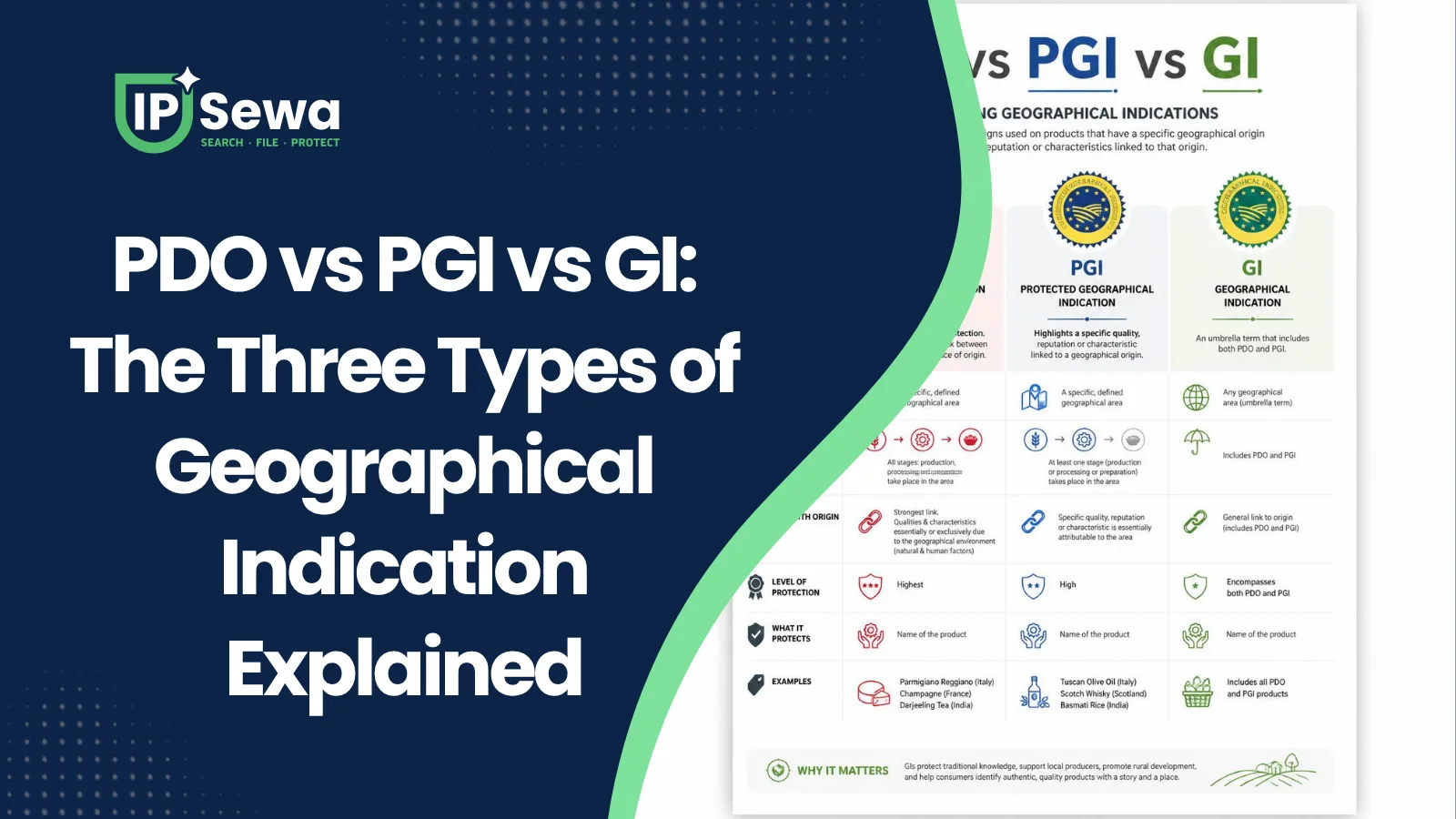
It is a European Union registration for a food, drink or farm product whose reputation or quality is tied to a named region.
At least one production stage must happen inside that region. The rest may happen elsewhere, which makes PGI the more flexible of the two place schemes.
Behind the name sits a filed specification: boundary, raw materials, method and checks. A named control body verifies that producers follow it.
What is a PDO, and how is it stricter?
A Protected Designation of Origin expects essentially every stage in the named place, and expects the product's character to come from there.
Soil, climate, breed and inherited skill are the usual arguments. A PDO applicant claims the product could not be made the same way anywhere else.
PDO and PGI share one register and one application route. They differ only in how much of the making has to stay at home.
What is a TSG, and why does it get muddled in?
A Traditional Speciality Guaranteed protects a recipe rather than a place, so a TSG product can lawfully be made anywhere in the Union.
Writers still list it beside PDO and PGI as a third origin label. It is not one, and that is where much of the confusion starts.
What does a PGI holder actually receive?
A group registering in Europe ends up with a register entry, a published specification, a named control body and the right to use a Union symbol.
Notice how little of that is paper. The value sits in the public rulebook and the inspection system, which the scheme supplies rather than the group.
That is the part Nepal does not replicate, which is why copying a European template here leaves a hole rather than a scheme.
Does Nepal have a PGI register?
No. The Patent, Design and Trade Mark Act 1965 covers what its title names: patents, designs and trade marks. Nothing else is registrable under it.
Counted over the official English text, the words "geographical", "indication" and "appellation" each appear zero times. So does "collective".
The one appearance of "certification" is a Schedule 3 fee line for a certified copy of a record, which prices a photocopy rather than a kind of mark.
Is there such a thing as a GI certificate in Nepal?
There is not, and the phrase circulates anyway. If a consultant offers to obtain a GI certificate for your product, ask which section of which Act creates it.
No register means no certificate, because a certificate is only evidence of an entry somewhere. Without the entry it would certify nothing.
Our guide to Ilam tea and pashmina works through the same question for the two products people ask about most.
What certificate can you actually be issued?
The Schedule 2(c) trade mark registration certificate, issued by the Department once a mark is registered under Sec. 18.
It names one owner, one mark and one class of goods or services, and says nothing about a region, a standard or who else may use the name.
Our walk-through of the registration certificate shows what each field on it means.
How can you check all this for yourself?
Read the Act. It is short, and any reader's search box confirms the word counts above in about a minute.
The statute sits with the Nepal Law Commission, and the registering body lists its services at the Department of Industry. The international framing comes from WIPO, which treats geographical indications as a global concept rather than a Nepali right.
Is Nepal free to ignore geographical indications altogether?
Not entirely. Nepal joined the World Trade Organization in 2004, which brought the TRIPS Agreement with it, and TRIPS has a section on these signs.
Art. 22 asks members to give interested parties legal means to stop a designation that misleads the public about where goods come from. That is a duty to provide a remedy.
Art. 23 adds a stricter layer for wines and spirits. Our explainer on the TRIPS Agreement sets out how the framework came about.
Does TRIPS actually require a GI register?
It does not. TRIPS asks for legal means and leaves each member to pick the machinery, so some countries run a register while others lean on trade mark and unfair competition law.
Nepal is also a least-developed country, and the WTO has more than once extended the date by which such members must fully apply TRIPS. Check the current deadline with the WTO, not with an article.
Whether Nepal's present law discharges that duty is a real legal question, and one for a practising advocate rather than for us.
Where does Nepali law fall short of the PGI idea?
The gap shows at the refusal stage. The proviso to Sec. 18(1) lists the grounds on which the Department shall not register a mark, and they are narrow.
A mark is refused if it hurts the prestige of a person or institution, damages public conduct, morality or the national interest, harms another mark's goodwill, or is already registered to someone else.
Misleading buyers about origin is not on that list, so a false origin claim is argued through other routes, such as a passing off claim.
How do the two documents compare?
| Question | European PGI | Nepal, 1965 Act |
|---|---|---|
| Is it a filing category? | Yes, with its own application | No such category exists. |
| Who holds it? | A producer group | One firm, company or individual. |
| Who may use the name? | Any producer meeting the specification | Anyone the owner approves in writing. |
| Are the rules public? | Yes, the specification is published | No. Your group keeps them privately. |
| Who inspects? | A named control body | Nobody, unless you appoint one. |
| What is issued? | A register entry and a Union symbol | A Schedule 2(c) trade mark certificate. |
Does a European PGI protect the name in Nepal?
It does not. Sec. 21B says title to a patent, design or trade mark registered abroad is not valid in Nepal unless registered here by the person concerned.
A European or Indian registration is evidence of your reputation and nothing more. Protection here starts with a Nepali filing.
Is there a collective or certification mark to use instead?
No, and this is the most repeated error in articles about Nepal. Neither category appears in the Act, so neither has a form, a fee or an examiner.
Our guide to collective and certification marks in Nepal counts the words and sets out what replaces them.
The replacement is Sec. 21D, which lets an owner approve another user in writing, recorded at the Department by joint application.
How does a producer group file today?
- Fix the owner. One legal person holds the registration, decided before a designer is hired. A founder's own name is what breaks groups later.
- Write the rulebook. Boundary, membership, standard, inspection and consequences, since nobody publishes one for you.
- Search the register. Somebody may already hold the name; start with our trademark database.
- Choose each class.Sec. 18A(2) requires a separate application per category, so a crop and its processed version mean two filings. Start with the NICE class finder and our note on the NICE classes.
- File the application. The prescribed form with four specimens of the mark, under Sec. 17.
- Answer the examiner. Expect questions where a name is descriptive or close to an earlier mark.
- Record each user. A joint application under Sec. 21D for every approved member.
Our note on the application form covers what each field asks for, and our filing team can take it from there.
What does our register show about place names?
Something that makes the absence concrete. We index the marks published in the Industrial Property Bulletin, and place words in them sit with many unrelated owners.
"Himalaya" appears in 321 published entries held by 201 different applicants, and "Everest" in 94. Nothing reserves either word for one district's producers.
More pointedly, "ILAM" itself is published as an ordinary Class 30 label mark, application 052874, in one tea company's name. A GI regime would not have allowed that.
How long does the registration last?
Seven years from registration under Sec. 18D, renewable in further seven-year terms any number of times under Sec. 23B(3).
Renewal falls due within 35 days of expiry under Sec. 23B(1), with a six-month late window on payment of a fine, after which the registration is cancelled automatically.
A committee that changes every two years loses paperwork faster than deadlines, so our renewal calculator and renewal service exist for that reader.
What happens if the group never uses the mark?
Sec. 18C lets the Department cancel a registered mark not brought into use within one year of registration, after inquiry.
That catches schemes which file early and then spend two seasons arguing about the standard. File when the scheme is nearly ready, not years ahead.
Where would a group spot a copy?
Registered marks are published under Sec. 21A(1), and Sec. 21A(2) allows an objection within 35 days, although the trade mark opposition window is treated in practice as 90 days from publication.
Those notices run in the Industrial Property Bulletin, and our guide to reading the Bulletin shows how an issue is laid out. Somebody has to open each one.
The owner search shows what a rival group holds, and our opposition team files the challenge if one is needed.
Common mistakes
- Asking the Department for a GI application. There is not one to hand over.
- Paying for a "GI certificate". No register exists for it to certify.
- Copying an Indian or European template. Both describe categories Nepal never enacted.
- Assuming a foreign PGI travels. Sec. 21B says plainly that it does not.
- Registering the name to one member. The register will back that member, not the group.
- Leaving the standard vague. "Traditional quality" cannot be inspected or enforced.
A worked example
This is an illustration, not a real case. Twenty growers in one hill district share a crop with a genuine local reputation and want one name for it.
They register a cooperative, agree a written standard on altitude, variety, drying and labelling, then file the name and device in their product's class.
Each grower goes on record as an approved user by joint application, so the cooperative can prove who was entitled to the name in any season.
What they hold at the end is a trade mark certificate and a contract. It is not a PGI, and calling it one in their marketing is the first misstep.
What if somebody already holds the name?
Then the first-to-file rule in Sec. 16(1) is against you, and the options narrow to negotiation, a challenge on the Sec. 18 grounds, or a new name.
Check first. A conflict found through our register guide or a proper clearance search costs far less than one found after the cartons are printed.
Would a new law change this?
A consolidating industrial property bill has been reported for years, and geographical indications are among the things it is expected to add.
We will not describe its contents, because no enacted text exists. Until something is passed and published, the 1965 Act is the law in force.
In short
PGI is a European label, and Nepal has no version of it: no law, no register, no certificate, and no collective or certification category.
A producer group can hold one ordinary trade mark, owned by one body, with approved users recorded under Sec. 21D and a rulebook it writes itself.
See what the register already holds through our mark search, and read our note on the Department of Industry for who decides what.
People also search for
- How Champagne, Scotch and Darjeeling were protected
- Ilam tea and pashmina: what Nepal protects today
- Collective and certification marks in Nepal
- What your registration certificate says
- The TRIPS Agreement, explained
If your association is weighing a shared name and wants the ownership, approvals and rulebook set up properly, tell us who the producers are and what the name has to promise.













Comments (0)
Leave a comment
Replying to — cancel