
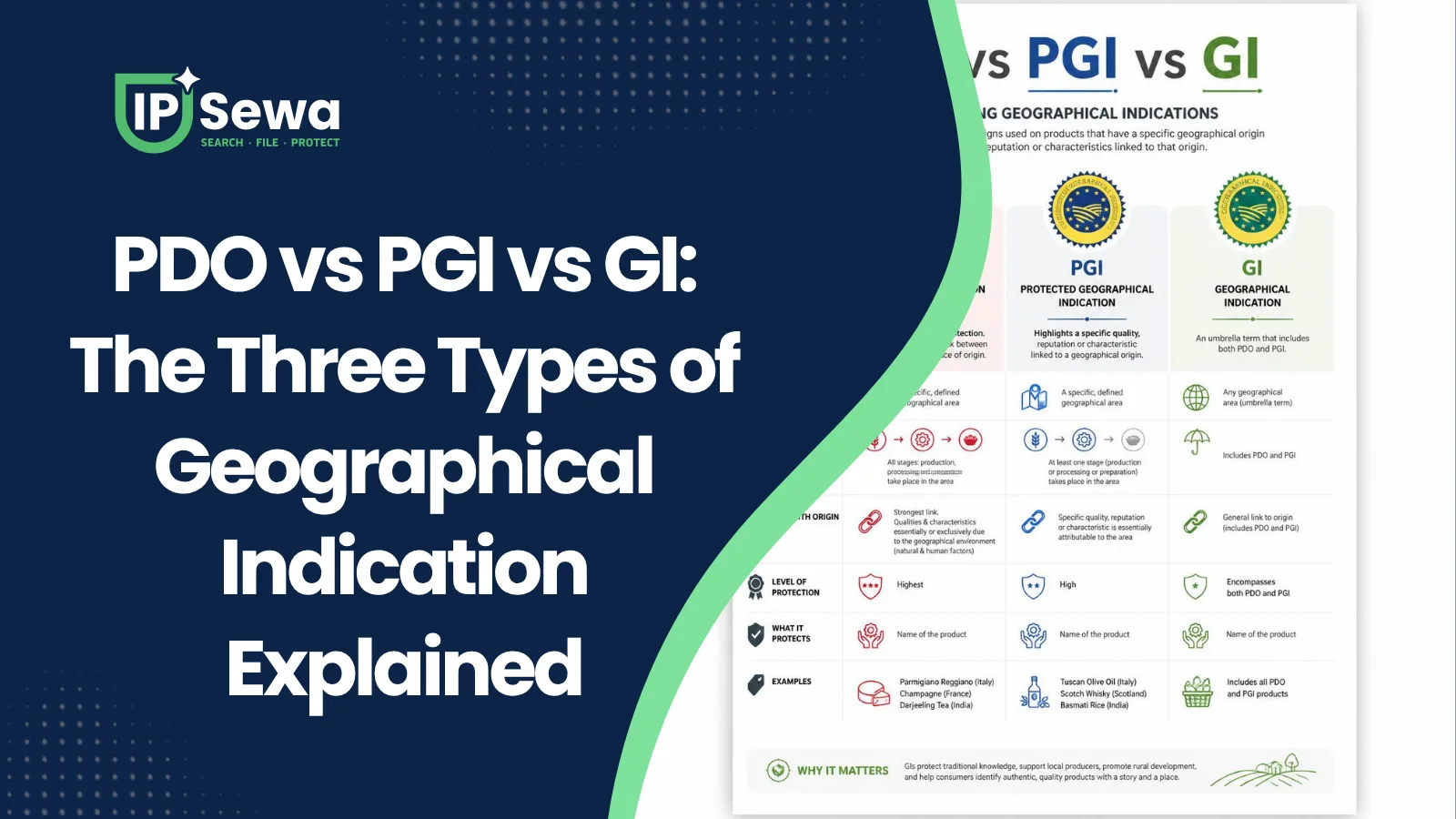
PDO and PGI are European categories, and GI is the wider term used in world trade law. Nepal has none of the three as a register: as of our last check there is no GI law here, no GI application, no GI certificate. What a Nepali producer has instead is a trademark.
Key takeaways
- GI stands for geographical indication, defined in TRIPS Art. 22(1).
- PDO and PGI are registration categories in the European Union, not global ones.
- The Patent, Design and Trade Mark Act 1965 uses the words "geographical" and "indication" zero times.
- It also never says "collective mark" or "certification mark", so neither exists here as a filing type.
- Nepal has been a WTO member since 2004, so TRIPS Art. 22 applies to it.
- TRIPS asks for "legal means", not for a register, so a trademark route can be part of the answer.
- The practical tool today is an ordinary trademark at the Department of Industry.
What does GI actually mean?
TRIPS Art. 22(1) defines a geographical indication as an indication that identifies goods as coming from a territory, region or locality.
Their quality, reputation or other characteristic must be essentially attributable to that origin, and that phrase carries the whole test.
So a GI is not merely a place name on a label: the place has to be doing real work in the product itself.
What is a PDO?
Protected Designation of Origin is the strictest European category, and every step of production, processing and preparation must happen inside the defined area.
The product's character must also come from that place, including its natural conditions and local skill.
What is a PGI?
Protected Geographical Indication is the looser European category, where at least one stage of production must take place in the named area.
The link can rest on reputation rather than soil and climate. That suits a product grown in one district and finished elsewhere.
What is a TSG, and why does it confuse people?
A Traditional Speciality Guaranteed protects a recipe or method, and it is the odd one out because nothing ties it to a place. People meet all three on European packaging and assume they are global.
Anyone anywhere may make a TSG product by following the registered method, whereas a GI is about origin.
So where does Nepal fit in?
It does not, and that is the honest answer to the question most readers arrive with: Nepal runs no geographical indication system of any kind.
There is no GI application form at the Department of Industry, no GI examination and no GI certificate.
Plenty of pages about Nepal say otherwise, so treat any page describing a Nepali "GI registration" as describing something that does not exist.
Does the 1965 Act mention geographical indications at all?
No, and this is checkable rather than an opinion. We counted over the official English text of the Patent, Design and Trade Mark Act 1965 published by the Nepal Law Commission.
The words "geographical", "indication", "appellation" and "collective" appear zero times, and "certification" appears once, in a fee schedule.
Is Nepal bound by any GI obligation?
Yes, in principle, because Nepal joined the World Trade Organization in 2004 and that brings the TRIPS Agreement with it.
TRIPS Art. 22(2) requires members to give interested parties legal means against misleading origin claims and unfair competition.
Note what it does not require, which is a register: a country may meet Art. 22 through trademark law, unfair-competition law or a dedicated statute.
Art. 23 adds stronger protection for wines and spirits, where a false origin claim bites even if the true origin is stated.
Has that ever mattered in a Nepali court?
It has been argued here before, and Supreme Court Decision No. 8577 leaned on Nepal's obligations under the Paris Convention and TRIPS. That was a trademark dispute, so it settles nothing about origin claims.
Whether Nepal's existing law satisfies Art. 22 for an origin claim is a question for an advocate rather than for a blog.
Can a Nepali product be registered as a GI internationally?
Not through any route Nepal belongs to, and the Lisbon Agreement is the international register for appellations of origin and GIs.
WIPO's own contracting-party list for Lisbon, checked in September 2026, runs to 30 members and does not include Nepal.
So a producer wanting protection abroad files country by country under whatever each one offers, and the WIPO country profiles are the place to start.
How do the four positions compare?
| Scheme | Who runs it | What you get | Open to a Nepali producer? |
|---|---|---|---|
| PDO | European Union | A registered name with an all-stages origin rule | Only by applying in the EU |
| PGI | European Union | A registered name with a one-stage origin rule | Only by applying in the EU |
| GI under TRIPS | WTO members | A duty on states to provide legal means | Indirectly, through national law |
| Nepal today | Department of Industry | An ordinary trademark, nothing GI-specific | Yes, and it is the only route. |
What can a Nepali producer group actually do today?
Register a trademark, because under Sec. 16(1) a person acquires title to the trade mark of their business upon registration at the Department.
Sec. 17(1) sets the filing: an application in the prescribed form, with four specimens of the mark, plus the fee.
One body owns the mark, and members use it with that body's written permission, which Sec. 21D records through a joint application.
What does our register show about place names?
Something uncomfortable: nothing reserves a Nepali place name for the people of that place, so the names get taken mark by mark.
Across the marks published in the bulletins we index, "Ilam" appears on 13 published marks held by 12 different owners.
"Gorkha" appears on about 71 marks across roughly 50 owners, and "Himalaya" on over 320 marks across over 200 owners.
These are IP Sewa counts over published bulletin entries, not official Department statistics. They show who filed, not who still holds a live registration.
What happened to "Chyangra"?
This one is worth checking, because several pages call Chyangra Pashmina a Nepali certification mark.
In the bulletins we index, the word appears on exactly two published marks. One is held by a brewery in Class 32, the other by a bag manufacturer in Class 24.
Neither is a pashmina mark and neither is owned by a producers' association, which our owner search lets you confirm for yourself.
That is not proof the name is unprotected, since our data covers published entries only. It is a reason to ask the Department before repeating the claim.
Can a place name be registered as a trademark here?
Sometimes, and it is harder than it looks, because a word that only describes where goods come from cannot distinguish one trader from another.
The proviso to Sec. 18(1) also lets the Department refuse a mark that may hurt the prestige of a person or institution, harm public morality, or undermine another trader's reputation.
A place name with a distinctive word or device travels much better than the bare name, so check what exists on our trademark database first.
Is there a collective or certification mark in Nepal?
Not as a filing category, and Sec. 2(c) defines a trade mark as a word, symbol or picture used by "any firm, company or individual" — one applicant, not a class of users.
There is no collective-mark application, no certification-mark application and no separate rulebook to file with the Department.
What exists instead is Sec. 21D, under which the owner may give written approval for another party to use the mark, recorded by a joint application.
How does a producer group file today?
- Agree the owner. A cooperative, association or company has to hold the registration in its own name.
- Write the rules. Area, standard, inspection and consequences, before anybody designs a label.
- Search what exists. Somebody may already hold your place name; the conflict checker is the fast first pass.
- Pick the classes.Sec. 18A(2) wants a separate application per category, and processed tea and raw leaf are different categories.
- File at the Department. The prescribed form, four specimens of the mark, and the fee. Our filing team does this daily.
- Answer the examiner. Descriptiveness is the objection a place name usually attracts.
- Licence the members. A joint application under Sec. 21D for each approved user.
Which classes does a regional product usually need?
The class follows the goods, not the region: processed tea sits in Class 30, raw produce in Class 31, clothing in Class 25 and yarn in Class 23.
Work the real list out with the NICE class finder, compare wording in the goods and services search, and read our guide to the 45 classes.
How long does the mark last, and who can object?
A registered Nepali trade mark runs seven years from registration under Sec. 18D. The renewal term is another seven years, and a mark may be renewed any number of times under Sec. 23B(3).
Renewal falls due within 35 days of expiry, with a six-month late window on a fine, and missing both cancels the registration.
Objections run the other way too: Sec. 21A(2) allows a complaint within 35 days of publication, while the Department's opposition window in practice is treated as 90 days.
That is when a group can stop an outsider taking its district name, so watching the Bulletin matters more here than where a GI register exists.
What is the difference between a GI tag and ODOP?
They are not the same kind of thing at all, and "GI tag" is Indian usage for a registration under India's own geographical indications law.
ODOP, One District One Product, is a government promotion and market-access programme, which is policy support rather than an IP right.
Common mistakes
- Believing a Nepali GI certificate exists. Ask the Department to show you the form.
- Calling a Nepali mark a certification mark. The Act has no such category.
- Waiting for the law to change. Nepal is first to file, and place names are being taken now.
- Filing the logo and not the name. The word is what a copier uses.
- Letting one member own the group's name. That member can then exclude everybody else.
- Assuming an EU PGI reaches Nepal. It protects the name in Europe and nowhere else.
A worked example
This is an illustration, not a real case. Twenty growers in a hill district make a smoked cheese and want their district's name on every wheel.
They form an association, register the name and a device in the dairy class, write a standard covering milk source and smoking time, and licence each member.
What they do not have is a GI, and if Nepal ever builds one the trademark will be evidence of the scheme rather than a substitute for filing.
What if somebody is already using the name?
It depends entirely on whether they registered it, since an unregistered user may still meet a passing-off claim if your reputation came first. A registered owner is a harder problem, and the route runs through the Department.
Imported goods carrying a Nepali place name are a different question again, nearer grey-market trade than copying.
Our opposition and enforcement team handles both of those, while legal-effect questions belong with an advocate.
Would a GI law fix this?
It would change the tool, not the work: any GI system still needs an area, a standard and an inspector. A consolidating industrial-property bill has been reported more than once, but we will not describe its provisions, because no official text confirms them.
Until something is enacted, the 1965 Act is the law in force.
In short
PDO and PGI answer a European question about how tightly a product is tied to its place, and GI is the treaty word for the same idea.
Nepal has neither the categories nor a register, so the realistic step is a well-governed trademark at the Department.
See who already holds your name on our register search, then get a view from our clearance service.
People also search for
- Geographical indications in Nepal: Ilam tea and pashmina
- How Champagne, Scotch and Darjeeling got protected
- The TRIPS Agreement explained
- What the Department of Industry does for IP
- The Nepal trademark application form
If you are trying to protect a regional product and cannot tell which of these routes applies to it, send us the product, the district and the group behind it and we will tell you what is actually available.













Comments (0)
Leave a comment
Replying to — cancel