

A protected designation of origin reserves a place name for the producers of that place. Nepal has no PDO register and no geographical indication law, so a Nepali place name belongs to whoever registers it first as an ordinary trade mark.
Key takeaways
- PDO is a European Union category, not a global right, and Nepal has no equivalent.
- The words "geographical", "indication" and "appellation" appear zero times in Nepal's 1965 Act.
- Sec. 2(c) describes a mark used by "any firm, company or individual", which is one owner rather than a region.
- In our index of published entries, "Gorkha" appears in 71 marks held by 50 different applicants.
- The bare word "Ilam" is itself published as a Class 30 mark in one company's name.
- Nepal has no collective mark and no certification mark either, so a group registers in one name.
- Misleading buyers about origin is not among the Act's listed grounds for refusing a mark.
What is a protected designation of origin?
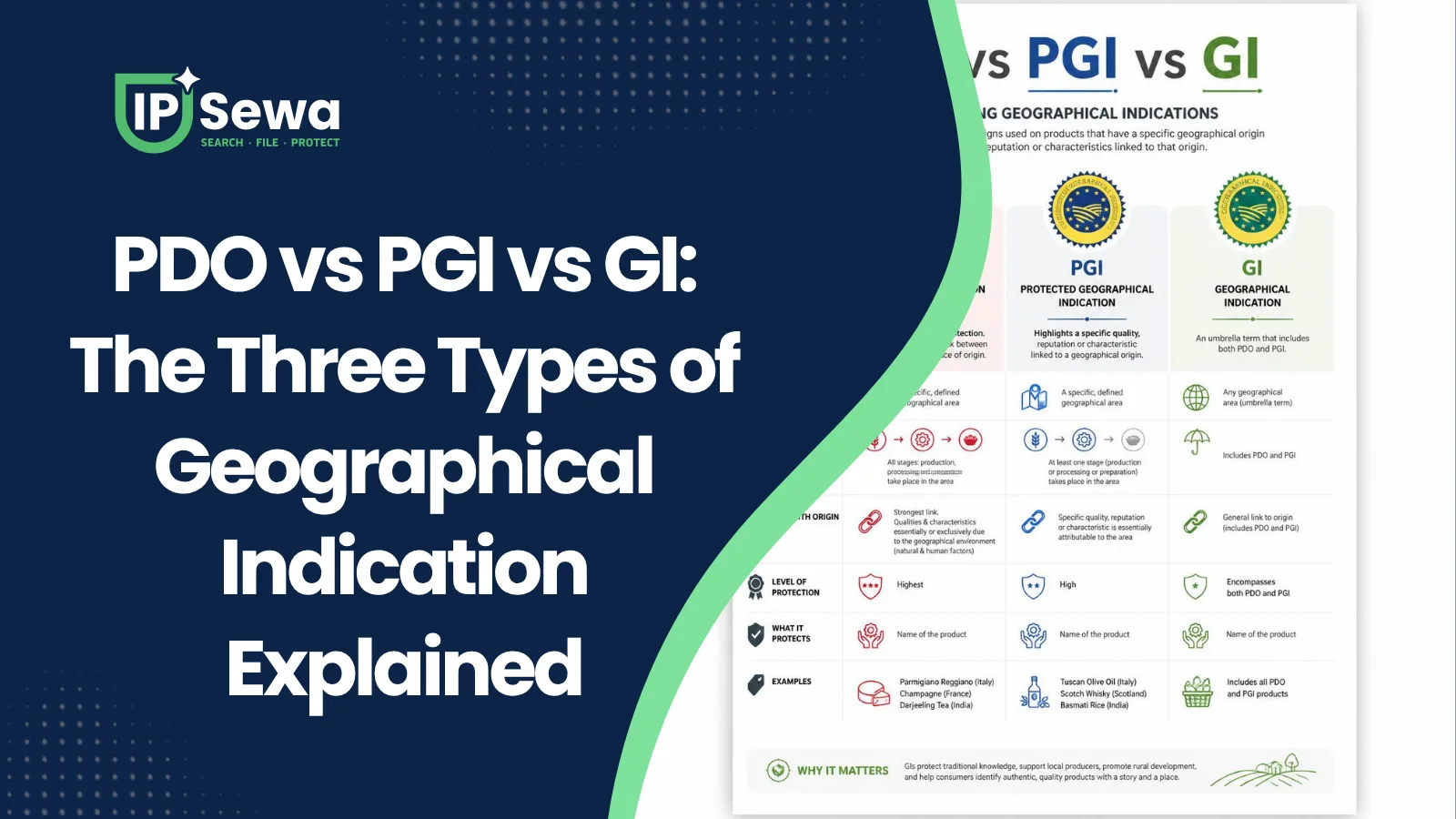
It is a European Union registration that ties a product name to a defined place. Once the name is registered, only producers inside that place who follow the filed specification may use it.
The specification is a public document. It sets the boundary, the raw materials, the method and the checks, and a named control body verifies that producers follow it.
So a PDO is not really a brand. It is a reserved word, held for a region rather than owned by a company.
What makes PDO stricter than PGI?
The amount of the work that has to stay at home. A PDO expects essentially every stage of production, processing and preparation to happen inside the named area.
A Protected Geographical Indication asks for only one stage, and it can lean on reputation rather than on soil and climate. Both sit on the same European register.
A PDO applicant is therefore claiming something quite strong: that the product could not be made the same way anywhere else.
Does Nepal have a PDO register?
No. The Patent, Design and Trade Mark Act 1965 covers exactly what its title names, which is patents, designs and trade marks.
Counted over the official English text published by the Nepal Law Commission, the words "geographical", "indication" and "appellation" each appear zero times, and so does "collective".
That is checkable rather than arguable. If a consultant offers to obtain a PDO or a GI certificate for a Nepali product, ask which section of which Act creates it.
So who owns a Nepali place name?
Whoever filed for it, in the class they filed for. That is the honest answer, and the register shows it plainly.
Because nothing reserves a place name for the people of that place, a district name behaves like any other word. It can be part of one company's registered trade mark.
A PDO regime exists precisely to prevent that. Nepal simply has no such regime to prevent it with.
What does the Nepali register actually show?
Place names spread across many unrelated owners, which is the pattern you would expect where nothing reserves them. The figures below come from our index of marks published in the Industrial Property Bulletin.
They are IP Sewa counts of published entries rather than official Department statistics, and they describe published marks rather than confirmed registrations.
| Place word | Published entries containing it | Distinct applicants | What that tells you |
|---|---|---|---|
| Gorkha | 71 | 50 | A district name in fifty different hands. |
| Himalaya family | 328 | 206 | The best known word of all, shared widely. |
| Everest | 94 | 71 | A mountain used by brewers, banks and traders. |
| Annapurna | 44 | 38 | Almost one owner per mark. |
| Ilam | 13 | 12 | Including the bare word, published in Class 30. |
Why does the Ilam example matter?
Because it is the exact thing a PDO exists to stop. The single word "Ilam" is published as a Class 30 mark under application number 052874, in the name of one tea corporation.
In a PDO country a district famous for tea could not be handed to one applicant for tea. In Nepal there is no rule that says otherwise.
We are not suggesting the filing was improper. It was lawful, and that is the point worth understanding.
Are there other examples in the data?
Yes, across categories. "Manang Valley" is published three times in Class 33 for one beverage company, and several "Lumbini" marks sit with one gas supplier in Class 4.
Look those up yourself on our register search, or check a particular business with the owner search.
The lesson is the same every time. A place name is first come, first served, class by class.
Why does the Act allow it?
Because of what the refusal grounds say, and what they leave out. The proviso to Sec. 18(1) lists when the Department shall not register a mark, and the list is short.
A mark is refused if it hurts the prestige of a person or institution, damages public conduct, morality or national interest, harms another mark's goodwill, or is already registered by someone else.
Misleading buyers about where goods come from is not on that list. A false origin claim has to be argued through other routes instead, such as a passing off claim.
Can you build a brand on a place name at all?
You can file one, and many businesses have. Whether it makes a strong brand is a separate question from whether it is registrable.
A word that only tells buyers where something comes from is doing weak work as a badge of trade, and an examiner may say so. Adding a distinctive word or device usually helps.
It also narrows what you can stop. Owning "Gorkha Something" rarely stops a neighbour using "Gorkha" honestly about their own goods.
What if a whole producer group wants the name?
Then the group has to pick one owner, because Nepal offers nothing else. There is no collective mark and no certification mark in the Act, and "certification" appears once as a fee line for a certified copy of a record.
The nearest machinery is Sec. 21D, which lets an owner transfer a mark or give written approval for its use, recorded by a joint application at the Department.
Our explainer on collective and certification marks in Nepal works through what that structure has to contain.
How does a producer group file, in order?
- Choose the owner. A cooperative, an association or a company, decided before a designer is hired.
- Write the rules. Membership, standard, inspection and consequences, since nobody publishes them for you.
- Search first. Run the name through our conflict checker before printing anything.
- Pick the classes. One application per category of goods, so list what you actually sell.
- File at the Department. The prescribed form with the specimens it asks for.
- Record each user. A joint application under Sec. 21D for every approved producer.
What happens after the group files?
The Department examines the mark, and an accepted mark is published in the Industrial Property Bulletin before registration is completed.
Publication opens the door to an objection. Sec. 21A(2) states 35 days, while trade mark practice treats the opposition window as 90 days, so confirm the count that applies to your own filing.
If nothing blocks it, the mark is registered and a registration certificate is issued to the owner named on the application, not to the producers collectively.
Which classes do regional foods fall into?
Usually the food classes, and often more than one. Preserved and animal-origin foods, prepared foods such as tea, coffee and spices, and fresh agricultural produce each sit in a different class.
A grower selling fresh apples and apple jam is looking at two applications. The NICE classification finder gives you a first list to check.
Take the class headings from WIPO's current list rather than from an old article, because the headings are revised from time to time.
What records should the group keep?
The ones a filed specification would have held. Where the raw material comes from, what the process is, who inspects and what happens when a member fails.
Keep the approval notes issued under Sec. 21D with them, because a committee that changes every two years loses paperwork faster than it loses deadlines.
None of this is filed at the Department. All of it decides whether the scheme survives its first serious argument.
How long does the registration last?
Seven years from registration under Sec. 18D, and the renewal term for a trade mark is another seven years, repeatable any number of times under Sec. 23B(3).
Renewal falls within 35 days of expiry with a six-month late window on payment of a fine, after which the registration is cancelled automatically. Our renewal calculator works out the dates.
Is there a deadline for actually using it?
Yes, and it catches groups that register early and launch late. Sec. 18C allows the Department to cancel a mark not brought into use within one year of registration, after inquiry.
File when the scheme is nearly ready rather than years ahead of it. A group that spends two seasons agreeing its standard is exposed to that provision.
Does a European PDO protect the name in Nepal?
No. Sec. 21B provides that title to a patent, design or trade mark registered in a foreign country is not valid in Nepal unless it is also registered in Nepal.
A PDO is not even a trade mark, so it has still less purchase here. The holder of a European name who wants protection in Nepal files a Nepali trade mark like anyone else.
The Department of Industry is where that filing goes, and its published information lists the services it provides.
Could a Nepali product ever hold a PDO?
Only by applying in the scheme's own jurisdiction, on that jurisdiction's terms and through a representative there. Nothing in Nepal creates, sponsors or recognises such an application.
Treat it as a foreign filing project with its own law, its own evidence and its own timetable, and get advice in that market before spending on it.
What does world trade law ask of Nepal?
Something real, but less than a register. Nepal joined the World Trade Organization in 2004, which brought the TRIPS Agreement with it, and TRIPS asks members to provide legal means against misleading origin claims.
It does not prescribe the machinery, so a country may answer with trade mark law, unfair competition law or a dedicated statute. Our explainer on the TRIPS Agreement sets out the background.
Whether Nepal's present law discharges that duty is a genuine legal question. Ask a practising advocate before relying on either answer.
Common mistakes
- Asking the Department for a PDO or GI form. There is not one to give you.
- Assuming a district name is already protected because the product has been made there for generations.
- Filing the place name alone and expecting to stop honest neighbours using it.
- Registering in one member's personal name while calling the label a community asset.
- Filing one application for everything when each category of goods needs its own.
- Using the registered symbol before registration, which Sec. 18B prohibits and Sec. 19 backs with a fine and confiscation of the goods.
- Confusing the company registry with the trade mark register, which are different offices doing different jobs.
A worked example
This is an illustration, not a real case. Growers in one hill district want a shared name for their timur, and everyone assumes the district name is theirs already.
A search shows a trader in another province published a similar mark two years earlier in the same goods class. The group's options narrow immediately.
Had they searched and filed first, through their cooperative, with a written members' agreement, none of that would have happened. Searching costs almost nothing compared with rebranding.
In short
Nepal has no protected designation of origin, so a place name here is not reserved for the place. It is available to whoever registers it.
A producer group protects its regional brand by choosing one owner, filing early in the right classes, and writing the rulebook a PDO scheme would have published.
Check what is already published on our trade mark search, then let our filing team take the application forward.
People also search for
- Collective and certification marks in Nepal
- How the Nepali trade mark register works
- What the NICE classes mean
- What the Industrial Property Bulletin is
- What the registration certificate says
- What the Department of Industry does
If your group is building a regional brand and needs the ownership and approval structure drafted properly, tell us who the producers are and what the name has to promise.












Comments (0)
Leave a comment
Replying to — cancel