
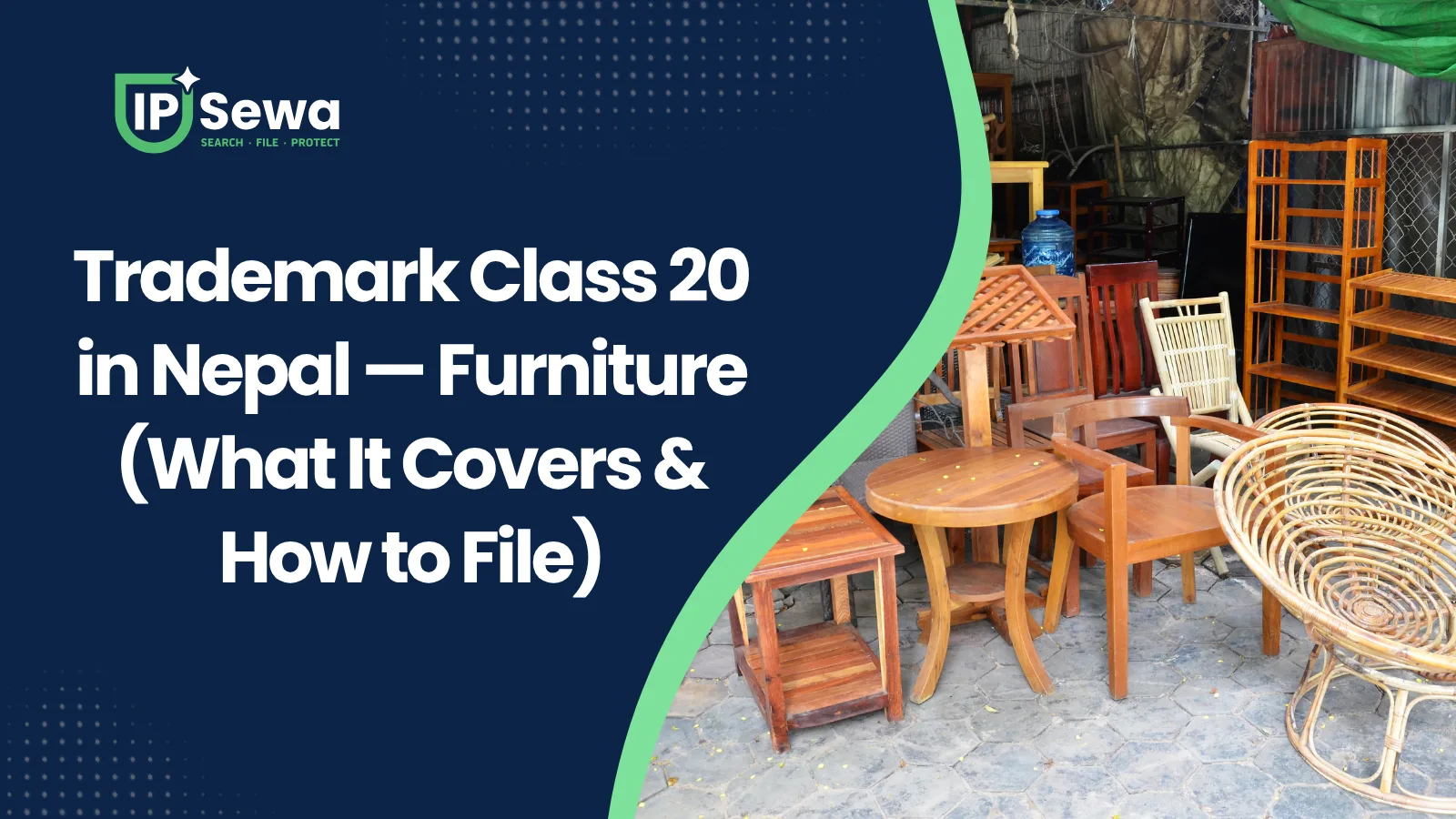
Trademark Class 20 in Nepal covers furniture, mattresses, mirrors, picture frames and non-metal storage containers. You register this goods class directly with the Department of Industry under the Patent, Design and Trademark Act 1965 for a renewable seven-year term.
Key Takeaways
- NICE Class 20 protects furniture, bed bases, mattresses, pillows, mirrors, picture frames and non-metal storage containers.
- Bed linen, textiles and sleeping bags belong in Class 24, not Class 20, despite being used on furniture.
- Medical furniture like hospital beds falls under Class 10, while standard household furniture stays in Class 20.
- Nepal requires a separate trademark application for each NICE class you wish to protect.
- The Department of Industry grants registration for seven years, renewable indefinitely for further seven-year terms.
- Metal hardware and fittings belong in Class 6, whereas non-metal furniture fittings remain in Class 20.
What goods does Trademark Class 20 cover in Nepal?
Trademark Class 20 encompasses furniture, mirrors, picture frames, non-metal storage containers and goods made from wood, cork, cane, horn, bone, shell, amber or plastic. The Department of Industry applies the WIPO NICE Classification to determine scope, meaning items like sofas, office desks, camping mattresses, window blinds and non-metal dowels all fall within this single goods class.
Understanding what belongs in trademark class 20 nepal prevents costly misclassification. This class centres on furnishings and non-metal structural items rather than their function alone. A wooden bookcase qualifies because it is furniture, but a metal filing cabinet might straddle Class 6 depending on material composition. When you file, your specification must list only goods that genuinely fall within Class 20's boundaries to avoid examiner objections during the preliminary review.
The unifying principle is that Class 20 captures movable furnishings and containers not classified elsewhere by function or material. Goods of wood, plastic or natural materials default here unless another class claims them specifically. For example, plastic packaging containers sit in Class 20, but plastic bags for retail belong in Class 16. Our team can help you distinguish these nuances through our trademark search service before you commit to filing.
Which products are excluded from NICE Class 20?
Several goods commonly associated with furniture are explicitly excluded from NICE class 20 and require separate applications in different classes. Bed linen, pillowcases, duvet covers and textile bedding belong in Class 24, while medical furniture such as hospital beds and operating tables fall under Class 10. Metal furniture fittings including hinges, brackets and locks are classified in Class 6, not Class 20.
| Product Type | Correct NICE Class | Why Not Class 20 |
|---|---|---|
| Bed sheets and pillowcases | Class 24 | Textile goods, regardless of furniture association |
| Hospital beds and medical chairs | Class 10 | Medical apparatus defined by therapeutic function |
| Metal door handles and hinges | Class 6 | Common metals and hardware classified by material |
| Glass mirrors for vehicles | Class 9 | Optical apparatus, not household furnishing |
| Built-in kitchen countertops | Class 19 | Non-metal building materials, not movable furniture |
This distinction matters because Nepal operates a strict one-class-per-application system. If your business manufactures both wooden bed frames and cotton bed sheets, you need two separate registrations: one in Class 20 for the frame and another in Class 24 for the textiles. Filing everything under Class 20 will result in partial refusal for the textile goods, delaying protection and increasing costs. Use our free NICE class finder to verify where specific goods belong before preparing your application.
How do I register a furniture trademark in Nepal?
You register a furniture trademark by filing an application with the Department of Industry, passing examination, surviving publication in the Industrial Property Bulletin without opposition during the 90-day window, and paying the registration fee to receive your certificate. The entire process typically takes 12–14 months when unopposed, though straightforward cases may conclude in 6–8 months under optimal conditions.
- Conduct a comprehensive clearance search using the DoI database to identify conflicting prior marks in Class 20.
- Prepare your application with four specimens of the mark, a notarised Power of Attorney and the correct goods specification.
- File with the Department of Industry and receive an acknowledgment number confirming your priority date.
- Respond to any examiner objections regarding distinctiveness or similarity within the prescribed timeframe.
- Monitor the Industrial Property Bulletin after publication and defend against any third-party opposition filed within 90 days.
- Pay the registration fee upon approval and collect your certificate, valid for seven years from the registration date.
Nepal follows a first-to-file system, meaning rights accrue to whoever submits the earliest valid application regardless of prior use. This makes early filing critical for furniture manufacturers launching new product lines. Foreign applicants cannot use the Madrid System for Nepal; they must file directly through a local agent with a notarised Power of Attorney. Our trademark registration service handles this end-to-end for both domestic and international applicants.
What documents are required for Class 20 trademark filing?
Filing a mattress class 20 or furniture trademark requires an application form, four specimens of the mark, a notarised Power of Attorney signed by the applicant and attested by two witnesses, plus a board resolution if filing under a company name. Foreign applicants must additionally submit a notarised copy of their home country registration certificate in English. All documents must be complete at submission to establish your priority date.
The specification of goods deserves particular attention for Class 20 applications. Vague descriptions like "furniture" may trigger examiner queries requesting greater specificity. Instead, list concrete goods such as "wooden dining tables," "spring mattresses," "plastic storage containers" or "bamboo window blinds." This precision reduces back-and-forth during examination and strengthens your eventual registration against challenges. You can draft accurate specifications using our free goods and services search tool to find accepted wording.
For priority claims under the Paris Convention, include a notarised copy of the original foreign filing receipt or application in English. Nepal honours priority dates from convention countries provided you file within six months of the original application. Missing this window forfeits your priority claim entirely. The Department of Industry examines priority documentation strictly, so ensure translations are certified and all seals are properly affixed before submission.
How much does Class 20 trademark registration cost?
Registration costs depend on government fees per class, professional service charges for search and prosecution, and potential additional expenses if objections or oppositions arise. Nepal charges separate government fees for application, registration and renewal stages, with foreign applicants paying higher rates than domestic filers. Total investment varies based on case complexity and whether multiple classes are needed for comprehensive protection.
Beyond base fees, budget for notarisation of Powers of Attorney, translation of foreign documents and possible response drafting if the examiner raises objections. Opposition proceedings introduce hearing costs and legal representation expenses that can significantly increase total outlay. These variables make fixed pricing impractical; use our trademark fee calculator for current government fee estimates or contact us for a tailored quote covering your specific situation.
What common mistakes affect Class 20 applications?
The most frequent error is misclassifying textile bedding as Class 20 when it belongs in Class 24, leading to partial refusal and wasted fees. Another pitfall is listing overly broad goods descriptions that invite examiner objections or fail to distinguish your mark from existing registrations. Some applicants also neglect to search thoroughly for similar marks in adjacent classes like Class 6 or Class 10, missing conflicts that surface during examination or opposition.
Failing to monitor the Industrial Property Bulletin after publication leaves your application vulnerable to unchallenged opposition filings. While the statutory opposition window is 90 days, you won't receive automated alerts when competitors file objections. Proactive monitoring or engaging professional opposition watch services ensures you can respond within deadlines. Additionally, many businesses forget that furniture trademark protection lasts only seven years before requiring renewal; missing the 35-day renewal window triggers late fees and risks automatic cancellation after six months.
Can foreign companies register Class 20 marks in Nepal?
Foreign companies can register trademark class 20 nepal marks but must file directly through a Nepal-based agent since Nepal is not party to the Madrid Protocol. International applicants submit the same core documents as domestic filers plus a notarised home registration certificate in English. Priority claims under the Paris Convention are available if filed within six months of the original foreign application.
This national-only requirement catches many international brands off guard. An existing Madrid registration designating other countries provides zero protection in Nepal. You must initiate a fresh national application with full documentation and local representation. Our team regularly assists foreign furniture manufacturers entering the Nepali market, handling Power of Attorney execution, document certification and prosecution through to certificate issuance. Contact us to discuss your international filing strategy for Nepal.
In short, NICE class 20 protects the physical goods that furnish homes and offices in Nepal, from wooden chairs to plastic storage bins. Correct classification, thorough searching and timely filing secure your exclusive rights for seven renewable years. Missteps in class selection or documentation delay protection and expose your brand to competitors operating under similar marks.
People also search for
- What is NICE classification and how do trademark classes work
- How to choose the right trademark class in Nepal
- Difference between goods and services in trademark classification
- Trademark Class 10 for medical devices and hospital furniture
- What can and cannot be trademarked in Nepal
- What is a trademark and why register in Nepal
Ready to protect your furniture or mattress brand? Start with a free search of Nepal's trademark database via our trademark database search to check availability, then explore our trademark registration service or contact our team for personalised guidance on Class 20 filing strategy.











Comments (0)
Leave a comment
Replying to — cancel