
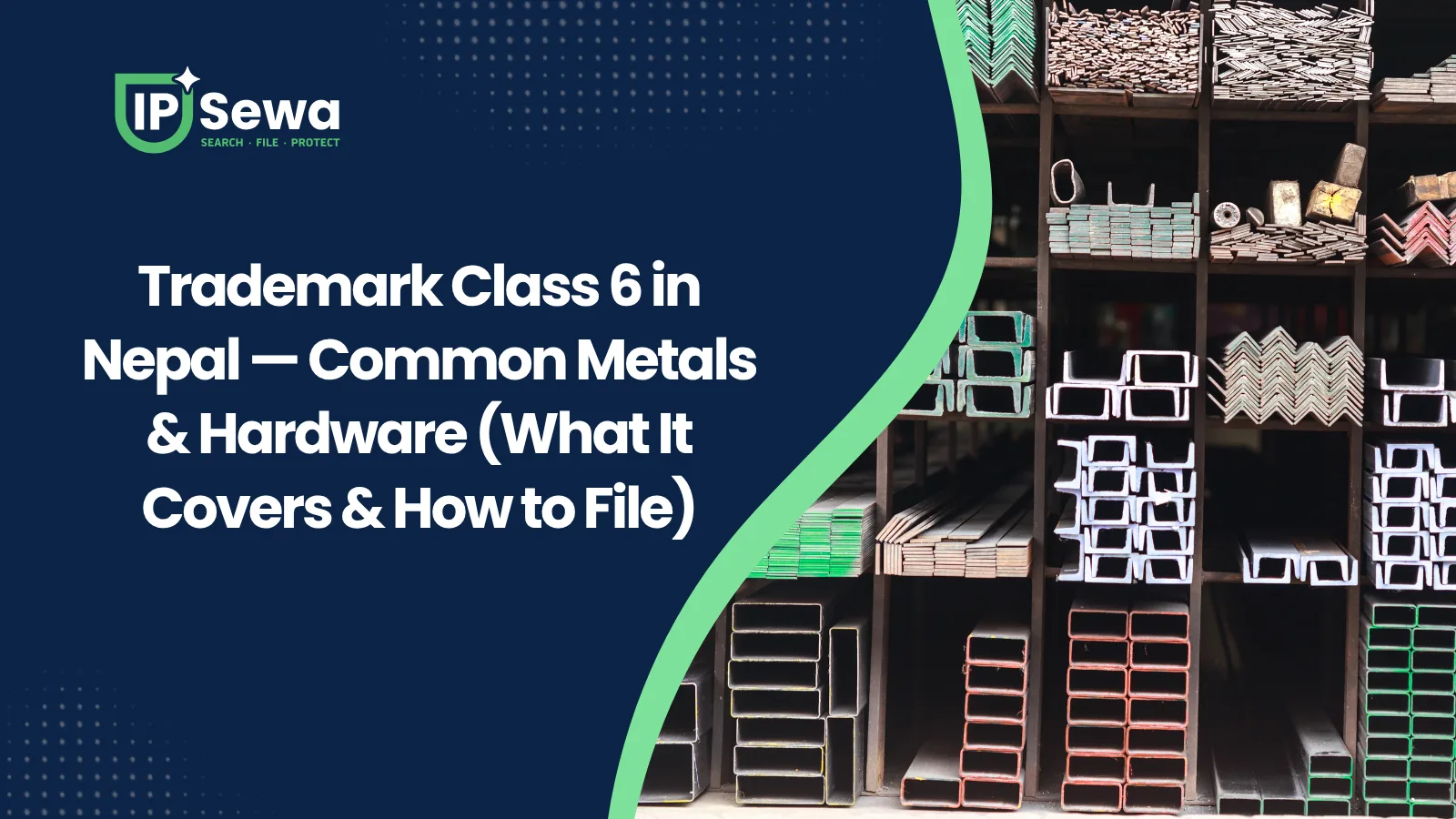
Trademark Class 6 in Nepal covers common metals, metal building materials, hardware, non-electric metal wires, containers and safes. You file this goods-class application with the Department of Industry under the Patent, Design and Trademark Act 1965. An unopposed registration typically takes about 12–14 months and lasts seven years, renewable.
Key Takeaways
NICE Class 6 protects specified metal goods in Nepal, while the Department of Industry applies the national filing and examination system. Your application covers one class only, and precise goods wording matters because registration does not automatically protect every product your business may sell.
- Class 6 is the common-metals and hardware class under the NICE Classification.
- It includes raw metals, alloys, ores, metal construction goods and transportable metal buildings.
- Small metal hardware includes bolts, screws, nails, locks, hinges and fittings.
- Non-electric metal cables and wires can fall in Class 6; insulated electric cables generally belong elsewhere.
- One Nepal trademark application covers one class, so related products may need separate applications.
- The DoI publishes accepted marks in the Industrial Property Bulletin before the opposition period.
- A registered mark lasts seven years and can be renewed for further seven-year terms.
What does trademark Class 6 cover in Nepal?
Class 6 covers common metals and their alloys, ores, metal materials for building, transportable metal buildings, non-electric cables and wires of common metal, small metal hardware, metal containers and safes. The class is mainly material-based. The product’s metal composition matters, but its specific function can move it into another class.
Typical examples include unwrought or semi-wrought iron, steel, aluminium, copper, brass and bronze. It can also cover metal sheets, bars, beams, rails, pipes, doors, gates, fences, roofing materials, frames, ladders and structural parts. Metal statues and works of art may also fit this class.
For a Nepal business, the key question is not simply, “Is this product metal?” Ask what you sell, how customers use it, and how the NICE Classification describes it. A metal kitchen utensil, powered machine, hand tool or electric cable may need a different class despite its metal content.
Which products belong in hardware Class 6?
Hardware Class 6 commonly includes small metal hardware such as bolts, screws, nails, nuts, rivets, hinges, hooks, brackets, latches, locks and non-electric door fittings. It also covers many metal fasteners and fittings for buildings, furniture, windows, pipes and cables. The exact product description should match your real catalogue.
| Business product or line | Likely Class 6 position | Practical filing point |
|---|---|---|
| Steel bars, sheets and alloys | Common metals and semi-wrought metals | State the metal form and type clearly. |
| Metal doors, gates and window frames | Metal building materials | List each major construction product you sell. |
| Bolts, screws, nails and hinges | Small metal hardware | Use specific fastener terms rather than “hardware” alone. |
| Metal storage boxes and industrial containers | Storage or transport containers | Explain the container’s use where needed. |
| Powered drills or cutting machines | Usually another goods class | Check function before treating the item as Class 6. |
“Hardware” by itself can be too broad. A specification such as “metal door locks; metal hinges; metal bolts; metal brackets for building” gives the examiner and third parties a clearer boundary. The Department of Industry considers the goods listed in your application, not every product associated with your trade.
Which NICE classes apply to a metals or hardware business?
Metal businesses often need Class 6, but a brand may span several NICE classes. Nepal requires a separate application for each class. Class 6 covers goods; Class 35 may cover retail or wholesale services, while Class 7 or Class 8 may apply to machines or hand tools.
For example, a company selling steel doors under one brand may need Class 6 for the goods. If it also operates branded retail outlets or online trade services, Class 35 may be relevant. A company selling electric drilling machines should assess Class 7, not assume that metal construction makes every product Class 6.
Use the NICE class finder and goods descriptions as a starting point. For a wider product range, the guide to choosing a trademark class in Nepal explains why class selection should follow your actual commercial activity.
How do you file a Class 6 trademark in Nepal?
You file a Class 6 trademark with the Department of Industry, beginning with clearance and ending with a registration certificate. The DoI examines the mark, publishes it in the Industrial Property Bulletin, allows a 90-day opposition period, and registers it if no valid objection prevents registration.
- Search existing marks. Search the Nepal trademark record for the proposed wordmark, spelling variations and similar marks. Check both the name and the goods category using the Nepal trademark database search.
- Define the goods. Prepare a focused Class 6 specification. Separate steel products, fittings, fasteners, doors, pipes or containers instead of using one vague phrase.
- Prepare the mark and applicant details. Decide whether you are protecting a wordmark, logo, or combined mark. Confirm the applicant’s legal name and address.
- Submit the application. File the prescribed application at the DoI with the label, specimens and supporting papers. Nepal follows first-to-file principles, so an early complete filing matters.
- Answer examination issues. The DoI reviews similarity, distinctiveness and statutory refusal grounds. If it raises an issue, respond with evidence or legal reasons within the applicable process.
- Watch publication and opposition. After acceptance, the mark appears in the Industrial Property Bulletin. Any person may oppose within 90 days of publication. An opposition can delay the certificate and require a hearing response.
- Obtain the certificate. If the application proceeds without a successful opposition, complete the registration stage and receive the certificate. Use TM while the application is pending; use ® only after registration.
What documents are needed for a Class 6 application?
A domestic applicant generally prepares the application form, trademark label, specimens, notarised Power of Attorney, company board resolution, industry certificate and latest tax clearance letter. A foreign applicant also supplies certified home-registration material and files through a Nepal-based agent or representative with authority to act.
- Prescribed trademark application form.
- The Class 6 wordmark, logo or combined label in the required format.
- Four specimens of the mark for filing practice based on the Act.
- Notarised Power of Attorney, signed and witnessed as required.
- Board resolution where the applicant is a company.
- Industry certificate and latest tax clearance letter for a domestic business.
- Certified English filing receipt or application for a Paris Convention priority claim, where applicable.
- For a foreign owner, a certified English home registration certificate and local representative documents.
Keep the applicant name consistent across the form, label, corporate papers and authority documents. Small differences can create avoidable clarification requests. If the logo has several versions, decide which version you want protected before filing rather than relying on later changes.
How long does Class 6 registration take in Nepal?
Class 6 trademark registration usually takes about 12–14 months from filing to certificate when the application is unopposed. A straightforward case may finish in roughly 6–8 months, but that is the favourable end rather than the normal promise. Examination queries, publication timing and opposition can extend the process.
What does a Class 6 trademark cost in Nepal?
The total cost has a government component and, if you use professional help, a service component. Nepal’s one-class rule means each additional NICE class usually creates another application cost. The final figure also depends on search work, document preparation, examination responses, opposition risk, applicant type and later renewal.
DoI charges are not the whole budget. Notarisation, certification, translation, corporate paperwork and a Nepal-based agent for a foreign applicant may add work. Avoid choosing a class only because it appears cheaper. A narrow or wrong specification can leave an important product unprotected.
For a current estimate, use the trademark fee calculator or send your product list to our team through IP Sewa’s contact page. Current charges can change, and professional advice depends on the application.
What is the legal basis for Class 6 registration?
The Patent, Design and Trademark Act 1965 provides Nepal’s trademark framework. Sec. 2(c) defines a trademark as a word, symbol, picture or combination distinguishing goods or services. Sec. 17 covers filing, Sec. 18 concerns examination and registration, and Sec. 18A requires classification with a separate application for each class.
The Act also refuses marks that are already registered in another person’s name, damage another mark’s goodwill, harm public morality or conduct, hurt reputation, or conflict with national interest. A registered mark gives stronger statutory protection than an unregistered trading name. Registration is title to the mark; company registration alone is not a trademark registration.
Sec. 18D sets the trademark term at seven years. Sec. 21A concerns publication and objections, while Sec. 23B governs renewal. You can read the official English text of Nepal’s intellectual-property law and check current administrative information from the Department of Industry. The NICE system itself is maintained internationally by WIPO.
What mistakes should metals businesses avoid?
Metal businesses often lose time by filing a broad brand without a clear goods list, searching only exact spellings, or assuming company registration protects the brand. Another common error is filing one class for every activity. The DoI record and first-to-file system reward preparation before public launch and before a competitor submits a similar mark.
- Searching only the logo: Search the wording, sound, translation and close spellings too.
- Using “all metal products”: Name the actual products, such as metal doors, fasteners or steel sheets.
- Ignoring other classes: Machines, hand tools, electric goods and retail services may need separate assessment.
- Filing after launch: Another applicant may file first, even if you used the name informally.
- Changing the logo casually: The registered label defines the mark protected by the certificate.
- Missing publication deadlines: A conflicting application must be opposed within the applicable 90-day window.
- Forgetting renewal: A trademark is renewable, but failure to renew can lead to cancellation.
What would a Nepal Class 6 filing look like?
Imagine “Himal Forge” is a Kathmandu startup selling steel gates, metal window frames and construction fasteners. It could prepare a Class 6 specification for those goods, search similar marks, file the wordmark or logo early, and later assess Class 35 if it offers branded retail services under the same name.
This is a realistic example, not a claim about an existing company or registration. If the startup also sells powered cutting machines, it should not add them to Class 6 simply because the machines contain metal. That product line needs a separate classification review.
What alternatives and edge cases should you consider?
A foreign owner cannot rely on a Madrid international registration because Nepal is not in the Madrid System. It files directly in Nepal through a local agent or representative. A Paris Convention priority claim may be available if the required foreign filing evidence is supplied. Nepal likewise does not provide automatic national coverage through an international filing route.
If your product is primarily a service, Class 6 will not protect that service. A hardware shop may need Class 6 for its own branded goods and Class 35 for retail services. If the concern is a copied product appearance, consider industrial design protection. If it is a technical invention, consider patent protection. IP Sewa’s trademark registration team can help separate these rights and prepare the filing.
Do not treat this guide as a substitute for advice on your exact goods, ownership structure or conflict. A written search can be useful where the mark resembles an existing steel, tools or construction brand. If someone files a confusing mark, our team can help with the staffed trademark opposition and enforcement service.
In short, how should you approach trademark Class 6 Nepal?
Start with the brand, then identify every metal product you actually sell. Search the Nepal record, select Class 6 wording carefully, and file before a competitor does. Remember that one application covers one class. After DoI examination and Bulletin publication, allow the 90-day opposition period and plan for a typical 12–14-month journey.
- Class 6 protects specified common-metal and hardware goods.
- Product function may place metal goods in another NICE class.
- Nepal uses a first-to-file system.
- Registration lasts seven years and is renewable.
People also search for
- What is the NICE Classification for trademarks?
- How do I choose the right trademark class in Nepal?
- What is the difference between goods and services classes?
- What is trademark Class 7 for machines in Nepal?
- What is trademark Class 8 for hand tools in Nepal?
- What is trademark Class 9 for electronics in Nepal?
- How do I register a trademark in Nepal?
Before filing, search the Nepal trademark database, review your goods with the trademark search and clearance team, and contact IP Sewa for help with Class 6 filing, examination or opposition.











Comments (0)
Leave a comment
Replying to — cancel