
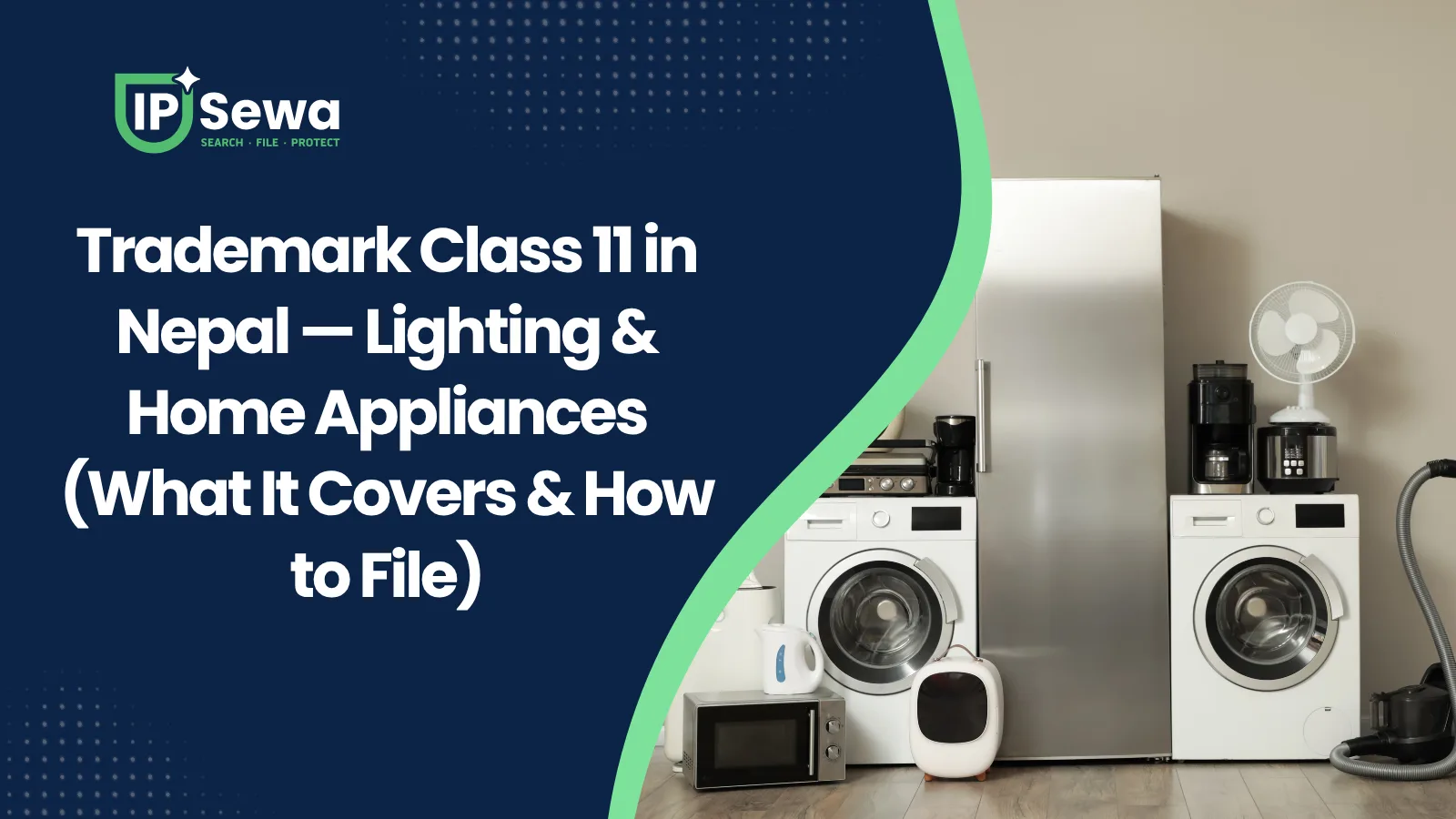
Trademark Class 11 Nepal covers lighting, heating, cooling, cooking, water-supply and sanitary appliances. You file one Class 11 application with the Department of Industry (DoI) under the Patent, Design and Trademark Act 1965 (PDTA); an unopposed application typically takes about 12–14 months to reach registration.
Key Takeaways
Class 11 protects physical appliances and installations, not appliance retailing or repair services. The DoI applies the NICE Classification system of 45 classes, and Sec. 18A requires a separate application for each class. A registered Class 11 mark lasts seven years from registration and can be renewed.
- Class 11 is a goods class for lighting, heating, cooling, cooking, drying, ventilation, water and sanitary apparatus.
- LED lamps, fans, air conditioners, water heaters, gas stoves, water filters, taps and toilets commonly fall in Class 11.
- A trademark filing in Nepal protects the selected class only; one application does not cover Classes 7, 9, 21, 35 or 37.
- Nepal follows first-to-file rules, so search and file before a distributor, competitor or copycat applies first.
- The DoI examines the mark, publishes accepted applications in the Industrial Property Bulletin, then allows 90 days for opposition.
- Use a clear goods list that matches what you make, import or plan to sell under the brand.
What does Trademark Class 11 cover in Nepal?
NICE Class 11 covers apparatus and installations for lighting, heating, cooling, steam generating, cooking, drying, ventilating, water supply and sanitary purposes. The DoI uses this international classification for Nepal filings under Sec. 18A. It is a goods class, so it protects branded products rather than the shop or installation service.
The broad heading matters, but your actual goods wording matters more in practice. A Class 11 specification should identify the products you will sell under the mark. “Lighting apparatus” may suit a general LED importer, while a company selling only solar water heaters should state that product clearly.
Typical Class 11 goods include electric lamps, LED light bulbs, chandeliers, lighting fixtures, ceiling fans, air-conditioning apparatus, refrigerators, freezers, water heaters, solar water heaters, electric kettles, gas stoves, cookers, ovens, kitchen extractor hoods, water filters, taps, showers, sinks, toilets and sanitary installations.
“TM” can be used as a brand indicator, but do not describe your mark as registered or use ® until the DoI has issued the registration certificate. Registration is what gives the owner statutory title under Sec. 16 of the PDTA.
Which NICE classes go with appliances and lighting products?
Class 11 applies where the item’s main purpose is lighting, heating, cooling, cooking, water supply or sanitation. The NICE Classification has 45 classes, but Nepal requires one application per class under Sec. 18A. Related appliances often need another class for machinery, electrical controls, retailing or installation services.
| Business activity or product | Likely class | Why it differs |
|---|---|---|
| LED bulbs, lamps, fans, water heaters and cookers | Class 11 | These are utility, environmental-control or lighting appliances. |
| Generators, pumps and machine motors | Class 7 | These are machines or machine parts, even if used with an appliance system. |
| Switches, wiring controls and smart electrical controllers | Class 9 | Electrical control and measuring equipment generally belongs outside Class 11. |
| Non-electric pots, pans and household utensils | Class 21 | Household utensils are different from electric cooking apparatus. |
| Appliance retail shop, wholesaling or online sales service | Class 35 | Retail and business services need their own service-class filing. |
| Installation, repair or maintenance of air conditioners | Class 37 | Installation and repair are services, not the appliance goods themselves. |
A common mistake we see is filing Class 11 for an appliance showroom and assuming the shop name is fully covered. Class 11 protects the goods; Class 35 may be needed for retail services. Use the NICE class finder and review the guide to choosing a trademark class in Nepal before settling on your list.
Who should file a Class 11 appliances trademark?
Manufacturers, importers, distributors and private-label sellers should file Class 11 if they put a wordmark or logo on covered goods in Nepal. The DoI recognises applications from firms, companies and individuals under the PDTA. Foreign applicants must file directly through a Nepal-based agent because Nepal is not part of the Madrid System.
This applies to a Kathmandu lighting importer, a Nepali maker of improved cookers, a sanitaryware distributor, or a foreign air-conditioner brand entering Nepal. A business-name registration at the Office of the Company Registrar (OCR) is not a replacement for trademark registration. The OCR records a company identity; the DoI registers the trade mark for specified goods or services.
If you import an established foreign brand, check ownership and authority before filing. Nepal is first-to-file: the first valid local application normally has the stronger position. A Paris Convention priority claim may be available in suitable cases, but it does not remove the need for a direct Nepal filing.
How do you register a Class 11 trademark in Nepal?
You register a Class 11 mark by filing with the DoI, passing examination, publication and the 90-day opposition period, then obtaining a certificate. This order follows the PDTA trademark process, including Sec. 17 filing and Sec. 21A publication. Smooth cases can finish in 6–8 months, but 12–14 months is the normal planning range.
- Search the proposed mark. Check exact words, close spellings, sound-alikes and similar product names already used for Class 11 goods.
- Set the goods specification. List the actual lighting or appliance goods, then identify any extra NICE classes needed for related products or services.
- Prepare and file the application. Submit the prescribed application, mark label and supporting records to the DoI for one class.
- Address examination issues. The DoI reviews conflicts and registrability. If it raises a concern, respond with a focused explanation and documents.
- Wait for Bulletin publication. Accepted marks appear in the Industrial Property Bulletin, where another party can oppose within 90 days.
- Complete registration. If no opposition succeeds, complete the registration stage and obtain the DoI registration certificate.
Start with the public Nepal trademark database search, but do not rely only on exact matches. Similar-looking logos, phonetic similarities and related goods can create problems. For a written clearance view before filing, our team can help through trademark search and clearance support.
What documents are needed for a Class 11 filing?
A Class 11 application needs the prescribed form, a clear label of the wordmark or logo, and applicant records for the DoI file. Domestic companies generally provide a notarised power of attorney, board resolution, industry certificate and current tax-clearance record. Foreign applicants also need notarised corporate and home-registration documents where applicable.
A power of attorney authorises the Nepal-based representative to act before the DoI. Priority documents are relevant only if you claim an earlier filing under the Paris Convention. Where a priority claim is made, provide the certified or notarised filing receipt or application in English. Keep the brand spelling identical across labels, resolutions and supporting documents.
For a logo filing, submit a clean, final version. Do not upload a draft packaging image that changes next month. If both the name and logo matter, consider whether separate wordmark registration and logo/wordmark registration will give clearer protection.
What affects the timeline and cost of Class 11 registration?
Class 11 registration normally takes about 12–14 months when unopposed, although a very straightforward DoI file can move in 6–8 months. The total cost depends on the number of classes, government charges, professional work, search depth, document preparation and whether examination or opposition issues arise. Each Nepal application covers one NICE class.
A simple application for a distinctive wordmark and focused goods list is usually easier than a broad filing with unclear product descriptions. Adding Class 35 for retailing or another related class creates a separate application and changes the overall cost. For a current estimate, use the trademark fee calculator or ask our team through IP Sewa contact support.
What legal rules and mistakes matter for Class 11 brands?
The PDTA gives trademark title on registration under Sec. 16 and bars registration that damages another mark’s goodwill under Sec. 18. The DoI publishes accepted marks under Sec. 21A and issues the registration certificate after the opposition stage. A Class 11 registration remains valid for seven years and is renewable in further seven-year terms.
Read the official Nepal law resources alongside current DoI practice. The WIPO NICE Classification explains the international class structure, but the DoI decides the Nepal application and its acceptable goods wording.
- Choosing Class 11 for every electrical item: electrical products can belong in Class 7 or Class 9 instead.
- Using descriptive wording as the whole brand: names such as “Best LED” may face distinctiveness concerns and offer weak commercial separation.
- Listing goods you do not plan to sell: an inflated list can complicate filing and does not replace real brand planning.
- Skipping a conflict check: another party may already hold a close registered mark for related Class 11 goods.
- Waiting to file: first use does not defeat an earlier valid Nepal application under the first-to-file system.
- Forgetting renewal: renewal is due within the statutory period; a missed mark can ultimately be cancelled.
How does a Class 11 filing work for a Nepali appliance seller?
Imagine “Himali Glow,” a Pokhara business importing LED lamps, ceiling fans and solar water heaters under one new house brand. It should file Class 11 for those goods with the DoI, after checking similar marks. If it also operates a branded showroom and installation team, Classes 35 and 37 may be appropriate separate filings.
The business should not assume that a company name at the OCR, a Facebook page or a supplier invoice creates the same protection as a registered mark. It should select the final spelling, obtain authority from any overseas owner, and file before launching a large advertising campaign. If a competitor later applies for “Himali Glo” for lamps, the earlier filing record becomes central.
If the product has a distinctive lamp shape or a novel appliance mechanism, trademark registration may not be the only right to consider. Industrial design registration can protect a product’s appearance, while patent protection addresses a qualifying invention. Those rights have different tests, terms and filing documents.
In short
Class 11 is the correct starting point for branded lighting, heating, cooling, cooking, ventilation, water-supply and sanitary goods in Nepal. File directly with the DoI under the PDTA, prepare a precise goods list and plan for the 90-day Bulletin opposition period. Registration gives a renewable seven-year right in the class you selected.
- File Class 11 for the appliance goods themselves.
- Add other NICE classes only where your products or services truly require them.
- Search early, file early and retain the DoI registration certificate after approval.
People also search for
Nepal business owners often compare Class 11 with nearby goods and service classes before filing. The following guides explain the NICE system, class selection and related product categories used by the DoI. They are useful if your appliance brand includes electronics, machinery, household goods or a separate retail service.
- What is the NICE Classification for trademarks?
- How do I choose the right trademark class in Nepal?
- What is the difference between goods and services classes?
- Trademark Class 7 in Nepal: machines and pumps
- Trademark Class 9 in Nepal: electronics and controls
- Trademark Class 10 in Nepal: medical devices
- Trademark Class 6 in Nepal: metals and hardware
Ready to protect an appliance, lighting or sanitaryware brand? Search possible conflicts in the Nepal trademark database, explore trademark registration help, or contact IP Sewa for practical filing advice. This article is general information, not legal advice for a particular dispute or application.







Comments (0)
Leave a comment
Replying to — cancel