
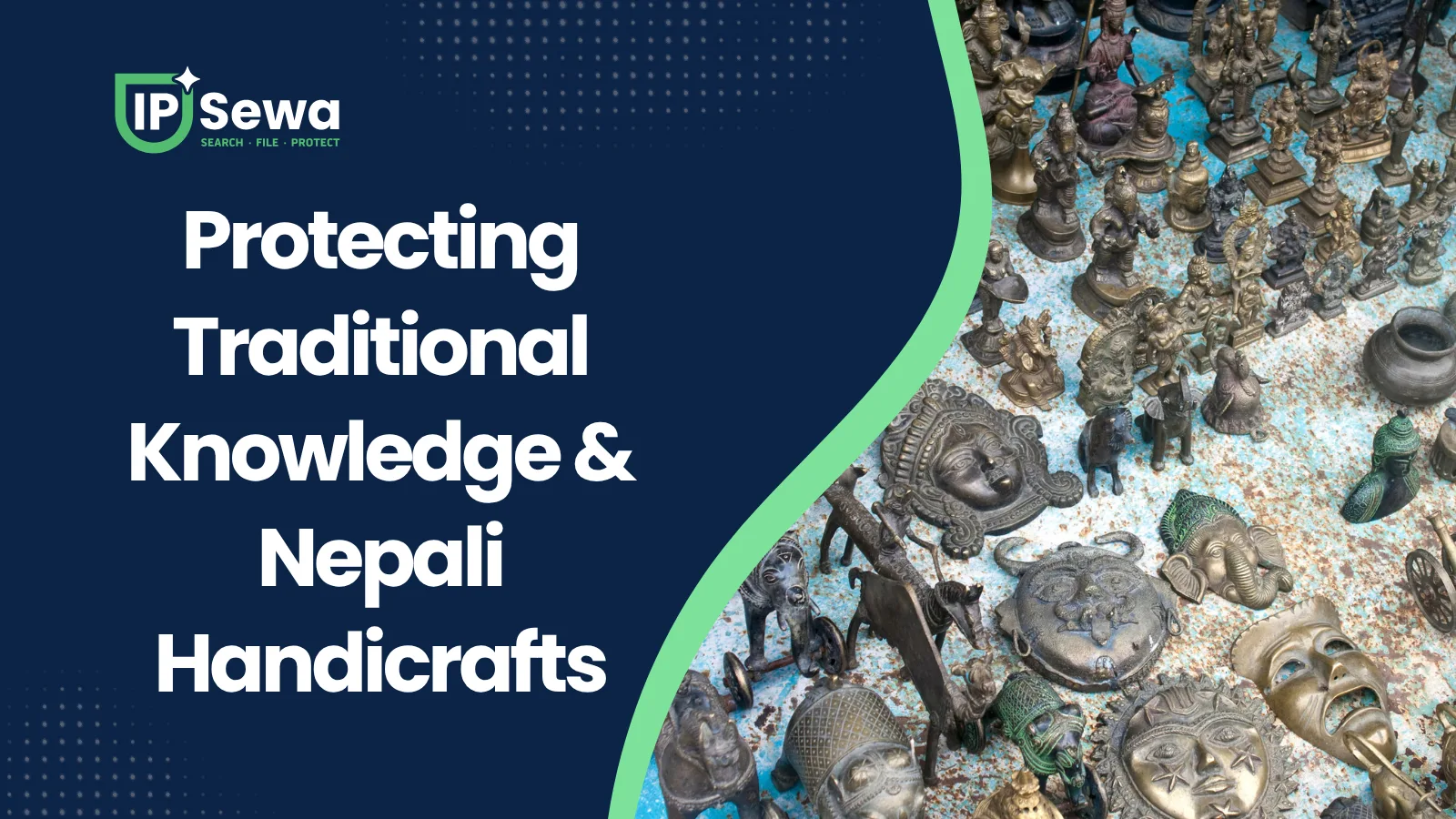
Nepal's 1965 Act protects patents, designs and trade marks, and nothing else. There is no traditional knowledge right and no folklore right here. A craft business can own its name and a genuinely new product appearance, while the technique and the material word stay shared.
Key takeaways
- The Patent, Design and Trade Mark Act 1965 contains no traditional knowledge provision of any kind.
- Sec. 2(c) gives a mark to "any firm, company or individual", which is one owner and not a community.
- Nepal has no collective mark, no certification mark and no geographical indication to file.
- An industrial design protects a new appearance, so an old motif is not available to claim.
- In our index, only four published marks contain the word "Pashmina", and every one adds something distinctive.
- Sec. 18B forbids presenting a mark as registered before it is, and Sec. 19 adds a fine and confiscation.
- What you cannot register, you document, contract for and enforce commercially.
Does Nepal have a traditional knowledge law?
No. The words tell you as much: the statute is the Patent, Design and Trade Mark Act, and those three rights are all it creates.
There is no separate register for a weaving method, a motif, a recipe or a healing practice. Nothing at the Department of Industry accepts an application of that kind.
You can read the Act yourself on the Nepal Law Commission site. It is short, and the absence is obvious once you look.
What does that actually leave a craft business?
Three concrete things, and they are worth more than most makers expect. A registered trade mark on your name and logo, an industrial design on a genuinely new product shape or pattern, and contracts over anything confidential.
Those tools protect your business rather than your heritage. That distinction sounds bleak, but it is the difference between a plan that works and one that never files anything.
The heritage question is a policy question, and it belongs with the state rather than with a workshop in Patan.
Where does the line fall between yours and shared?
Roughly where a buyer stops learning about the craft and starts learning about you. The craft word tells them what the object is; your mark tells them who made it.
"Pashmina", "Dhaka", "thangka" and "khukuri" are the first kind. They describe a material, a weave or an object, and no maker invented them.
A coined house name, a designed emblem, a consistent label layout and an original product silhouette are the second kind. Those are registrable.
What does the register show about craft words?
Exactly that pattern, in the data. The counts below come from our index of marks published in the Industrial Property Bulletin, and they are IP Sewa figures rather than official Department statistics.
Only four published entries contain the word "Pashmina" at all, and every one of them pairs it with something else, in the clothing class. Nobody holds the bare word.
| Craft word | Published entries containing it | Distinct applicants | What that suggests |
|---|---|---|---|
| Pashmina | 4 | 4 | Always paired with a distinctive word. |
| Khukuri or Khukri | 62 | 24 | An object word in many hands at once. |
| Dhaka | 7 | 7 | One applicant per mark, no concentration. |
| Chyangra | 2 | 2 | Far rarer on the register than in the press. |
| Thangka or Thanka | 1 | 1 | The craft word is barely claimed at all. |
Why can nobody own the word "Pashmina"?
Because it tells a buyer what the fabric is, not who wove it. A word doing that job is describing goods rather than distinguishing them.
The four published marks in our index prove the practical answer. Each adds a distinctive element, and it is that element doing the legal work.
Use the craft word truthfully on the label, and put your money behind the part of the name that is actually yours. Our guide to what you are really protecting works through the same choice.
Can a community own a craft name together?
Not as a community, and this is the point most articles about Nepal get wrong. Nepal has no collective mark and no certification mark, and it has no geographical indication either.
Counted over the official English text of the Act, "collective", "geographical", "indication" and "appellation" each appear zero times. "Certification" appears once, in a fee table, where it prices a certified copy of a record.
Sec. 2(c) describes a mark used by "any firm, company or individual". One applicant, not a class of users.
So what does a producer group actually do?
It picks one legal person to own the registration, then permits the others in writing. Sec. 21D lets an owner transfer a mark or give written approval for its use, recorded by a joint application at the Department.
The membership rules, the standard, the inspection and the consequences all live in the group's own agreement, because no Nepali filing publishes them for you.
Our guide to cooperatives and producer groups sets out that structure in full.
Who should hold the registration?
A cooperative, an association or a company, decided before a designer is hired and written into the minutes. Sec. 16(1) provides that a person acquires title to the trade mark of their business by registering it at the Department, so the register decides ownership rather than long use.
Avoid putting it in one member's personal name for convenience. That member can later refuse the others, and the register will back them.
If you are unsure whether your body can hold property in its own name, settle that with your registering authority first, because it decides who may sign the form.
What can an industrial design protect?
The new ornamental appearance of a product: a shape, a pattern, an ornament or a surface treatment. It protects how the object looks, never how it is made.
Novelty matters, so a pattern that has been woven in the valley for two centuries is not available to claim. Your original adaptation of it may be.
The drawings define the claim, so vague drawings buy a vague right. Our design filing team prepares the views the Department expects.
Can a traditional technique be patented?
Almost never. Sec. 5 asks whether the invention is new and whether it is useful to the general public, and a technique already practised in a community fails the first test.
A genuinely new mechanism or process developed in your workshop is a different matter, and it must be filed before it is disclosed publicly.
Take advice before publishing anything you might later want to patent, because a trade fair, a catalogue or a social post can all count as disclosure.
What about sacred or community symbols?
The Act does give the Department grounds to refuse. The proviso to Sec. 18(1) covers marks that hurt the prestige of a person or institution, or that damage public conduct, morality or the national interest.
Those grounds are not a traditional knowledge rule, and nobody should treat them as one. They are discretionary, applied case by case, and they depend on someone raising the issue.
If a community is concerned that a sacred symbol is being filed, take advice quickly, because the objection window after publication is short.
Which classes does a craft range need?
As many as it has kinds of goods, because Sec. 18A(2) requires a separate application for each category. Nepal uses the international NICE classification of 45 classes.
A weaver selling fabric by the metre and finished garments is in two classes, and a shop selling both is arguably in a third.
Draft the list against what you will sell in the next two or three years, not only this season. The class finder gives you a starting list.
How does a craft business file, in order?
- Pick a distinctive name. Coined beats descriptive every time, and "Nepal Handicrafts" is not a brand.
- Search before printing. Run it through our conflict checker against published marks.
- List the goods. One application per category, so count the classes before the cost.
- File at the Department. The prescribed form with the specimens and documents it asks for.
- Answer the examiner. Expect questions where the mark is close to an earlier one.
- Add the design application if the product's appearance is genuinely new, before it is shown.
What documents will be asked for?
The application and the mark label, plus a notarised power of attorney where an agent files for you. A company usually adds its authority documents and current tax paperwork.
A design application needs clear drawings showing the views the Department requires, plus a statement of what is original about the design.
Our deep dive into the documents Nepali applicants need lists them properly.
What happens after you file?
The Department examines the mark, and an accepted mark is published in the Industrial Property Bulletin before registration completes.
Publication opens the door to an objection. Sec. 21A(2) states 35 days, while trade mark practice treats the opposition window as 90 days, so confirm the count for your own filing.
Our register search indexes those published entries, which is also how you spot someone filing close to your own name.
How long do the rights last?
A trade mark runs seven years from registration under Sec. 18D, and the renewal term is another seven years, repeatable without limit under Sec. 23B(3).
An industrial design runs five years and is renewable under the Act's own rules. Keep both diarised, because a workshop that misses a renewal loses the right rather than the paperwork.
There is also a use deadline. Sec. 18C allows the Department to cancel a mark not brought into use within one year of registration, after inquiry.
What about the TM and R symbols?
Be careful here, because the usual advice is imported and wrong. The Act does not recognise TM as a notice at all, and the registered symbol appears in it nowhere.
Sec. 18B prohibits presenting a mark as registered when it is not, and Sec. 19 backs that with a fine and confiscation of the goods involved.
So do not put a registered symbol on a shawl label while the application is pending. Wait for the registration.
Where does the international policy debate sit?
Outside this Act, and outside anything a workshop can file. WIPO runs an intergovernmental committee on intellectual property, genetic resources, traditional knowledge and folklore, and that is where the treaty discussion happens.
Access to genetic resources and benefit sharing are handled through a separate environmental framework, including the Nagoya Protocol under the Convention on Biological Diversity.
What each of those means for Nepal is a question for the responsible ministries and for WIPO itself, not something we will summarise here. Our companion guide to folklore and genetic resources covers the documentation side.
Common mistakes
- Trying to register the craft word alone. It describes the goods, so it does weak work as a badge.
- Waiting for a traditional knowledge law instead of filing the brand you can file today.
- Claiming an inherited motif as a new design. Novelty is the whole test.
- Asking the Department for a collective or certification mark form. There is not one.
- Filing one application for a whole product range when each category needs its own.
- Putting the registered symbol on packaging early, which Sec. 18B prohibits outright.
- Publishing a technique you may later want to patent, before taking advice.
A worked example
This is an illustration, not a real case. A collective in Pokhara hand-finishes shawls and wants to protect what it has built.
It registers a coined house name in the clothing class in the collective's own name, uses "pashmina" as an honest description on the label, and files a design on its original woven border.
Each weaver then goes on record as an approved user by joint application, so the collective can prove who was entitled to the name in any given season.
In short
Nepal gives a craft business three real rights and no traditional knowledge right at all, so build the plan around the three that exist.
Register the distinctive name, file the genuinely new design, describe the shared word honestly, and put the rest in a written agreement.
Search what is already published on our trade mark database, then let our filing team take the application from there.
People also search for
- Protecting a pashmina or handicraft brand
- Trade marks for handicraft exporters
- Regional products and the trade mark route
- The neem, turmeric and basmati cases
- IP protection for export businesses
- The most iconic Nepali brand marks
If your workshop or collective wants the name, the design and the members' agreement handled together, tell us what you make and who makes it.













Comments (0)
Leave a comment
Replying to — cancel