
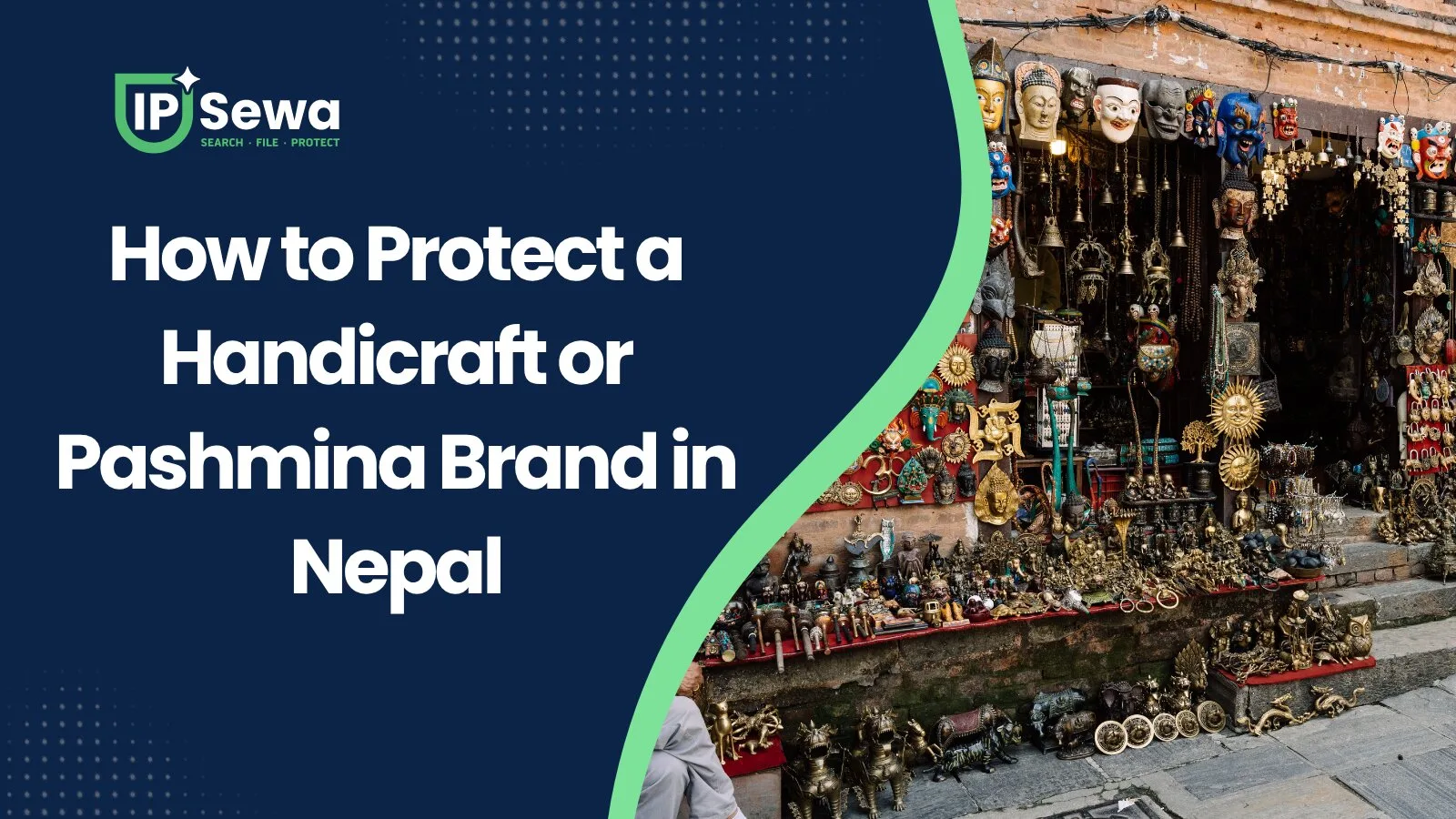
Protect a handicraft or pashmina brand in Nepal by filing trademarks at the Department of Industry under the Patent, Design and Trademark Act 1965, then adding design, copyright or shared-origin protection. Nepal is first-to-file. A typical unopposed trademark takes about 12–14 months from application to certificate.
Key Takeaways
- A registered trademark protects your artisan brand name, wordmark, logo and trade mark in Nepal.
- Nepal uses the NICE Classification, with one application covering one class.
- Pashmina businesses commonly consider Classes 24, 25 and 35, while craft products may need Classes 20, 21, 27 or others.
- Industrial design registration can protect a new ornamental pattern, weave, shape or product appearance.
- Copyright may protect original artwork, illustrations, photographs and catalogue material separately from the product mark.
- A collective or certification mark can help a producer group control a shared quality or origin sign.
- Nepal is outside the Madrid System, so export protection requires national filings in each target market.
What does handicraft brand protection in Nepal cover?
Handicraft brand protection in Nepal covers the signs, products and creative material that distinguish your work. A trademark identifies the business behind goods or services. An industrial design protects a product’s visible appearance. Copyright protects original creative expression. A collective or certification mark can control a shared producer-group name or quality sign.
Your customers may buy a pashmina for warmth, but they also pay for trust, workmanship and origin. Those commercial signals can be copied in different ways. Someone may use a similar name, reproduce your motif, sell an inferior item under your logo, or misuse a group quality label. One filing cannot answer every problem.
Why should an artisan file before selling or exporting?
File early because Nepal follows a first-to-file system, under which the earliest valid application generally receives priority. The Department of Industry does not award trademark ownership simply because you used a name first. Public sales, social-media use and export invoices may show reputation, but they do not replace a registration.
A common mistake we see is waiting until an overseas buyer asks for proof of ownership. By then, another party may have applied for the name in Nepal or an export market. Before investing in labels, packaging, showroom signs or international promotion, search existing marks and decide which version of your brand deserves filing.
Use IP Sewa’s Nepal trademark database search for an initial check. It can help you spot similar word marks and applicants, but a search is not a guarantee of registration. A professional clearance review should consider spelling, sound, meaning, logo elements and the goods or services involved.
Who should file an artisan brand trademark?
The owner of the brand should file the application. That may be an individual artisan, partnership, company, cooperative or association, depending on who controls the mark. The applicant’s legal name should match the ownership records. If several makers share one sign, consider whether a collective or certification mark is more suitable than one person’s individual trademark.
An individual trademark belongs to one business and normally identifies its own goods. A collective mark is owned by an association and used by qualifying members. A certification mark is controlled by a body that sets and checks a standard. The rules, membership conditions and quality controls should be clear before a group files.
Do not register a cooperative’s shared name in the personal name of one founder merely because that person handles paperwork. Ownership disputes are harder to fix after registration. Record who owns the mark, who may use it, what products qualify and who can take action against misuse.
Which NICE classes apply to pashmina and handicrafts?
Choose NICE classes by the goods and services you sell, because Nepal requires a separate application for each class. Class 24 may cover textile fabrics, Class 25 clothing and shawls, Class 27 carpets and mats, Classes 20 and 21 certain craft goods, and Class 35 retail services. Confirm the exact specification before filing.
| NICE class | Possible craft use | Practical filing question |
|---|---|---|
| 24 | Textile fabrics, woven material and cloth sold by length | Do you sell fabric separately from finished clothing? |
| 25 | Wearable pashmina goods, shawls, scarves, stoles and clothing | Are customers buying the item to wear? |
| 27 | Carpets, rugs, mats and some floor or wall coverings | Is the craft item used as a covering or furnishing surface? |
| 20 | Wooden, wicker and certain non-metal craft articles | Is the finished product mainly a wooden or non-metal article? |
| 21 | Ceramics, pottery and some household craft articles | Is the product a household vessel, utensil or similar object? |
| 35 | Retail, wholesale and shop services | Do you want protection for the selling service itself? |
This list is a starting map, not a final legal specification. A pashmina exporter may need Class 25 for finished shawls and Class 24 for fabric. A carpet maker may focus on Class 27. A showroom selling many makers’ goods may also consider Class 35. Several applications may be needed for one brand.
IP Sewa’s NICE class finder can help organise a product list. Write goods precisely. “Handicrafts” alone may be too broad to guide a useful filing. Include the items that matter commercially, without claiming products you do not sell.
How do you register a pashmina trademark in Nepal?
Register a pashmina trademark by filing with the Department of Industry, completing examination, surviving Bulletin publication and the 90-day opposition period, then obtaining the certificate. The Patent, Design and Trademark Act 1965 governs the core process. Each class requires its own application, so class planning comes before paperwork.
- Define the mark. Decide whether you need a wordmark, logo, label, or both. Keep the owner name consistent with your business records.
- Search for conflicts. Check similar names and marks in the relevant goods or services classes. Search before printing packaging or signing export contracts.
- Choose the NICE class. Separate goods from retail services. If the same mark covers different classes, prepare separate applications.
- Prepare and file. Submit the prescribed application, mark label or specimens, authorisation documents and supporting business papers to the DoI.
- Answer examination issues. The DoI may raise similarity, distinctiveness or other concerns. Respond with evidence and reasoned submissions within the required process.
- Wait through publication. A qualified mark is published in the Industrial Property Bulletin. Third parties may oppose it within 90 days of publication.
- Complete registration. If there is no successful opposition, complete the registration stage and receive the registration certificate.
The DoI also functions as a quasi-judicial authority for industrial-property disputes. An opposition is not an automated alert or a casual complaint; it can require evidence, written arguments and hearings. If your application is opposed, get advice promptly rather than abandoning a valuable artisan brand.
What documents does a craft business need?
A domestic applicant normally prepares the application form, trademark label, notarised Power of Attorney, company board resolution, industry certificate and latest tax-clearance letter. The exact documents depend on the applicant’s legal form and filing circumstances. A foreign applicant needs a Nepal-based representative and additional certified home-registration or priority documents.
Keep the mark label clear and consistent. If the logo changes later, the new version may need separate advice rather than being treated as the old registration. For a cooperative or certification mark, prepare the membership, use and quality rules that explain who may use the sign.
How long does handicraft trademark registration take?
Trademark registration in Nepal typically takes about 12–14 months end to end when unopposed. A straightforward matter may finish in roughly 6–8 months only in a favourable, smooth case. Examination questions, corrections, publication timing, opposition, hearings and delayed decisions can extend the process.
Use the waiting period well. Preserve invoices, production records, supplier details, design files, export correspondence and photographs showing genuine use. These records can support ownership, respond to challenges and help distinguish authentic goods from imitations.
What does craft brand protection cost?
Cost depends on the number of NICE classes, government filing and registration charges, professional work, document certification, translations, searches, responses and opposition. Each additional class normally creates another government application and related work. Foreign applicants may face extra filing requirements. Use the current IP tools or contact the team for a case-specific figure.
Do not choose one class simply because it appears cheaper. Under-filing can leave the product line that matters most unprotected. At the same time, filing every possible class without a business reason wastes resources and may create unnecessary use obligations. Build the list around current products and realistic expansion plans.
What do the Nepal IP laws protect?
The Patent, Design and Trademark Act 1965 is the main statute for trademarks and industrial designs. Sections 16–18 address trademark rights and registration, Sec. 18A addresses class-based applications, Sec. 21A concerns publication and opposition, and Sec. 23B provides the renewable seven-year trademark term. Copyright is governed separately by the Copyright Act 2059.
The Act does not turn a generic product word into private property. “Pashmina” may describe material or product characteristics. Your protectable asset is usually the distinctive brand, logo, label or controlled shared sign used with those goods. Review the authoritative Nepal legislation resources and current DoI practice before relying on a legal conclusion.
Can a design or motif receive separate protection?
An industrial design may protect the new and original visual appearance of a craft product, including an ornamental pattern, weave arrangement or three-dimensional shape. The DoI registers industrial designs. Registration lasts five years and is renewable. Copyright may separately protect an original drawing, thangka, motif artwork, photograph or catalogue text.
Design and copyright are not interchangeable. Design registration targets the applied appearance of a product. Copyright protects original creative expression. A traditional motif already widely known may not provide the same design claim as a genuinely new arrangement. Keep dated sketches, creator agreements and first-use records before public disclosure.
For product packaging and visual form, see guidance on protecting product packaging design in Nepal. IP Sewa’s industrial-design team can help prepare representations and file the design application, but the drawings must accurately show what you want protected.
Does Nepal have a geographical indication for pashmina?
Nepal does not currently have a dedicated geographical-indication registration system in force. A geographical indication links goods to a place and qualities associated with that place. For now, producer groups can explore collective or certification marks, standards, contracts and enforcement to control an origin or quality message.
That route needs careful governance. A group should define eligible producers, testing or inspection rules, permitted labels, record keeping and sanctions for misuse. Do not describe a private certification mark as a government GI. For wider context, read about geographical indications and Nepali products.
How should a Nepal craft brand prepare for export?
Export protection is national, not automatic. Nepal is not a member of the Madrid System, so a Nepal trademark does not create worldwide rights. File directly in each important destination under that country’s law. Nepal’s Paris Convention membership may allow a priority claim when foreign filings are made within the applicable six-month period.
Coordinate the Nepal filing with export plans. Check the buyer’s market, distributor ownership, transliterations, local-language versions, domain use and the mark shown on invoices. A foreign company entering Nepal must file directly through a Nepal-based agent or representative because Nepal is outside the Madrid System.
IP Sewa can help plan a Nepal filing and advise on the local record, but foreign applications require separate national counsel or agents in each destination. Do not assume a marketplace listing, company registration or domain name gives trademark ownership.
What mistakes weaken an artisan brand?
Common mistakes include filing after launch, choosing the wrong owner, ignoring similar marks, selecting only one class, treating a generic word as exclusive, and changing the logo after filing. Businesses also confuse company-name registration with trademark registration. The Office of the Company Registrar records a company; the DoI registers the mark identifying goods or services.
- Search before printing labels or accepting a large export order.
- File the exact name and logo versions used in commerce.
- List goods precisely instead of relying on “all handicrafts.”
- Keep evidence of creation, authorship, manufacture and sales.
- Track the 90-day Bulletin opposition period after publication.
- Use a registered mark correctly; do not claim registration before the certificate issues.
- Renew the trademark every seven years and keep ownership records updated.
What is a realistic Nepal craft-brand example?
Imagine “Himal Loom House,” a Kathmandu artisan business selling handwoven pashmina shawls, fabric and a small showroom. It might assess Class 25 for finished wearable goods, Class 24 for fabric and Class 35 for retail services. It could file its wordmark and logo, keep motif artwork records and consider design registration for a genuinely new pattern.
If several independent weavers use a common quality label, the group could examine a collective or certification mark instead. Each maker would still need its own individual brand strategy. If the business later exports, it should review national filings and Paris priority with advisers before the six-month window closes.
What alternatives apply in difficult cases?
If the preferred name is too similar, change it before filing rather than building a costly launch around it. If the name is descriptive, strengthen it with a distinctive house mark and a memorable logo. If a former employee or supplier owns the filing, review assignment and evidence. If a copycat appears, consider opposition within 90 days or enforcement against infringement.
There is no substitute for a trademark where the core asset is a name or logo. Copyright, design, contracts, packaging evidence and passing-off arguments may support the wider case, but each has a different scope. IP Sewa’s opposition and enforcement team can assess the record and next step.
In short, what should a craft exporter do first?
Start with a clearance search, then map every product to the correct NICE class and identify the true owner. File the brand before public expansion, preserve design and artwork evidence, and plan export filings separately. A pashmina trademark protects your commercial identity; shared marks, designs and copyright protect other parts of the craft business.
- Search the Nepal record.
- Choose the applicant and classes.
- File the wordmark and logo at the DoI.
- Consider a design, copyright or shared mark.
- Keep evidence and watch the Bulletin process.
- Renew and defend the registered mark.
People also search for
- How to register a brand in Nepal
- IP protection for Nepali export businesses
- How to protect a clothing and fashion brand in Nepal
- How to protect a business name in Nepal
- Brand protection checklist for new businesses
- How to protect intellectual property in Nepal
This article gives general information, not legal advice. Search your proposed name, review the relevant NICE classes, and speak with our team through IP Sewa’s contact page for a tailored filing plan. You can also review our trademark registration service before preparing your handicraft or pashmina application.











Comments (0)
Leave a comment
Replying to — cancel