
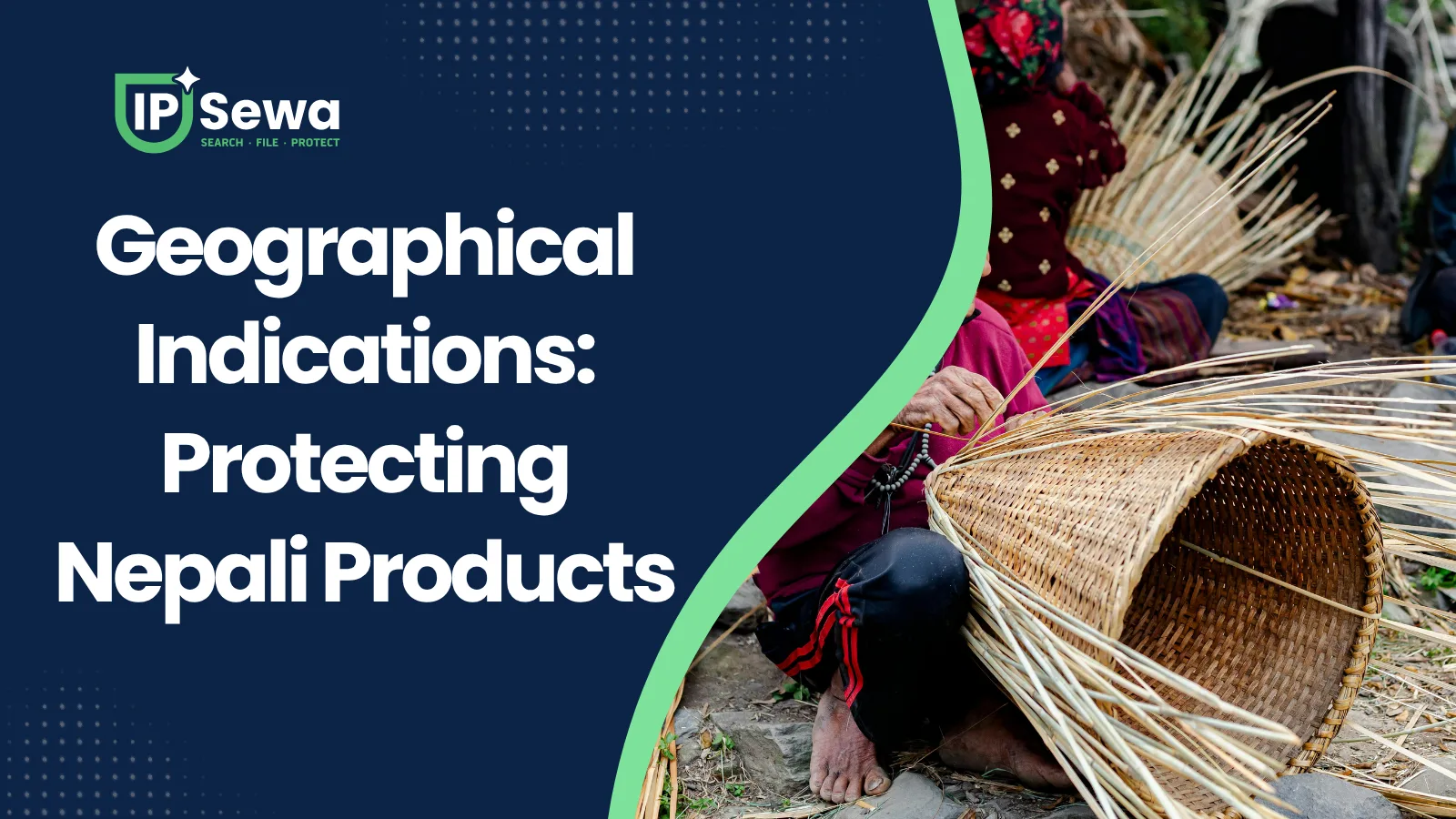
Nepal has no GI register, so a Nepali product cannot be protected at home as a geographical indication today, as of our last check. Producer groups protect origin-linked products with four tools that do exist: a group trademark, written rules on who may use it, watching the Industrial Property Bulletin, and a passing-off claim.
Key takeaways
- A geographical indication (GI) links a product’s quality or reputation to its place of origin. Nepal has no law or register for GIs yet.
- A cooperative or association can register its own name or logo as an ordinary trademark at the Department of Industry (DoI).
- It can let members use that mark by written permission, which the DoI can record.
- Copycat marks appear in the Industrial Property Bulletin. Anyone may oppose a trademark within 90 days of publication.
- Passing off protects goodwill against misleading copies, but needs evidence and a hearing.
- Nothing filed in Nepal protects goods abroad. Export markets need their own filings.
Can a Nepali product be registered as a GI today?
No. Nepal’s Patent, Design and Trade Mark Act 1965 covers patents, designs and trademarks. WIPO’s list of Nepal’s IP laws shows no separate law on geographical indications, and the Act has no category for collective or certification marks either.
So a producer group has no GI application to make. What it can do is build protection from the rights that exist, and keep good records so it is ready if a GI law arrives.
Which tools can a producer group use now?
Four tools cover most of what a group needs. None of them gives the group control of the place name itself, but together they protect the group’s own brand and its reputation.
| Tool | What it protects | What it does not do | Where it happens |
|---|---|---|---|
| Group trademark | The group’s own name or logo, in the classes filed | Give control of the place name | Department of Industry |
| Written permission | Who may use the group’s mark, on what terms | Bind people who are not members | Agreement, recorded with the DoI |
| Bulletin opposition | Stops a confusing new mark before registration | Remove a mark already registered | DoI, within 90 days of publication |
| Passing off | Goodwill against misleading copies | Work without evidence of reputation | DoI hearing, then appeal |
A fifth tool helps some products. If the group’s packaging or product has a distinctive shape, an industrial design registration can protect how it looks for five years, renewable. It does not protect the name.
Why should a group collect evidence before designing a logo?
Because every tool depends on proof. A trademark needs a clear owner and a clear list of goods. Passing off needs proof that buyers know the product. A future GI law, if one comes, would almost certainly ask what makes the product special and where it comes from.
Evidence is cheapest to collect now, while memories are fresh and records exist. Keep originals, note dates and store everything in one place.
Who should own the group’s mark?
Trademark rights in Nepal come from registration (Sec. 16), so ownership matters from day one. The owner should be a registered body that can act for its members, such as a cooperative, an association or a company the members own. One trader should not own the shared sign, because the others then depend on that trader’s goodwill.
For a domestic applicant, the DoI filing usually needs the application form, the label, a notarised power of attorney if an agent files, a board or committee resolution, the industry registration certificate and a recent tax clearance letter. Check the current list with the DoI or your agent.
Members keep their own brands too. A tea garden, a weaving workshop or a paper maker can register its own name beside the group’s mark.
How does a producer group build its protection plan?
- Agree the product and the area. Write down what the product is, where it is made and what makes it different.
- Set up the owner. Register the cooperative or association, and pass a resolution to file the mark.
- Choose a distinctive name and logo. A bare place name is weak and may be refused under Sec. 18. Pair the place with a group name.
- Search the register. Check similar names and logos with our trademark search, which covers marks published in DoI bulletins, and the conflict checker.
- File class by class. Nepal needs one application per NICE class (Sec. 18A), such as Class 30 for tea or Class 24 for fabric. The NICE class finder helps you pick.
- Write the use rules and permissions. Say who may use the mark, the standard they must meet and how misuse is handled. Put permissions in writing under Sec. 21D.
- Watch, renew and enforce. Check new bulletins, renew the mark every seven years (Sec. 23B) and act on copies.
An unopposed trademark usually takes about 12–14 months, and 6–8 months only in the smoothest cases. Our trademark registration service files and tracks the group’s mark.
How do you stop a copycat mark in the bulletin?
New trademarks are published in the Industrial Property Bulletin before registration (Sec. 21A). Anyone may oppose a trademark within 90 days of publication, and the DoI holds a hearing on the objection. Missing that window makes a copy much harder to remove.
Place names are already on the register as private brands. Our archive of 71,500+ published marks includes a brewery’s JUMLA EDITION beers in Class 32, and Dhaka cloth marks such as MENCHHYAM DHAKA in Class 25. Each belongs to one applicant; the goods and services search finds others by what they cover. A group that wants to object to a new filing needs to see it in time, so check each new bulletin, or ask our opposition and enforcement team to act on one you have found.
What is passing off, and when does it help?
Passing off is misrepresenting your goods as someone else’s. Nepali practice looks for four things: goodwill, a misrepresentation, a likelihood of confusion, and actual or likely damage. It protects reputation even where the exact sign is not registered.
It is slower than relying on a registration. The DoI hears the matter first, and its decision can be appealed to the High Court within 35 days. A group with dated sales records, press coverage and old labels stands a far better chance than one relying on reputation alone. Whether it fits your facts is a question to ask a lawyer.
Which Nepali products are linked to places?
Many. Tea from Ilam, Dhaka cloth from Palpa and Terhathum, lokta paper, Mustang apples, Jumla produce and large cardamom are often mentioned. These are examples of place-linked products, not registered GIs.
The same product can need different tools. Tea and cardamom are goods sold in packs, so a group trademark and passing off fit well. Dhaka cloth is known by its patterns; whether a pattern can be registered as a design is a question for your agent, because the Act defines a design as a product’s form or shape. Lokta paper is often sold under exporters’ own brands, so the brand owner matters most.
Do Nepali filings protect products sold abroad?
No. Rights are national. Nepal is not part of the Madrid System, so a brand sold abroad needs a filing in each market. The Paris Convention gives trademark owners six months from a first filing to file in other member countries while keeping the first date.
Some export markets run GI registers of their own. Whether a Nepali group can use one depends on that country’s law, so ask a lawyer there before you print claims on export packs. Our guide to IP protection for exporters covers the wider picture.
Is a GI law on the way?
Possibly. Press reports in 2025 and 2026 describe a draft Industrial Property Bill from the Ministry of Industry, Commerce and Supplies that would add geographical indications. We could not confirm the text or its status on an official site, and a draft is not law. Watch the Department of Industry for any new procedure. The evidence a group collects now would help under any future GI law.
Common mistakes producer groups make
- Waiting for a GI law. Nepal is first-to-file for trademarks; someone else may file the name first.
- Letting one trader own the shared sign. The group loses control if that trader leaves.
- Using the place name alone. It is weak and may be refused.
- No written permissions. Verbal approval is hard to prove or withdraw.
- Missing the bulletin. The 90-day opposition window closes quickly.
- Calling the mark a “GI”. Describe it as what it is: a registered trademark.
What does this look like for a weavers’ cooperative?
Here is an illustration, not a real case. A cooperative of Dhaka weavers in the hills finds lookalike cloth sold in Kathmandu as “hill Dhaka”. It asks about a GI and learns there is no GI register.
Instead, it registers its cooperative name and logo in Class 24 and Class 25, writes simple rules on thread, looms and labels, and gives each member written permission to use the logo. It keeps sales records and photos of its patterns. When a trader copies the logo, the cooperative relies on its registration. When a trader only uses the word Dhaka, it has evidence ready for a lawyer.
In short
Nepal has no GI register today, as far as we can find, so producer groups work with what exists: a group trademark, written use rules, bulletin opposition and passing off. Collect evidence now, file early, and plan export filings market by market.
People also search for
- Are Ilam tea and pashmina protected as GIs?
- What is the difference between a GI and a trademark?
- How do you fight counterfeit products in Nepal?
- Can you protect product packaging in Nepal?
- What can Champagne and Darjeeling teach Nepal?
Running a cooperative or producer association? Tell us about your product and your members and we will explain what can be protected today. This article is general information, not legal advice.













Comments (0)
Leave a comment
Replying to — cancel