
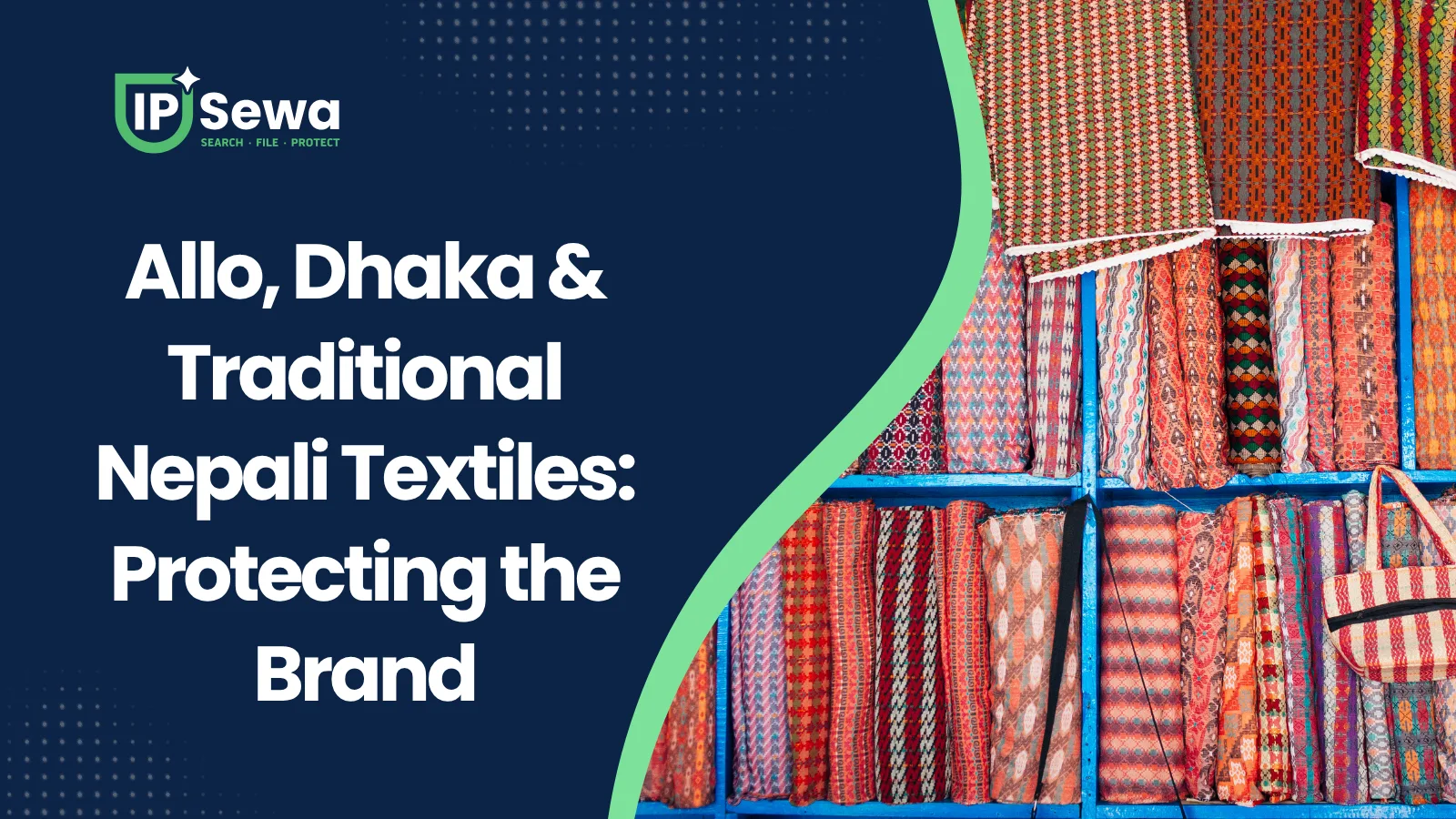
A dhaka textile trademark in Nepal protects the name, logo or label used for your allo, handloom or traditional fabric business. The Department of Industry (DoI) registers marks under the Patent, Design and Trademark Act 1965, and Nepal follows first-to-file rules. An unopposed application usually takes about 12–14 months.
Key Takeaways
The DoI grants trademark registration for seven years under the Patent, Design and Trademark Act 1965. A dhaka, allo or handloom business should search early, choose the correct NICE classes, file before public expansion, and prepare for Bulletin publication and a 90-day opposition period.
- Nepal is first-to-file: the earliest valid application generally has the stronger registration position.
- Dhaka cloth and allo fabric commonly fall in NICE Class 24, finished clothing in Class 25, and retail services in Class 35.
- One trademark application covers only one NICE class, even if the same brand appears on fabric, garments and a shop sign.
- A descriptive name such as “Pure Allo Fabric” is harder to register than a distinctive invented brand name.
- The process is filing, DoI examination, Industrial Property Bulletin publication, 90-day opposition, registration and certificate.
- A registered mark lasts seven years and can be renewed in further seven-year terms.
Why should a traditional Nepali textile brand register a trademark?
Trademark registration gives your business a recorded right in Nepal under Sec. 16 of the Patent, Design and Trademark Act 1965. The DoI can refuse later conflicting marks, hear opposition disputes, and act as a quasi-judicial industrial-property authority. First use alone does not create the same registered right.
A trade mark tells buyers whose goods they are buying. For a weaver, that may be the name on a dhaka topi label, a woven tag on an allo shawl, or a logo printed on packaging. Registration helps distinguish your genuine work from imitations sold under a similar name.
It also matters as the business grows. A registered mark can support supply arrangements, retail partnerships and licensing. You should not use the ® symbol until the mark is registered; before registration, treat TM as a marketing claim rather than proof of a DoI registration.
What can an allo or handloom business protect as a trademark?
The DoI can register a word, symbol, picture, or their combination as a trademark under Sec. 2(c) of the Act. For a traditional Nepali textile brand, this can include a distinctive wordmark, logo, label design or product-line name, provided it distinguishes your goods or services from others.
A wordmark protects the brand name in ordinary text. A logo registration protects the particular visual artwork you file. If both the name and emblem matter, consider filing each separately. That gives broader protection if you later refresh the logo but keep the business name.
Distinctiveness is the practical test. “Handwoven,” “Allo,” “Dhaka Cloth,” or “Natural Textile” tells customers what the goods are. Those words may be difficult to claim alone. A made-up name, or a distinctive combination of words and graphics, is usually easier to defend.
Be careful with place names too. A name that merely describes a location or style may not clearly identify one business source. Build a brand around the textile tradition rather than trying to own the tradition itself.
Which NICE classes apply to dhaka and allo textile brands?
Nepal uses the WIPO NICE Classification, which has 45 classes, and Sec. 18A requires a separate application for each class. Textile makers commonly need Class 24 for fabric, Class 25 for clothing, and Class 35 for retail services. Your list should match what you genuinely sell.
Class choice is not a formality. A Class 25 registration for shawls and jackets does not automatically cover dhaka cloth sold by the metre in Class 24. Likewise, registering goods does not automatically protect retail-store services in Class 35.
Use the free NICE class finder for Nepal trademark filings to test individual goods and services before filing. If your product range is wide, a professional clearance review can help avoid filing too narrowly or paying for classes you do not need.
How do you register a dhaka textile trademark in Nepal?
You register a dhaka textile trademark in Nepal by filing with the DoI, passing examination, appearing in the Industrial Property Bulletin, completing the 90-day opposition period, and obtaining a certificate. The process follows Sec. 17–21A of the Patent, Design and Trademark Act 1965 and requires one filing per class.
- Clear the proposed name and logo. Search for exact and similar marks in Classes 24, 25 and 35 using the public Nepal trademark database search. Search spelling variations, translated terms and similar-sounding names. A logo needs visual comparison as well as word searching.
- Choose the applicant and goods list. Decide whether the owner is an individual weaver, cooperative, partnership or company. Then identify the specific goods or services. Your applicant name should match the person or entity that will own and use the brand.
- File the mark in each required class. Prepare the prescribed application, clear specimens of the mark, applicant details and supporting documents. File a wordmark and logo separately if you need independent protection for each.
- Address DoI examination issues. The examiner checks conflicts and whether the mark is registrable. An objection may arise because a name is descriptive, geographically suggestive, misleading, or too close to an earlier registered mark.
- Wait through publication and opposition. Accepted marks are published in the Industrial Property Bulletin. Another party has 90 days to oppose. If there is an opposition, the DoI examines the dispute before registration can proceed.
- Obtain the certificate and use the mark consistently. Once registration requirements are completed, the DoI issues a registration certificate. Keep the certificate, use the registered version of the mark, and diarise the renewal date.
What documents are needed for handloom trademark registration?
The DoI generally requires the application form, mark label, authority documents and business evidence for a Nepali trademark filing. Under the DoI process, a notarised Power of Attorney is used where an agent files, while company applicants commonly provide a board resolution, industry certificate and current tax clearance.
- A clear label or specimen of the wordmark, logo or combined mark.
- Applicant details and the selected NICE class goods or services.
- A notarised Power of Attorney where a representative files for you.
- Company authority documents where the owner is a company or other organisation.
- Industry registration and tax-clearance evidence where applicable.
- Priority documents in English if you are claiming Paris Convention priority.
Foreign applicants must file directly through a Nepal-based agent or representative because Nepal is not part of the Madrid System. A foreign owner may also need certified home-country registration material. The World Intellectual Property Organization explains the international NICE system, but a foreign registration does not automatically protect Nepal.
How long does trademark registration take for a textile brand?
The DoI process typically takes about 12–14 months from filing to certificate when no opposition is filed. A smooth, straightforward dhaka textile trademark application can finish in roughly 6–8 months, but that is the favourable end of the range. The 90-day Bulletin opposition period is a fixed part of the route.
What affects the cost of protecting a Nepali textile brand?
The total cost depends on the number of NICE classes, the marks filed, and the work needed before the DoI grants registration. Government charges apply per class, while professional work may include clearance searching, drafting, filing, examination responses, and opposition representation. A wordmark and logo usually mean separate filings.
| Cost driver | Why it matters for a textile business |
|---|---|
| Number of classes | Fabric, garments and retail services may require separate Class 24, 25 and 35 filings. |
| Mark format | A name, logo and combined label can each need their own filing strategy. |
| Clearance work | Similarity searches and advice can identify avoidable conflicts before filing. |
| Objection or opposition | Extra written submissions or hearings can add work and delay registration. |
| Foreign documents | Notarisation, certification and translation may be required for overseas applicants. |
For a current class-based estimate, use the trademark fee calculator or ask our team for filing advice. Figures should be checked before filing because your final scope and document position affect the work required.
Which mistakes put traditional textile brand protection at risk?
The most common mistakes are filing too late, choosing a weak descriptive name, and protecting only one part of the business. Under Sec. 18C, a registered trademark that is not used within one year of registration may be cancelled by the DoI. Registration should reflect a real and continuing commercial plan.
- Assuming company registration protects the brand. Registration with the Office of the Company Registrar (OCR) identifies a legal entity. It is not the same as DoI trademark registration.
- Filing only Class 25. This may leave fabric sales in Class 24 or retail services in Class 35 outside the application.
- Using a copied logo. A logo may conflict with an earlier registered mark even where the words differ.
- Changing the label after filing. A major logo or word change may need a fresh application rather than a simple update.
- Missing renewal. The mark lasts seven years. Renewal should be filed within 35 days of expiry, with only a limited late period after that.
How should a dhaka weaver choose a stronger brand name?
A stronger traditional Nepali textile brand uses a distinctive source identifier rather than a direct product description, improving its prospects during DoI examination under Sec. 18. For example, “Kailash Loom” paired with a unique mountain-and-weave logo is usually more distinctive than “Original Dhaka Fabric” alone.
Imagine a Lalitpur workshop selling handwoven dhaka fabric, topis and scarves under “Kailash Loom.” It could consider Class 24 for cloth, Class 25 for finished items, and Class 35 if it operates a retail store. The workshop should clear “Kailash,” related spellings and its logo before printing thousands of labels.
That approach protects the source of the goods without claiming ownership over “dhaka,” “allo,” or Nepal’s shared weaving heritage. If your strength lies in a distinctive fabric surface pattern, consider whether industrial design protection is also relevant; it protects appearance, while a trademark protects the business badge.
What alternatives and edge cases should textile businesses consider?
Trademark registration protects the brand badge, not every creative feature of a textile product. The DoI handles trademarks and industrial designs under the Patent, Design and Trademark Act 1965, while a design registration may suit a new ornamental product appearance. Each industrial-property right has a different purpose and renewal term.
A cooperative may own a shared brand if it is the proper applicant and controls how members use it. A foreign fashion house entering Nepal must file nationally through a Nepal-based representative; Nepal is outside both the Madrid System and the PCT. A Paris Convention priority claim may be available where the requirements are met.
Where another party files a confusing textile mark after your application is published, act within the 90-day opposition period. If a registered mark is copied in the market, the DoI’s enforcement role may be relevant. These points are fact-specific, so this article is general information, not legal advice.
In short: protect a dhaka, allo or handloom name early, search before you print labels, file every class that matches your business, and keep the registration alive through seven-year renewals. A distinctive brand can sit beside Nepal’s textile heritage without trying to monopolise it.
People also search for
These related Nepal IP guides explain brand naming, clothing protection, export planning and practical checks before your textile business files with the DoI. They are useful if your handloom label also sells fashion goods online, works with retailers, or plans to take traditional Nepali fabrics into overseas markets.
- How do I protect a clothing and fashion brand in Nepal?
- How can handicraft and pashmina businesses protect their brands?
- How do I choose a registrable brand name in Nepal?
- How does brand registration work in Nepal?
- What IP protection do Nepali export businesses need?
- Should I secure a domain and social handles with my trademark?
Start by searching your proposed dhaka or allo brand in the Nepal trademark database, then speak with our team through IP Sewa’s contact page about trademark registration support in Nepal.











Comments (0)
Leave a comment
Replying to — cancel