
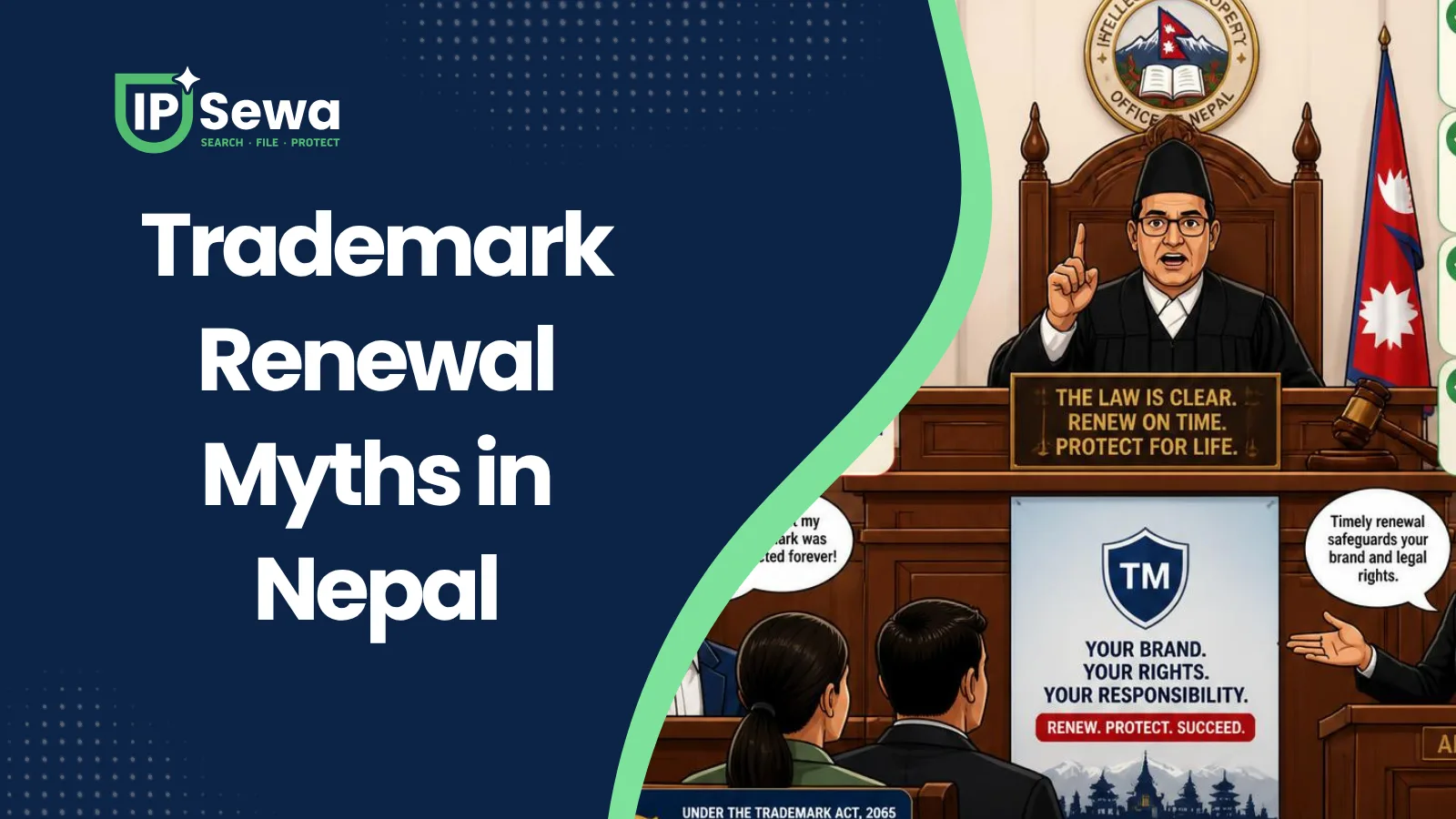
Trademark renewal myths in Nepal often cause owners to lose registered marks. The Department of Industry (DoI) grants a seven-year term under the Patent, Design and Trademark Act 1965, and you must file renewal yourself before expiry or use the permitted late period.
Key Takeaways
Trademark renewal in Nepal keeps an existing registered mark alive for another seven-year term. The DoI does not treat continuous use, business registration, or marketplace reputation as a substitute for a renewal filing under Sec. 23B of the Patent, Design and Trademark Act 1965.
- Nepal's trademark term is 7 years, not 10 years, from the registration date.
- Renewal extends the existing registration; it does not add classes, goods, services, or a new logo.
- You should file during the 35-day renewal period before expiry.
- A further 6-month late period may be available after expiry, subject to the applicable late charge.
- Failure to renew within the permitted period leads to automatic cancellation.
- Nepal is first-to-file, so a fresh application after cancellation can lose priority to another applicant.
- Foreign owners renew directly through a Nepal-based agent because Nepal is not in the Madrid System.
What is the biggest trademark renewal myth in Nepal?
The biggest trademark renewal myth says Nepal registrations last 10 years. They do not. Under Sec. 18D, the Nepal trademark term is seven years from registration, followed by renewable seven-year terms. The Department of Industry applies this national rule whether the mark belongs to a Kathmandu startup or an overseas company.
Ten-year terms are common in many countries, which explains the confusion. They don't change Nepal's rule. Check the registration certificate, not an overseas portfolio calendar, for the relevant date. A registered mark may include a wordmark, logo, symbol, or combination used to distinguish your goods or services.
Does using the mark protect it after expiry?
Continuous use does not replace a renewal application at the DoI. Nepal follows a first-to-file system, while registration creates the statutory trademark right. Use can support your commercial position, but it cannot keep an expired registration alive under Sec. 23B or preserve its priority against a later applicant.
This point matters for a familiar local example. Imagine “Himal Bean,” a Kathmandu café brand registered for café services. The founders keep selling coffee under the name but miss renewal. Their use does not stop cancellation. A competitor could file a similar mark during the gap, creating a serious priority problem.
Nepal law also permits cancellation where a registered mark is not put into use within one year of registration under Sec. 18C. That rule works alongside renewal. Using the mark helps satisfy use-related expectations; it does not remove the separate duty to renew.
Can I renew a trademark whenever I want after expiry?
Late renewal is limited, not open-ended. Owners should file within the 35-day period before expiry. If the term expires, a further six-month late period may be available with the applicable government late charge. After that period, the registration is automatically cancelled, so a normal renewal route is no longer available.
There is a practical reason to act early. A company may change its authorised signatory, lose an old certificate, or discover that its agent's Power of Attorney is outdated. Finding those issues after expiry leaves less time to correct them. Put the renewal date in your own records and review it before the final window.
What happens after a trademark is cancelled?
Cancellation ends the existing registration. You may be able to file a fresh application for the same brand, but that is not restoration of the old right. The new filing receives a new priority position and must pass examination, publication in the Industrial Property Bulletin, and the 90-day opposition period.
A fresh application can also face a changed register. Another business may have filed a similar wordmark, logo, or trade mark during the gap. Because Nepal is first-to-file, the intervening application can create a conflict that did not exist when you first registered.
Before making a new filing decision, check the current record using IP Sewa's Nepal trademark database search. A search is not a guarantee of registration, but it can reveal later applications, similar marks, or changes that deserve professional review.
Does renewal require the original filing bundle?
Renewal normally concerns the existing registration rather than a new application. The DoI still needs the prescribed renewal filing and supporting authority documents. A domestic company should keep its registration details, mark label, company authorisation and current records ready; a foreign owner also needs suitable home-registration evidence and a Nepal-based representative.
Document requirements can vary with ownership, certificate records, signatory changes, and the way the original application was filed. A notarised Power of Attorney is commonly needed for representation, with the required signatures, seal, and witness attestations. Do not assume an old document remains acceptable without checking its wording and date.
The safest approach is to collect the certificate, registration number, owner name, mark representation, class, expiry date, and current contact details first. Our team can review the file and assist with trademark renewal at the DoI through the IP Sewa contact page.
Can renewal add goods, services, classes, or a new logo?
Renewal extends the same registered right; it does not expand its scope. Nepal uses the NICE Classification, with 45 classes: Classes 1–34 cover goods and Classes 35–45 cover services. One Nepal application covers one class, so new classes or materially different goods require separate filing and examination.
For example, a restaurant that registered “Himal Bean” in Class 43 for café services cannot add packaged coffee in Class 30 through renewal. It may need a separate application for the new goods. A changed logo or wordmark may also need its own filing or a carefully assessed amendment, rather than being quietly substituted during renewal.
Use the NICE class finder for Nepal to map your current business activities. Class selection should reflect what you actually sell or provide, not every possible future idea.
| Question | Renewal answer in Nepal | What may need a separate step |
|---|---|---|
| How long is the term? | Seven years, renewable for further seven-year terms. | Nothing, if the registered mark and class stay the same. |
| Can use replace renewal? | No. Continued use does not keep the registration alive. | A fresh filing may be needed after cancellation. |
| Can renewal add a class? | No. One Nepal application covers one NICE class. | File a new application for another class. |
| Can foreign owners use Madrid? | No. Nepal is not a Madrid System member. | Renew directly through a Nepal-based agent. |
| What if the deadline is missed? | A six-month late period may apply after expiry. | After cancellation, a fresh application loses the old priority date. |
How do you renew a trademark with the DoI?
Trademark renewal at the Department of Industry follows a focused administrative process. Confirm the certificate and expiry date, prepare the authority documents, file the renewal, answer any request from the DoI, and retain proof of the updated record. The key difference from registration is that renewal does not reopen the original application process.
- Confirm the record. Check the registration certificate, owner, mark, class, registration date, and expiry date. Check each class separately because Nepal requires one application per class.
- Review the mark and ownership. Decide whether the registered wordmark or logo still matches your brand. If ownership or company details changed, ask whether an endorsement or separate record amendment is needed.
- Prepare documents. Gather the renewal form, registration details, Power of Attorney where an agent acts, and any company or foreign-owner documents the DoI requires.
- File within time. Submit the renewal to the DoI during the 35-day period before expiry. If the date has passed, act promptly within the possible six-month late period.
- Respond and preserve proof. Answer any DoI query, pay the applicable government and professional charges, and retain the receipt or renewed certificate for the next seven-year calendar.
What does trademark renewal cost in Nepal?
Trademark renewal cost depends on the government charge, whether the filing is late, the number of classes, representation, document certification, and any record correction. Nepal's one-class structure matters: renewing two classes means handling two registrations, not one combined national renewal.
Government charges and professional fees are separate. A late filing adds another cost factor, while foreign documents may require certification, translation, or agent handling. Do not rely on an old quote or a foreign country's fee schedule. For a current estimate, use IP Sewa's trademark fee calculator or ask the team for a case-specific figure.
Do foreign trademark owners renew differently in Nepal?
Foreign owners follow the same seven-year term and renewal deadline, but they must deal directly with Nepal's system. Nepal is not part of the Madrid System, so an international registration does not automatically renew or protect the mark here. A Nepal-based agent or representative handles the filing before the DoI.
Keep the Nepali registration separate from a global portfolio calendar. A foreign company's home registration, Madrid record, or overseas renewal does not replace the Nepal filing. The representative may need a notarised Power of Attorney and certified home-registration documents, depending on the record and DoI requirements.
Priority is a separate issue. The Paris Convention can support priority claims for qualifying filings, but it does not turn a Nepal registration into an international registration. For practical foreign-brand guidance, see myths about registering a foreign brand in Nepal.
What are the most common renewal mistakes?
Most failed renewals come from simple record errors rather than difficult legal questions. Owners copy the wrong date, overlook a class, change the logo informally, use an outdated Power of Attorney, or wait until the late period. A renewal checklist should cover the certificate, class, owner, representative, documents, deadline, and proof of filing.
- Counting seven years from the application date instead of the registration date.
- Treating several NICE classes as one renewal because the brand is the same.
- Assuming a company registration or tax filing renews the trademark.
- Waiting for an informal reminder instead of keeping an internal deadline calendar.
- Submitting a changed logo or expanded goods list as though it were the same mark.
- Failing to update the agent after a merger, address change, or ownership transfer.
- Assuming a cancelled registration can be restored without a fresh priority risk.
What legal rules support these TM renewal facts?
The Patent, Design and Trademark Act 1965 supplies the core rules. Sec. 18D sets the seven-year trademark term, while Sec. 23B governs renewal, the late period, and automatic cancellation. Sec. 18A supports class-based filing, and Sec. 21A concerns publication and opposition in the Industrial Property Bulletin.
The Nepal Law Commission's legal materials are useful for checking the statute, while the Department of Industry is the administering authority. Practice can depend on the registration record and current DoI instructions, so this article is general information, not legal advice.
What should a Nepal business do before its renewal date?
Start with a record review, not a last-minute form. Confirm every certificate, class, owner name, mark version, agent and expiry date. Then decide whether you are renewing the existing right or filing separately for a new product, service, logo, or class before another applicant reaches the DoI first.
A useful internal calendar has three points: an early review date, the 35-day renewal window, and a final emergency check before expiry. Keep copies of filing receipts and certificates. If a business has several marks, organise them by registration date rather than by brand launch date.
For a realistic Nepal example, “Himal Bean” may renew its Class 43 café mark but file separately for packaged coffee in Class 30. That is proper portfolio planning. Treating both activities as one renewal is a common mistake.
In short, what are the real trademark renewal rules?
Trademark renewal Nepal owners need to remember is straightforward: the registration term is seven years; renewal is active, not automatic; the 35-day window should be respected; and the six-month late period is limited. Renewal preserves the existing mark, while new classes and changed brands need separate analysis.
- Check the registration date and class on every certificate.
- File the renewal with the DoI before expiry where possible.
- Do not rely on use, company records, or an overseas renewal.
- Act quickly if the mark has already expired.
- Search the register before a fresh application after cancellation.
People also search for
Owners comparing TM renewal facts often have related questions about forms, deadlines, myths and other Nepal IP rights.
- How to renew a trademark in Nepal
- What the Nepal trademark renewal form means
- Trademark myths Nepali businesses believe
- Patent renewal in Nepal
- Industrial design renewal in Nepal
- Myths about foreign brand registration in Nepal
Check your mark's current status with the Nepal trademark database, review renewal timing through the trademark renewal service, and contact IP Sewa for help preparing and filing with the DoI.











Comments (0)
Leave a comment
Replying to — cancel