
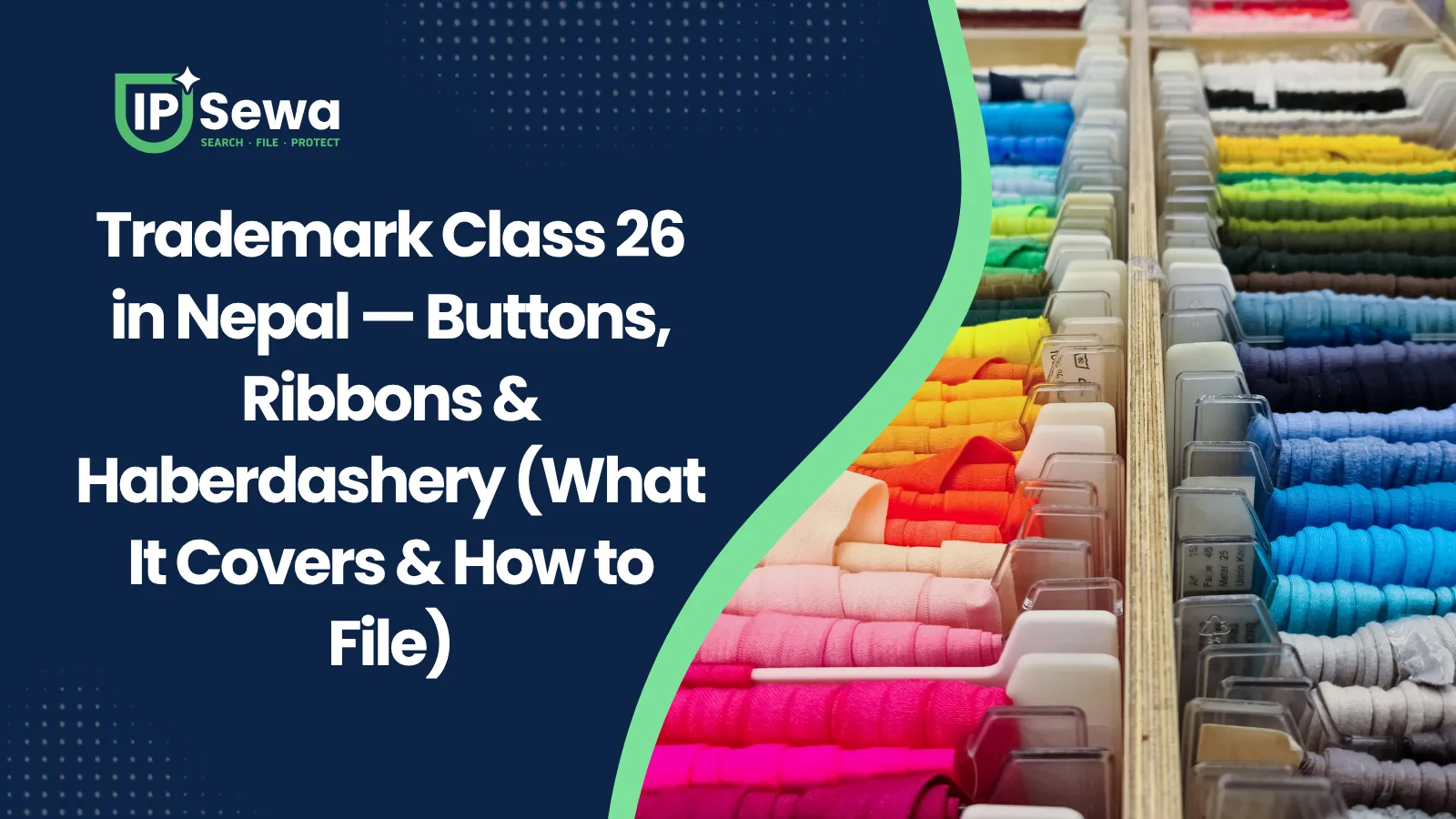
Trademark Class 26 in Nepal covers buttons, zips, ribbons, lace, sewing articles, artificial flowers and hair accessories. You file one Class 26 application with the Department of Industry (DoI) under the Patent, Design and Trademark Act 1965 (PDTA); an unopposed application typically takes about 12–14 months.
Key Takeaways
NICE Class 26 protects dressmaking accessories and adornments sold under your brand in Nepal, while the DoI registers each class separately under Sec. 18A of the PDTA. A Class 26 registration lasts seven years from registration and can be renewed in further seven-year terms.
- Class 26 is the main class for haberdashery: buttons, hooks, zips, ribbons, lace, pins and needles.
- Hair bands, barrettes, wigs, false hair and artificial flowers also fall within NICE Class 26.
- Clothing belongs in Class 25, while yarns and threads for textile use belong in Class 23.
- Nepal follows a first-to-file system, so an early valid application matters more than earlier informal use.
- One Nepal trademark application covers one NICE class only; related goods may require separate filings.
- The DoI examines the mark, publishes it in the Industrial Property Bulletin, allows 90 days for opposition, and then issues a registration certificate if accepted.
What does trademark Class 26 cover in Nepal?
Class 26 covers lace and embroidery, haberdashery ribbons and bows, buttons, hooks and eyes, pins and needles, artificial flowers, hair decorations and false hair. The NICE Classification is WIPO’s international system of 45 goods and service classes, which the DoI uses when assessing a Nepal trademark application.
“Haberdashery” means small articles used to make, repair, trim or decorate clothing and textiles. In practical terms, this includes a packet of shirt buttons, a branded zip supplied to a Kathmandu garment workshop, decorative lace, a hair clip, or a wig line.
Class 26 can also include clothing fastenings, shoe laces, decorative badges not made of precious metal, sewing kits, shoulder pads for clothing, hook-and-pile fastening tapes, and non-jewellery charms. Your application should list the goods you actually sell or genuinely plan to sell, in clear terms.
A wordmark registration protects the brand name as filed. A logo or device mark protects the visual label shown in the application. If your packaging uses both a distinctive name and a separate logo, consider whether each needs its own protection strategy.
Which NICE Class 26 goods should a haberdashery business list?
A Class 26 specification should name the actual buttons, ribbons, zips, sewing supplies or hair accessories you offer, because the DoI examines the mark against listed goods. Under Sec. 18A, Nepal requires a separate application for each NICE class, even where one brand serves several product lines.
| Goods group | Examples commonly placed in Class 26 | Why the wording matters |
|---|---|---|
| Fastenings | Buttons, zip fasteners, hooks, eyes, snaps, clothing clasps | Useful for component suppliers selling to tailors or garment makers. |
| Trimmings | Lace, embroidery, ribbons, bows, fringes, tassels, clothing edgings | Separates decorative materials from finished clothing. |
| Sewing articles | Sewing needles, pins, thimbles, needle cases, knitting needles | Do not confuse these goods with textile yarn or thread. |
| Hair and artificial flowers | Hair bands, barrettes, hair grips, wigs, false hair, artificial flowers | These goods may sit beside cosmetics or jewellery but have different classes. |
Use specific, ordinary product descriptions rather than a vague phrase such as “fashion items.” A narrow but accurate list is easier to defend and gives clearer business-name protection. You can check likely wording through the NICE class finder, then have the final goods list reviewed before filing.
What is excluded from buttons Class 26 and haberdashery trademark protection?
Class 26 excludes goods that may look related but are classified by their material or purpose elsewhere in the NICE system. The DoI assesses the stated goods, not a broad idea of “fashion,” so checking adjacent classes before filing avoids a gap in protection and a later second application.
| If you sell this | Usual NICE class | Reason |
|---|---|---|
| Finished shirts, trousers, uniforms or footwear | Class 25 | These are finished clothing and footwear, not trimmings. |
| Yarn and textile thread | Class 23 | Thread is expressly separate from haberdashery articles. |
| False eyelashes and cosmetic beauty goods | Class 3 | These are cosmetic preparations or beauty items. |
| Jewellery charms and precious-metal ornaments | Class 14 | Jewellery has its own goods class. |
| Medical hair prostheses | Class 10 | Medical-purpose goods are classified separately. |
The distinction can be commercially important. A company selling “Maya Stitch” buttons and sewing thread needs Class 26 for buttons but Class 23 for thread. A boutique selling “Maya Stitch” hair clips and earrings may need Class 26 and Class 14. One class does not automatically extend to the other.
Who should file a trademark Class 26 application in Nepal?
Manufacturers, importers, wholesalers, retailers and brand owners of Class 26 goods should file before their mark gains market visibility, because Nepal is first-to-file. Sec. 16 makes registration central to trademark title, and the DoI can refuse a mark that conflicts with another trader’s registered goodwill or mark.
Typical applicants include button and zip distributors, tailoring-supply shops, embroidery and lace sellers, hair-accessory labels, wig suppliers, artificial-flower businesses, and companies supplying branded garment components to factories. A retailer can apply too, provided the mark identifies its goods.
Foreign brands entering Nepal must file directly through a Nepal-based agent or representative. Nepal is not in the Madrid System, so an international trademark filing does not automatically create protection here. Nepal participates in the Paris Convention framework, which may matter where a valid priority claim is available.
How do you register a trademark in Class 26 in Nepal?
You register a Class 26 trade mark by filing with the DoI, passing examination, publication and the 90-day opposition period, then completing registration. The process follows the PDTA, including Sec. 17 for filing and Sec. 18 for examination and registration, and normally takes 12–14 months when unopposed.
- Search before committing to the name. Search identical and similar names, spellings and logo concepts for Class 26 and relevant nearby classes. Start with the public Nepal trademark database search, but assess similarity carefully rather than relying only on exact matches.
- Choose the mark and goods list. Decide whether you are filing a wordmark, logo, or both. List the actual Class 26 goods, such as buttons, zip fasteners, ribbons, hair bands or artificial flowers.
- Prepare the application documents. Gather the applicant details, mark label, supporting company papers and authority documents needed for your filing position.
- File one application for Class 26. The DoI gives the application a filing record and conducts its preliminary examination. A separate class, such as Class 23 or 25, needs a separate application.
- Respond if the examiner raises an issue. The DoI may question similarity, the goods description, or the mark’s distinctiveness. A timely, well-supported response can be decisive.
- Wait for Bulletin publication and opposition. An accepted mark is published in the Industrial Property Bulletin. Another party may oppose within 90 days, and the DoI considers any opposition before registration.
- Obtain and maintain the certificate. If the application clears the process, the DoI issues a registration certificate. Use the mark consistently and plan renewal at the end of its seven-year term.
Which documents are needed for a Class 26 trademark filing?
A domestic Class 26 filing generally needs the prescribed application, a clear mark label, a notarised power of attorney, company authorisation documents and business records requested by the DoI. Foreign applicants also provide their home registration evidence where applicable and file through a Nepal-based representative.
For a Nepali company, supporting papers commonly include a board resolution, industry certificate and current tax-clearance document. A priority claim may require a notarised or certified copy of the earlier filing receipt or application in English. The right documents reduce avoidable examination delays.
Prepare a clean label that matches how you plan to use the mark. If “Koshi Fastenings” appears in Roman letters, do not submit a label showing a different spelling or a different logo version without discussing the filing approach first. Consistency matters.
How long does Class 26 trademark registration take and what affects cost?
An unopposed Class 26 registration typically takes about 12–14 months from filing to certificate, though a smooth straightforward matter may finish in about 6–8 months. The DoI controls examination and Bulletin publication timing, while objections, document issues and conflicts can extend the process.
Costs depend on the number of classes, government charges, professional work, search depth, the form of the mark, and whether the DoI raises an objection or a third party files opposition. A Class 26-only filing differs from a combined Class 23, 25 and 26 brand plan.
Use the current trademark fee calculator for a general planning figure. For a quote based on your mark, goods list and applicant status, ask our team before filing rather than relying on an old fee schedule.
What legal rules and practical mistakes should Class 26 applicants know?
The PDTA governs trademark registration in Nepal: Sec. 16 addresses rights through registration, Sec. 18A requires separate applications by class, and Sec. 21A addresses publication. The DoI applies these rules through examination, while the Industrial Property Bulletin gives other traders a chance to oppose within 90 days.
A common mistake we see is filing only in Class 26 because a business works in fashion. Class 26 protects the fastening or trim, not the finished dress, jacket or uniform. A tailoring label selling garments normally needs Class 25 as well. A thread brand must consider Class 23.
Another mistake is selecting a descriptive name such as “Best Buttons” or “Nepal Zip.” Distinctive invented or unusual brand names are usually easier to distinguish from existing marks. Do not assume adding a small logo or changing one spelling will overcome a confusingly similar earlier mark.
Finally, do not use ® before registration. It signals a registered mark. TM may be used as a commercial notice, but it is not a substitute for a DoI registration certificate. After registration, keep evidence of genuine use because a mark not put into use within one year may face cancellation under Sec. 18C.
How does a Nepal haberdashery trademark work in practice?
Imagine a Pokhara supplier launching the brand “Sajilo Stitch” for garment buttons, zip fasteners, lace and sewing needles. Its main goods fit Class 26, so it files a Class 26 wordmark application at the DoI before supplying local tailoring shops and factory buyers.
If the same supplier begins selling polyester thread under “Sajilo Stitch,” it should assess Class 23. If it launches school uniforms, it should assess Class 25. The same visible brand may be used across all three lines, but Nepal’s one-class-per-application rule means each class needs its own filing.
This example is hypothetical, but the commercial lesson is real: map the goods before printing labels, invoices and packaging. Filing early helps establish the correct first-to-file position, while a proper search reduces the chance that an earlier similar mark disrupts the launch.
In short, is NICE Class 26 enough for your business?
NICE Class 26 is enough where your branded goods are buttons, ribbons, lace, zips, sewing articles, hair adornments or artificial flowers. It is not enough for every fashion-related product: add Class 23 for thread, Class 25 for clothing, or another relevant class where your product range requires it.
- File Class 26 for haberdashery and dressmaking accessories.
- Search for similar earlier marks before investing in packaging.
- Use accurate goods wording and separate applications for separate classes.
- Plan for the DoI process, 90-day opposition window and seven-year renewal cycle.
People also search for
These related Nepal trademark guides explain class selection, registrability and the wider NICE system used by the Department of Industry.
- What is the NICE Classification for trademarks?
- How do I choose the right trademark class in Nepal?
- What is the difference between goods and services classes?
- What is a trademark in Nepal?
- What does Trademark Class 3 cover in Nepal?
Before filing, search similar Class 26 marks in the Nepal trademark database, then speak with our team through IP Sewa contact support or review our trademark registration service for filing help. This article is general information, not legal advice.











Comments (0)
Leave a comment
Replying to — cancel