
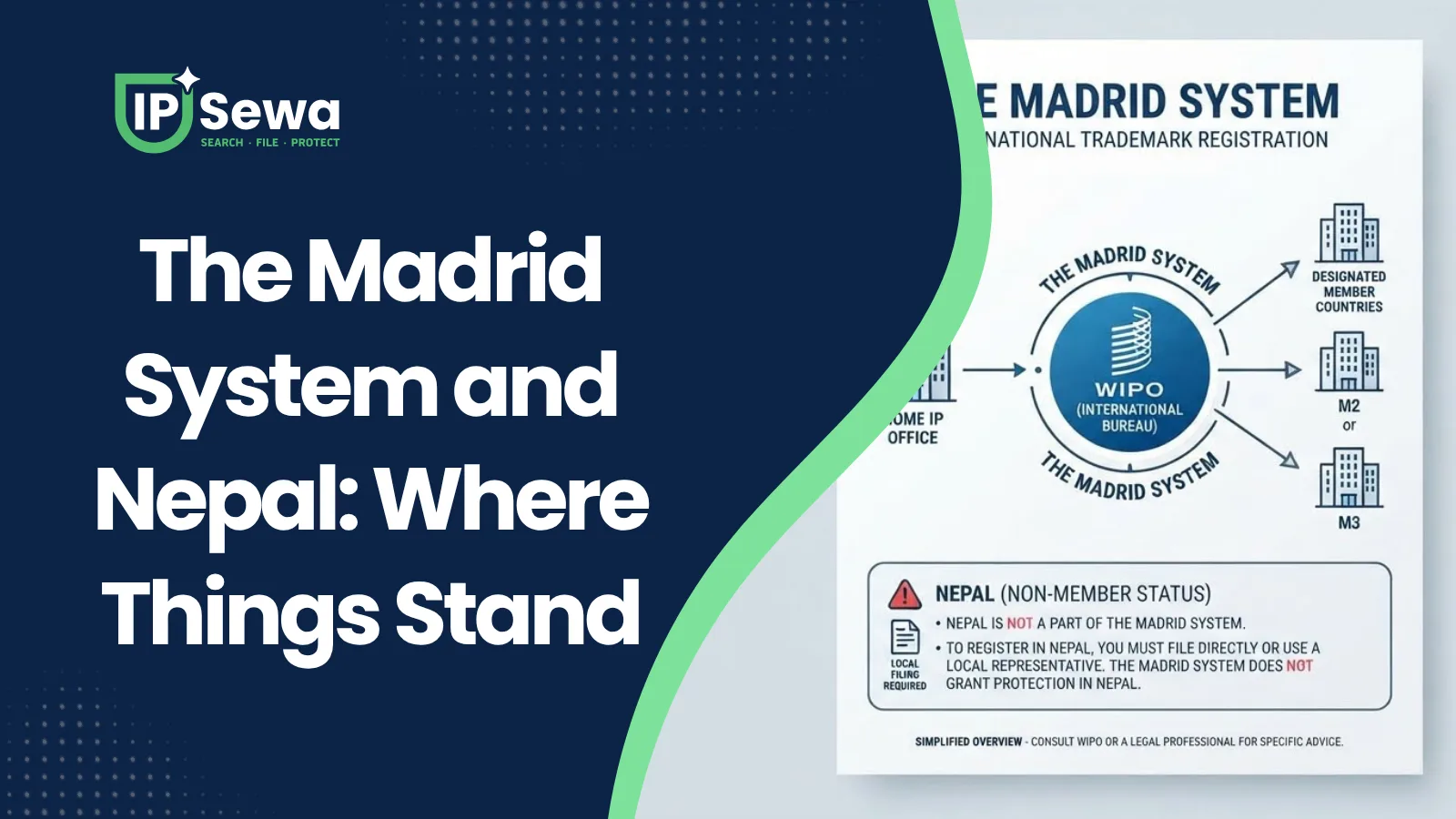
Nepal is not a member of the Madrid System. WIPO's own list of contracting parties, current to 8 July 2026, names 117 members, and Nepal is not among them. A brand is protected in Nepal only by a direct application to the Department of Industry (DoI).
Key takeaways
- Nepal appears on neither the Madrid Protocol nor the older Madrid Agreement list that WIPO publishes and dates.
- India, China, Bhutan, Afghanistan and Pakistan are contracting parties. Bangladesh, Sri Lanka, the Maldives and Myanmar are not.
- Nepal is in the Paris Convention, which gives a six-month priority right for marks — a date, not a filing route.
- Sec. 21B of the Patent, Design and Trademark Act 1965 says a foreign registration is not valid here unless registered here.
- A Nepali business cannot use Nepal as its Madrid home base, because Nepal is not a contracting party.
- Nepal is first-to-file, so the earlier valid DoI application wins even against a famous foreign brand.
Is Nepal a member of the Madrid System?
No. WIPO publishes a dated list of every state bound by the Madrid Agreement of 1891 and the Madrid Protocol of 1989. The version current to 8 July 2026 records 117 contracting parties, 55 of them also bound by the older Agreement.
Nepal is on neither list. That is not a technicality about how a form is filled in. There is no box to tick for Nepal, because the box does not exist.
We checked this against WIPO, not a secondary summary. Membership is the kind of fact an old page gets wrong without looking stale.
What does "Madrid" actually mean here?
Madrid is the capital of Spain, and it is where the original agreement on the international registration of marks was signed in 1891. The system carries the city's name and nothing more.
It is a place name, not a legal term with a Nepali translation. If you arrived looking for what the word means, that is the whole answer — and the thing it names is a filing system run by WIPO.
The system does not create a worldwide trademark. Even for members, it is a way of filing and administering national rights from one place. The history of the Madrid System explains how that arrangement grew.
How can you check Nepal's status yourself?
Two pages settle it. WIPO Lex keeps a member profile for every country, and Nepal's profile lists the WIPO-administered treaties it has joined. Madrid does not appear there.
WIPO also publishes a dated table of Madrid contracting parties, with the exact date each state became bound. Read the "status on" line at the top before you trust the contents.
Start at WIPO, not a law-firm page. Membership changes, and only the depositary's own record is current by definition.
Which of Nepal's neighbours are in the Madrid System?
Several are. China became bound by the Agreement in 1989 and the Protocol in 1995. Bhutan joined both in 2000, India in 2013, Afghanistan in 2018 and Pakistan in 2021.
Several are not. Bangladesh, Sri Lanka, the Maldives and Myanmar do not appear on WIPO's list either, so Nepal is not the regional outlier some sites suggest.
That mix matters for planning. One WIPO filing reaches India and China; Nepal, Bangladesh and Sri Lanka each need their own national application.
Which treaties is Nepal actually in?
Three WIPO-administered ones, according to Nepal's WIPO Lex profile: the WIPO Convention, in force February 1997; the Paris Convention, in force June 2001; and the Berne Convention, in force January 2006.
Nepal also joined the World Trade Organization in 2004, which brings TRIPS obligations. TRIPS sets minimum standards a member's law must meet, but creates no filing route into it.
One detail catches people out. Nepal is not a party to the Nice Agreement either, yet the DoI works with the Nice class list. Joining a classification treaty and using the classification are separate things.
What does the Paris Convention give you instead?
A right of priority. Article 4C(1) of the Paris Convention allows six months for marks and industrial designs, and twelve months for patents and utility models.
File your mark in one Paris country, then file the same mark in Nepal inside six months, and the Nepal application is treated as made on the earlier date. Anything filed by someone else in between does not defeat you.
Sec. 21C of the 1965 Act is the domestic hook for that claim. You still file a complete national application — priority moves the date, not the paperwork.
Does a foreign registration reach Nepal on its own?
It does not. Sec. 21B is blunt: title to a patent, design or trademark registered in a foreign country is not valid in Nepal unless it is registered in Nepal by the person concerned.
A European Union mark, a US registration, an Indian registration, a Madrid international registration — none gives you a right the DoI will enforce here.
Paris Article 6bis does ask members to refuse marks that copy a well-known mark, and Nepali decisions have applied that across classes. Relying on it means litigation, though, not registration.
So how does a foreign brand protect a name in Nepal?
By filing directly with the DoI, in almost every case through a Nepal-based agent holding a notarised power of attorney. The route is the same one a Nepali company uses, with extra authority documents.
An unopposed application usually reaches a certificate in about 12 to 14 months, and 6 to 8 months in the smoothest cases. Treat that as typical rather than promised.
- Search the register first. Our free Nepal trademark search covers marks published in DoI bulletins, so it shows publication rather than registration status.
- Check who else is already filing. The owner and applicant search shows whether a distributor or a competitor has been filing under your name.
- Pick every class you need. Sec. 18A takes a separate application per class, so list what you actually sell in Nepal, not what your home registration covers.
- File at the DoI. Your agent submits the Schedule 1(c) application form, the mark labels and the company authority papers, and claims Paris priority if it still applies.
- Answer the examination. The DoI checks the mark against the Sec. 18 grounds and may raise objections you have to reply to in writing.
- Clear publication. An accepted mark appears in the Industrial Property Bulletin, and anyone may oppose it within 90 days before the certificate issues.
Can a Nepali business use Madrid to register abroad?
Not from Nepal. A Madrid applicant needs a connection with a contracting party through nationality, domicile or a real establishment, and Nepal is not one.
A Nepali group with a genuine commercial establishment in a member country may be able to use that country as its base. Whether yours qualifies is a question for an adviser there.
Otherwise, protecting a Nepali brand overseas means a national filing in each target country. Our international filing timeline sets out how those routes run side by side.
What would change if Nepal joined?
Two things. A foreign owner could designate Nepal inside one WIPO filing, and a Nepali owner would gain an office of origin.
What would not change is the decision. A designated office still examines each mark under its own law and can refuse it. Madrid centralises filing, not the answer.
Members also work to a deadline: a designated office normally notifies a refusal within 12 months, or 18 months where it has declared the longer period. Nepal would have to pick one.
Is accession being discussed?
We could not confirm any official step today. Nepal's WIPO Lex profile records no Madrid instrument, and the DoI site announces none.
Treat any date, draft bill or "coming soon" claim with suspicion unless WIPO or the DoI says it. That is the sort of claim that circulates and never gets corrected.
The two bodies to ask are WIPO, which records accessions, and the Department of Industry. Until one of them says otherwise, plan on direct filing.
How does the current route compare with a Madrid designation?
Side by side, the differences are administrative rather than mysterious. Only one office is involved in the Nepal route.
| Feature | Madrid designation, in a member | Nepal direct filing |
|---|---|---|
| Where you file | Your home office, designating members | The Department of Industry, Kathmandu |
| Who decides | Each designated office, under its own law | The DoI, under the 1965 Act |
| Refusal deadline | 12 months, or 18 by declaration | Not fixed by the 1965 Act |
| Classes per filing | Several classes in one application | One application per class (Sec. 18A) |
| Term | 10 years, renewed in 10-year periods | 7 years, renewed in 7-year terms |
| Priority | Paris priority, claimed centrally | Paris priority, claimed at the DoI |
| Covers Nepal? | No — Nepal cannot be designated | Yes |
The row that decides everything is the last one. A wider international registration is worth having, and it still leaves Nepal untouched.
What does this look like for one brand?
Imagine a Mumbai snack maker with an Indian registration and a Madrid international registration designating ten countries. It appoints a Kathmandu distributor and ships its first pallets in March. This is an illustration, not a real case.
None of that paperwork reaches Nepal. If a local trader files the same name at the DoI in Class 30 before the maker does, the Indian company is the later applicant here, famous label or not.
The fix was cheap and early: one DoI application per relevant class before the first shipment, with a Paris priority claim if it still applied.
Where a conflicting mark is already published, the 90-day window is the moment to act. Our opposition and enforcement team assesses the record and files inside it.
Common mistakes
- Assuming "international" means everywhere. A Madrid registration covers the members you designated, and nothing else.
- Waiting for market entry. Nepal rewards the earlier valid filing, not the earlier user, so the distributor conversation is already late.
- Letting a distributor file in its own name. Recovering a mark from a former partner is far harder than filing it correctly once.
- Copying the home goods list. File for what you will sell in Nepal, and use a class finder to test the wording first.
- Missing the six-month priority window. Once Paris priority lapses, the Nepal filing date is simply the day it was filed.
- Trusting an undated source. If a page tells you Nepal's treaty position without saying when it was checked, it is telling you nothing.
How do you keep a Nepali registration alive?
A registration runs seven years from the date of registration and renews in further seven-year terms without limit, under Sec. 18D and Sec. 23B of the Act.
Renewal is filed within 35 days of expiry. A six-month late window follows on payment of a fine, after which the registration is cancelled automatically rather than by anyone's decision.
Sec. 18C also lets the DoI cancel a mark not used within one year, so a purely defensive filing is not permanently safe. Our renewal calculator maps the dates.
The Act itself sits on the Nepal Law Commission site, and our renewal service tracks the term for you.
In short
Nepal is outside the Madrid System, confirmed against WIPO's dated list. Nothing filed through WIPO reaches Nepal by itself.
What Nepal does offer is Paris Convention priority, six months for a mark, plus a straightforward national route at the DoI. Both work well if you use them early.
Treat Nepal as its own line in the filing plan from the first draft. If you want that handled, our trademark registration team files and prosecutes at the DoI, and a clearance search comes first.
People also search for
- How does the Madrid System actually work?
- What are Nepal's options outside the Madrid System?
- Why is Nepal not in the Hague System for designs?
- How do DoI fee notices and schedules work?
- How does Nepal treat regional product names?
If your brand is already registered abroad and Nepal is on the map for this year, the useful next step is a clearance search in the classes you will actually sell in — contact our team and we will tell you what the register already shows.














Comments (0)
Leave a comment
Replying to — cancel