
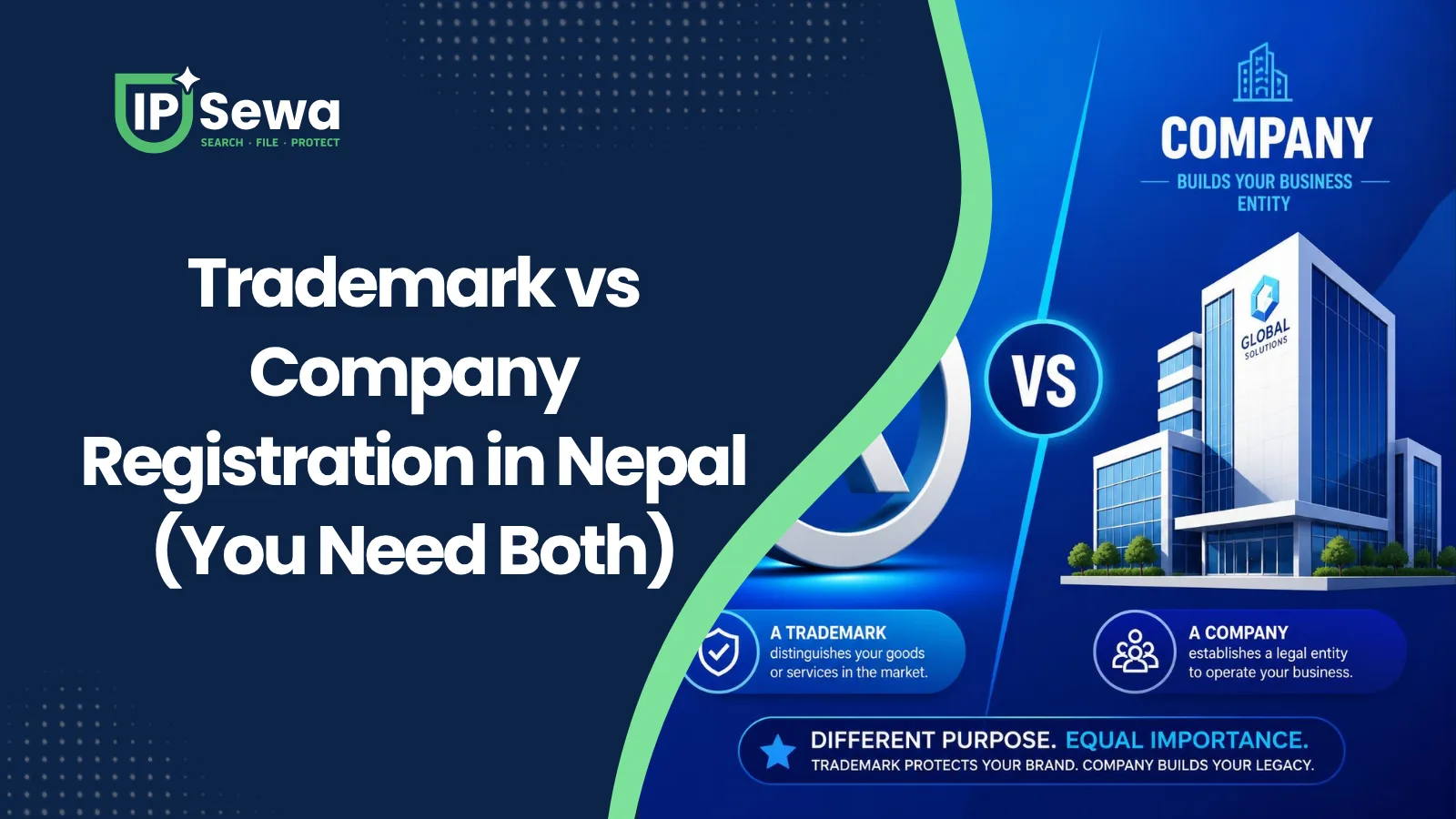
Registering a company in Nepal does not protect your brand name. Company registration at the Office of Company Registrar (OCR) creates a legal business entity; a trademark, registered with the Department of Industry (DoI), gives you the exclusive right to your brand. They are two different registers with two different purposes — and most businesses need both. Here's why one without the other leaves you exposed.
Key Takeaways
- Company registration (OCR) creates a legal entity to trade; a trademark (DoI) gives exclusive rights to your brand name and logo.
- A registered company name does not stop a competitor registering the same name as a trademark and blocking you.
- Nepal is first-to-file for trademarks — whoever registers the mark first owns it, regardless of who registered the company.
- You typically need both: the company to operate legally and pay tax, the trademark to own and defend the brand.
- Register the company to launch, then file the trademark as early as possible — ideally at the same time.
- The two are handled by different authorities under different laws — clearing one says nothing about the other.
What does company registration actually give you?
Company registration creates a legal business entity — it is how you become a private limited company, a firm, or another recognised structure that can open a bank account, sign contracts, hire staff and pay tax. In Nepal you register with the Office of Company Registrar under the Companies Act 2063 (2006). It records your company name so no other company registers an identical one, but that record is about corporate identity, not brand rights. See how to protect a business name in Nepal.
What does trademark registration give you?
Trademark registration gives you the exclusive right to use your brand — the name, logo or slogan — for the goods and services you register, and the legal power to stop others using a confusingly similar mark. You register with the Department of Industry under the Patent, Design and Trademark Act 1965, for a renewable 7-year term. Unlike a company name, a trademark is an asset you can license or sell. Start with what is a trademark and how to register one.
Why a registered company name is not brand protection
A company name recorded at the OCR only stops another company registering the identical corporate name — it does not stop a competitor registering your name as a trademark and then demanding you rebrand. Because Nepal is first-to-file, whoever registers the mark first owns the brand rights, even if you registered the company earlier and have been trading under the name for years. The OCR and the DoI keep separate registers and neither checks the other, so clearing one tells you nothing about the other.
Company registration vs trademark: side by side
The two answer different questions — "can I legally operate?" versus "do I own my brand?" This table sets them next to each other.
| Company registration | Trademark registration | |
|---|---|---|
| Authority | Office of Company Registrar (OCR) | Department of Industry (DoI) |
| Law | Companies Act 2063 (2006) | Patent, Design and Trademark Act 1965 |
| What it creates | A legal business entity | Exclusive rights to a brand |
| Protects the brand? | No | Yes |
| Stops copycats? | No | Yes, for the registered class |
| Can be licensed or sold? | Shares/the entity | The mark itself |
| Term | Ongoing while compliant | 7 years, renewable |
Do I really need both?
For most businesses, yes. You need the company to operate legally — to invoice, bank, hire and pay tax — and you need the trademark to own and defend the brand customers recognise. A company with no trademark can lose its name; a trademark with no company has nothing to trade through. A sole trader testing an idea might delay incorporation, but should still file the trademark early, because the brand is the asset competitors copy.
Which should you do first?
Register the company first if you need to operate immediately, then file the trademark as soon as possible — ideally in parallel. Because trademarks are first-to-file, every week between launching the brand and filing the mark is a week someone else can register it. Before you commit to a name, check it is free to use and free to register: run it through our Trademark Conflict Checker and read how to name a startup with a registrable brand.
Where do firm registration and PAN fit in?
Company registration is not the only "registration" a Nepali business deals with, and none of the others protect the brand either. A sole proprietorship or partnership firm is registered with the relevant government office (such as the Department of Cottage and Small Industries or the local ward) to operate legally. A PAN or VAT registration with the Inland Revenue Department covers tax. These make you legitimate and taxable, but a trademark is still the only registration that gives you ownership of the brand name and logo. Treat brand protection as a separate, deliberate step — see the brand protection checklist for new businesses.
The complete setup for a new brand
A cleanly protected new business usually has four pieces in place, in this order: register the company or firm to operate, get your PAN/VAT for tax, file your trademark to own the brand, and secure your domain and social handles so the name is locked online too. Skipping the trademark is the gap that most often costs founders their name later — it is the one registration about the brand itself, not the entity or the tax. Read how to protect your IP in Nepal for the wider picture.
Common mistakes
- Assuming the OCR name is "yours" everywhere. It only blocks identical company names, not trademark use — see trademark vs trade name vs company name.
- Delaying the trademark until "later". In a first-to-file system, later can be too late.
- Choosing a name that's registrable as a company but not as a trademark. A descriptive name may pass the OCR yet fail trademark examination.
- Skipping a clearance search. Your company name might already conflict with an existing registered mark — check both registers.
- Trading unregistered indefinitely. An unregistered mark has far weaker protection — compare registered vs unregistered trademarks.
People also search for
- Trademark vs trade name vs company name in Nepal
- How to protect a business name in Nepal
- Registered vs unregistered trademark in Nepal
- How to register a trademark in Nepal
- Brand protection checklist for new businesses
- Naming a startup with a registrable brand
Protect the brand behind your business
Registered the company but not the mark? Close the gap. Check your name free with the Conflict Checker or browse the trademark register, then file your trademark with our team — we search, prepare and file with the Department of Industry and track it to registration. Not sure where you stand? Talk to an IP expert.











Comments (0)
Leave a comment
Replying to — cancel