
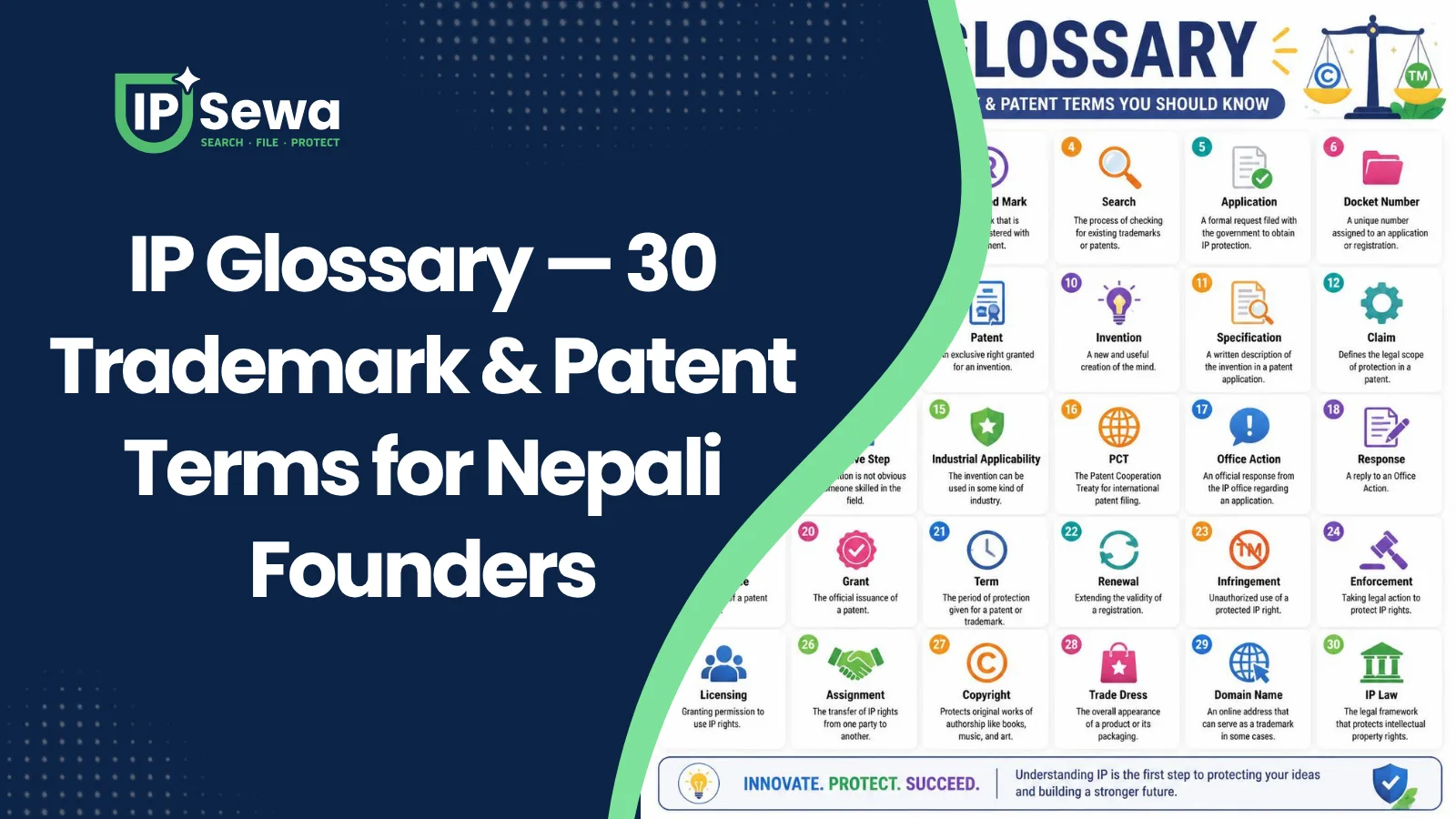
An IP glossary for Nepal should explain the 30 trademark, patent, design and copyright terms founders meet under the Patent, Design and Trademark Act 1965 and Department of Industry process, including the usual 12–14-month timeline.
Key Takeaways
- Nepal's Department of Industry registers trademarks, patents and industrial designs under the Patent, Design and Trademark Act 1965.
- Nepal follows first-to-file: the earliest valid application usually matters more than the date you began using a brand.
- NICE Classification has 45 classes, and Nepal requires one trademark application for each class.
- A trademark normally lasts seven years, a patent seven years with two renewals, and an industrial design five years with renewal options.
- The DoI examines an application, publishes it in the Industrial Property Bulletin, allows a 90-day trademark opposition period, then issues the certificate.
- Copyright is separate from industrial property and generally arises automatically when an original work is created.
What does an IP glossary explain for Nepal founders?
An IP glossary explains the legal vocabulary behind brand registration, inventions, product appearance and creative works. Nepal's Industrial Property framework includes trademarks, patents and designs, while copyright follows separate legislation. The Department of Industry is the main industrial-property authority, and the World Intellectual Property Organization provides international terminology and treaty context.
1. Intellectual property
Intellectual property means legal rights over creations, signs and business identifiers. In Nepal, the practical categories here are trademarks, patents, industrial designs and copyright. Each category has a different subject, application route, term and test.
2. Trademark
Trademark means a word, symbol, picture or combination used to distinguish your goods or services. It may protect a brand name, logo, slogan or label. Registration creates the strongest statutory basis for stopping unauthorised use.
3. Registered mark
A registered mark is a trademark entered on the DoI register after examination and publication. The owner receives a registration certificate. You should use the ® symbol only after registration, not while an application is still pending.
4. Word mark
A word mark protects the wording itself, such as a coined brand name. It is often more flexible than a logo filing because the protection is not tied to one particular font, layout or colour combination.
5. Device mark
A device mark protects a visual element, such as a symbol, emblem or graphic logo. A logo search can be harder than a word search because database results may not capture every visual similarity.
6. Combined mark
A combined mark joins words and artwork in one composite mark. If the name is commercially important, consider filing it separately as a word mark too. A later redesign may not preserve the same scope as the original composite filing.
Which trademark terms matter most in Nepal?
Trademark terms matter because Nepal uses first-to-file registration and class-based protection. The Patent, Design and Trademark Act 1965 and DoI practice focus on distinctiveness, earlier rights, public interest and goodwill. A clearance search before filing can expose conflicts that a company-name search alone will miss.
7. First-to-file
First-to-file means the first valid applicant generally has the stronger claim. Prior use can still matter in a dispute, but you should not rely on an unregistered reputation. File before launching widely, especially before public disclosure or advertising.
8. Distinctiveness
Distinctiveness is the ability of a mark to identify one business as the source of goods or services. Invented or unusual names are usually easier to distinguish than words that directly describe quality, ingredients or location.
9. Confusing similarity
Confusing similarity exists where marks, goods or services are close enough to mislead consumers. Examiners and opponents may compare sound, appearance, meaning, commercial field and the overall impression.
10. Well-known mark
A well-known mark has substantial recognition and reputation beyond an ordinary mark. Nepal's framework reflects Paris Convention principles, including protection against unfair use of famous marks. Recognition is evidence-based; simply calling a brand famous is not enough.
11. NICE Classification
NICE Classification is the international system of 45 classes: Classes 1–34 cover goods and Classes 35–45 cover services. Nepal requires one application per class. A bakery selling packaged spices and operating a café may need more than one class.
12. TM and ®
TM signals a claimed trademark, whether registered or not. ® signals registration. Treat these symbols as communication tools, not substitutes for filing. Misrepresenting an unregistered mark as registered can create legal risk.
What are the key patent terms Nepal inventors should know?
Patent terms describe the invention, its technical boundary and the information already available to the public. The DoI examines whether an invention is new and useful, then publishes an accepted application before a 35-day patent opposition period. A patent lasts seven years and may be renewed twice.
13. Patent
A patent is a time-limited exclusive right for a qualifying invention. It can help control making, using or selling the protected invention. Patent protection is national, so a foreign filing does not automatically protect Nepal.
14. Novelty
Novelty means the invention is new rather than already publicly known. Public demonstrations, sales, online posts or technical disclosures may damage novelty. Filing before disclosure is the safer business decision.
15. Inventive step
Inventive step asks whether the invention is more than an obvious development for a skilled person in that technical field. Combining known parts without a meaningful technical result may not satisfy this requirement.
16. Prior art
Prior art is information made available before the relevant filing or priority date. It may include patents, products, publications and public demonstrations. A structured prior-art search helps you judge risk before spending time on drafting.
17. Specification
A patent specification is the detailed written explanation of the invention. It normally describes the problem, solution, operation and supporting material clearly enough for the invention to be understood and reproduced.
18. Claims
Claims are the numbered statements that define the legal scope of a patent. The description explains the invention, but the claims mark the boundary you will rely on during enforcement.
How do design and copyright definitions differ?
Industrial design protects a product's visual appearance, while copyright protects original creative expression. The Department of Industry handles industrial-design registration under the 1965 Act. Copyright is separate, generally automatic on creation, and administered through Nepal's copyright system rather than the trademark register.
19. Industrial design
Industrial design protects features such as a product's shape, pattern or ornamentation. It does not protect the technical function. Drawings and representations are central because they show the appearance for which protection is sought.
20. Originality
Originality is the design quality of being independently created rather than copied. A design filing should explain its originality and show consistent plan, elevation and side views where relevant.
21. Copyright
Copyright protects original expression in works such as writing, art, music and software. It does not protect a business idea in the abstract. Copyright is separate from trademark registration and usually arises without registration.
22. Moral rights
Moral rights protect an author's personal connection with a work, including attribution and objections to harmful distortion. They differ from economic rights, which concern commercial use and may be transferred under applicable arrangements.
23. Public domain
The public domain contains material no longer protected by copyright or material that never received protection. Public-domain status should be checked carefully before copying a work, image or old publication into a commercial brand.
How do DoI filing terms work in Nepal?
DoI filing terms describe the path from application to certificate. For trademarks, the sequence is application, examination, Industrial Property Bulletin publication, 90-day opposition, registration and certificate. Foreign applicants generally use a Nepal-based agent because Nepal is outside the Madrid System, PCT and Hague System.
- Search the register: check words, similar spellings and relevant classes before choosing a name or logo.
- Select coverage: identify the NICE class and list goods or services precisely; one Nepal application covers one class.
- File the application: submit the prescribed form, mark label or invention papers and supporting documents to the DoI.
- Answer examination: respond to a formal or substantive objection within the stated period and correct defects where required.
- Manage publication: the accepted mark is published in the Industrial Property Bulletin, opening the trademark opposition period.
- Obtain the certificate: if no valid opposition prevents registration, complete the registration stage and receive the certificate.
24. Priority date
A priority date fixes the application's place in the queue. A Paris Convention priority claim may allow a foreign applicant to rely on an earlier filing, subject to the legal conditions and supporting certified documents.
25. Examination
Examination is the DoI's review of form, registrability, novelty or similarity, depending on the right. It is not a guarantee that nobody can later oppose or challenge the application.
26. Office action
An office action is an examiner's objection or request for correction. It may concern similarity, distinctiveness, classification, documents or technical disclosure. Ignoring it can place the application at risk.
27. Opposition
Opposition is a formal challenge by an interested person after publication. Trademark opposition uses the 90-day window set out in current Nepal filing practice. Patent and design objections use a shorter 35-day period.
28. Registration certificate
A registration certificate is the DoI document confirming the registered right. Keep its owner name, mark representation, class, application details and renewal date consistent with your business records.
29. Renewal
Renewal extends an industrial-property registration. A trademark lasts seven years and can be renewed for further seven-year terms. File within 35 days of expiry; a six-month late period may apply, after which cancellation can follow.
What enforcement and ownership terms should founders know?
Enforcement terms explain what happens after registration or misuse. Registration strengthens a claim, but you still need evidence, correct ownership records and timely action. The DoI can address industrial-property disputes, while contracts, court remedies and commercial evidence may also shape a practical enforcement strategy.
30. Infringement, assignment, licensing and passing off
Infringement is unauthorised use of a protected registered right. An assignment transfers ownership; a licence permits use without transferring ownership. Passing off concerns misrepresentation that diverts goodwill, often involving an unregistered brand.
Goodwill means the customer recognition and reputation attached to a business. It can support passing-off arguments and influence disputes over similar marks. Cancellation means removing a registration, including where legal grounds such as non-use or bad faith apply.
| Right | What it protects | Authority and key timing | Practical warning |
|---|---|---|---|
| Trademark | Name, logo, symbol or service sign | DoI; seven years, renewable; 90-day opposition | File each relevant NICE class separately. |
| Patent | New and useful technical invention | DoI; seven years, renewable twice; 35-day objection | Keep the invention confidential before filing. |
| Industrial design | New or original product appearance | DoI; five-year term with renewal options; 35-day objection | Drawings define the appearance protected. |
| Copyright | Original creative expression | Separate copyright system; generally automatic | Ownership and contracts still need clear records. |
How should a Nepal founder apply these definitions?
A founder should turn glossary terms into a filing plan: search the existing record, decide who owns the right, protect each relevant class or asset, and preserve priority before launch. The right choice may combine a word mark, logo filing, design application, patent and copyright evidence.
Imagine Himalayan Hearth Foods, a fictional Kathmandu startup selling spiced tea, packaged masala and café services. It should not assume one trademark application protects every activity. It would review the appropriate NICE classes, search similar marks, file early, and keep the label consistent with the application.
The same business might protect a distinctive name as a word mark, its emblem as a device mark, a new packet shape as an industrial design, and original packaging artwork through copyright. A technical drying process would raise patent questions instead. These rights can overlap, but none automatically replaces the others.
For domestic filings, prepare the application form, mark label and business records requested by the DoI. Corporate applicants may need a board resolution, industry certificate and current tax-clearance evidence. Foreign applicants generally need a Nepal-based representative, notarised Power of Attorney and certified home-country documents where relevant.
Costs vary with the number of trademark classes, government stages, document certification, translation, professional drafting and whether an objection or examination response arises. Do not judge the total from a single advertised figure. Use the current IP tools and fee calculator, or ask our team for a case-specific explanation.
For the governing statute, consult the Law Commission's official legal resources. The DoI is the filing authority, and its official information is available through the Department of Industry. This article is general information, not legal advice; facts, ownership and filing strategy should be checked for your situation.
In short, what should you remember from this IP glossary?
Search before choosing a name, file before revealing valuable inventions, select every necessary NICE class, and track publication and renewal dates. In Nepal, a registered mark is stronger than an informal claim, but registration is only the start of sensible brand protection.
- Use a trademark for source identification, a patent for a qualifying invention, a design for appearance and copyright for original expression.
- Remember that Nepal's trademark system is first-to-file and national in scope.
- Keep documents, ownership records and priority evidence organised from the first application.
- Act quickly if the Industrial Property Bulletin reveals a conflicting application.
People also search for
- Trademark vs copyright vs patent vs design in Nepal
- Patent registration in Nepal
- Patent search in Nepal
- What can be patented in Nepal?
- Industrial design vs patent in Nepal
- IP compliance for Nepali businesses
Ready to check a brand? Search Nepal's trademark database, review the trademark registration service, and contact our team for filing or advisory help.











Comments (0)
Leave a comment
Replying to — cancel