
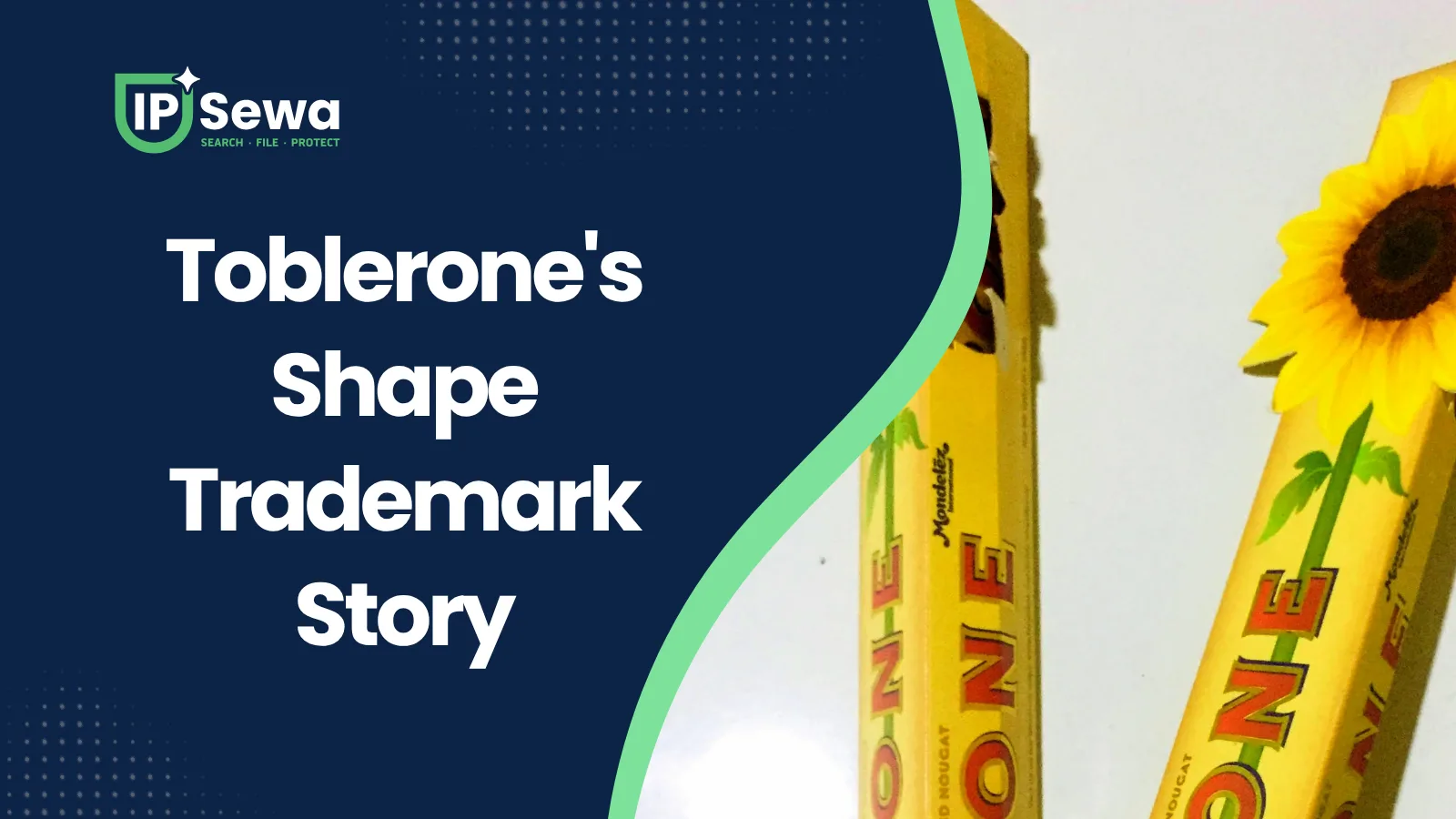
The Toblerone shape trademark shows why a product’s form can become a brand asset. In Nepal, the Department of Industry (DoI) assesses trademark applications under the Patent, Design and Trademark Act 1965 (PDTA); a shape-based filing follows the normal process and usually takes about 12–14 months when unopposed.
Key Takeaways
Toblerone’s triangular chocolate-bar form illustrates the central test for a shape mark: consumers must recognise the shape as identifying one commercial source. Under Nepal’s PDTA, the DoI reviews whether a proposed trade mark distinguishes goods, conflicts with an earlier registration, and can proceed through publication and opposition.
- A shape mark seeks trademark protection for a product’s three-dimensional form or its packaging.
- Toblerone is useful as an international example, but a foreign registration does not automatically protect the shape in Nepal.
- Nepal is first-to-file, so the first valid application in the relevant NICE class matters greatly.
- A shape that buyers see only as useful, ordinary, or decorative is harder to register as a 3D trademark.
- For chocolate products, Class 30 is the key NICE Classification class; other goods need their own class analysis.
- An industrial design and a trademark can protect different aspects of the same product appearance.
- A registered mark lasts seven years in Nepal and can be renewed in further seven-year terms.
What is the Toblerone shape trademark story?
The Toblerone shape trademark story centres on a chocolate bar whose long triangular prism and repeated peaks became strongly associated with the Toblerone brand. It demonstrates a non-traditional trademark: protection sought for something other than a word, logo, or label. The legal value lies in consumer recognition, not in geometric novelty alone.
That distinction matters. Many products have an attractive shape, but not every attractive shape works as a trademark. A buyer should be able to see the form, without relying on the packaging name, and think of one producer. Toblerone’s silhouette is memorable because the repeated triangular sections and overall profile are used consistently.
For a Nepali producer, this is not a shortcut to ownership of every unusual product form. The lesson is more practical: build a shape consistently, present it as part of your brand, and collect evidence showing that customers associate it with you. A distinctive sel-roti mould, soap profile, bottle, or tea tin may begin as design work and later become a brand signal.
Can a product shape become a trademark in Nepal?
A product shape may be presented for trademark registration in Nepal if it can distinguish your goods from another trader’s goods. Sec. 2(c) of the PDTA defines a trademark through words, symbols, pictures, or combinations used to distinguish products or services. The DoI therefore needs a clear representation and a credible source-identifying claim.
A 3D trademark is simply a trademark claim based on three-dimensional appearance. It may concern the product itself, such as a chocolate bar or sculpted soap, or the container around it, such as a distinctive bottle. “Trade dress registration” is a common business phrase for protecting the overall visual presentation, but Nepal’s filing system still requires you to identify the mark and the goods precisely.
The DoI is Nepal’s industrial-property registrar and a quasi-judicial authority for trademark disputes. It examines applications under the PDTA and publishes accepted marks in the Industrial Property Bulletin. You can read the official legal materials through the Nepal Law Commission’s legal resources, but a shape filing should be prepared with care because its boundaries can be difficult to show.
Why are shape marks harder to register than wordmarks?
Shape marks are harder because buyers often see a product’s form as practical, familiar, or decorative rather than as a brand name. The DoI must consider Sec. 18 of the PDTA, including whether registration could damage another mark’s goodwill or duplicate an earlier registered mark. Distinctiveness is the real hurdle for most 3D trademark claims.
A common mistake we see is treating originality as enough. A new shape may be original for an industrial design application, yet still fail as a trademark if consumers do not treat it as an indicator of source. A plain round biscuit, a standard jar, or a basic rectangular soap bar is unlikely to tell buyers who made it.
Function also creates risk. If the feature exists mainly because the product must work, fit, stack, pour, grip, or be manufactured in a particular way, competitors may need access to that form. Claims should focus on branding features that are not simply dictated by the product’s technical purpose. This is where product shape protection needs practical judgment, not copied foreign wording.
Is a 3D trademark different from industrial design registration in Nepal?
A 3D trademark protects a shape as a source identifier, while industrial design registration protects the visual appearance of a product. The DoI administers both rights under the PDTA, but their terms differ: a trademark runs for seven years and is renewable, while an industrial design runs for five years and is renewable.
| Issue | Shape trademark | Industrial design |
|---|---|---|
| Main purpose | Shows buyers the commercial source | Protects the product’s visual appearance |
| Key question | Does the shape distinguish your goods? | Is the appearance original or new? |
| Term | Seven years, renewable in further terms | Five years, renewable |
| Best timing | After the form acts as a brand signal | Before or close to market launch |
In practice, a new bottle, food mould, or consumer product may justify an industrial design filing first. As sales and promotion build consumer recognition, a trademark claim may become more persuasive. The rights can be complementary rather than interchangeable. Our team can help compare the options through industrial design registration support.
Which NICE classes apply to a chocolate-bar shape mark?
Class 30 is the primary NICE Classification class for a chocolate-bar shape mark because it covers chocolate, confectionery, cocoa products, and many baked goods. Nepal uses the NICE Classification’s 45 classes, and Sec. 18A requires a separate trademark application for each class. The correct class depends on the actual goods, not the shape alone.
Class 30 would be central for a Toblerone-style confectionery claim. A brand using the same silhouette on retail services, promotional services, packaging containers, or unrelated goods may need additional classes. For example, Class 35 can cover retail and business services, while the physical container may involve a different goods class depending on what is sold.
Do not choose classes based on what you might sell years later. Start with goods you genuinely plan to market, then use clear descriptions that match the business. The NICE class finder for Nepal filings can help you check the likely class before a professional review.
How do you apply for product shape protection in Nepal?
You apply for a shape mark by filing with the DoI, undergoing examination, and waiting through publication and opposition. The normal trademark route is application, examination, publication in the Industrial Property Bulletin, a 90-day opposition window, registration, and certificate. A smooth straightforward matter may finish in six to eight months, but 12–14 months is more typical.
- Define the claimed shape. Decide whether you claim the product form, the container, or a limited combination of visible features. Avoid claiming ordinary features you cannot distinguish from competing products.
- Search earlier marks. Review similar word, logo, and device registrations using the Nepal trademark database search. Shape conflicts are visual, so review images and relevant classes carefully.
- Select the NICE class or classes. File separately for every class that covers the goods or services you need to protect.
- Prepare the application material. Supply clear representations of the proposed mark and a concise description that matches them. Four specimens are required for a trademark application under Sec. 17.
- File and respond to examination. The DoI assesses conflicts and registrability. If it raises concerns, answer with a focused explanation and evidence of consumer recognition where available.
- Proceed through publication and registration. Once published, another person may oppose within 90 days. If the application clears, complete registration and obtain the registration certificate.
What documents support a shape trademark application?
A shape trademark application needs the prescribed application form, a power of attorney where an agent acts, and clear specimens of the mark under Sec. 17 of the PDTA. Company applicants commonly also provide their board resolution, industry or company documents, and tax-clearance material as required in current DoI practice.
The representations deserve special attention. They should show the claimed form consistently enough that an examiner, competitor, and future court can understand what falls inside the claim. A written description should identify the distinctive visual features without expanding beyond the submitted images. If the shape has acquired distinctiveness through use, preserve advertisements, packaging, sales records, media material, and evidence of public recognition.
Foreign owners must file directly in Nepal through a Nepal-based agent or representative. Nepal is not part of the Madrid System, so an international trademark registration does not extend here automatically. A Paris Convention priority claim may be relevant in suitable cases; the World Intellectual Property Organization explains the wider international trademark framework.
What mistakes should Nepali businesses avoid with shape marks?
Nepali businesses should avoid filing a shape mark before deciding whether the shape is truly a brand signal or simply a new design. Sec. 18A requires separate applications for separate NICE classes, while Sec. 18 can block a mark that conflicts with another’s goodwill or earlier registration. Poor images, vague claims, and late filing create avoidable risk.
- Using a label or wordmark in every photo, then claiming the bare product shape is already recognised on its own.
- Copying a foreign 3D trademark description without checking how the product is actually sold in Nepal.
- Ignoring earlier figurative marks, packaging shapes, and registered logos in the relevant class.
- Filing only for a company name at the Office of the Company Registrar (OCR) and assuming that creates trademark protection.
- Waiting until a competitor releases a similar product before filing in Nepal’s first-to-file system.
- Letting a registered mark sit unused; Sec. 18C allows cancellation where a mark is not used within one year of registration.
How would a Nepali chocolate brand use the Toblerone lesson?
A Nepali chocolate maker could use the Toblerone lesson by treating a distinctive bar shape as part of a long-term branding plan, not merely packaging decoration. For Class 30 goods, the DoI will still assess the application under the PDTA and publish an accepted mark for a 90-day opposition period before registration.
Imagine “Himal Peak Chocolate,” a fictional Kathmandu confectioner selling a bar with a repeated ridge pattern inspired by mountain terraces. At launch, it should consider whether the appearance is new enough for industrial design registration. It should also use the same form consistently, show it clearly in advertising, and avoid changing it every season.
After building recognition, the business could assess a non-traditional trademark filing for the shape. The strongest application would not say “we invented a mountain-shaped bar.” It would show why buyers see that particular repeated form as Himal Peak’s signature. That evidence-based approach is far stronger than relying on inspiration alone.
What does a shape trademark cost and how long does it last?
A shape trademark’s total cost depends on the number of NICE classes, government charges, the quality of the search, document preparation, and any examination response or opposition. Under the PDTA, a registered trademark lasts seven years from registration and can be renewed for further seven-year terms. The DoI issues the registration certificate after the process is complete.
Shape marks often require more preparation than ordinary wordmark registration because the images, description, search analysis, and evidence need closer work. A filing across several product classes also increases the total because Nepal uses one application for one class. Use the trademark fee calculator for a current starting estimate, then ask for advice on the full scope.
In short: Toblerone’s shape trademark story is not about owning triangles. It is about turning a distinctive product form into a reliable sign of commercial source. In Nepal, search first, choose the right class, define the claimed shape precisely, and consider industrial design protection where the appearance is still new.
What related trademark stories do people also search for?
These related topics explain other visual marks, trademark disputes, classification issues, and international filing systems that often arise beside shape mark Nepal questions. They provide useful context, but every Nepal filing still depends on the PDTA, the DoI record, the relevant NICE class, and the evidence available for your own mark.
- Why the Rubik’s Cube shape trademark failed
- The story behind the Apple logo
- Famous trademark disputes that shaped brand law
- The history of the NICE Classification and its 45 classes
- The Madrid System and international trademark history
- Luxury brands and the fight against counterfeits
Before filing a shape mark Nepal application, search comparable registrations in the Nepal trademark database, review our trademark registration service, and contact our team for filing advice tailored to your product. This article is general information, not legal advice.











Comments (0)
Leave a comment
Replying to — cancel