
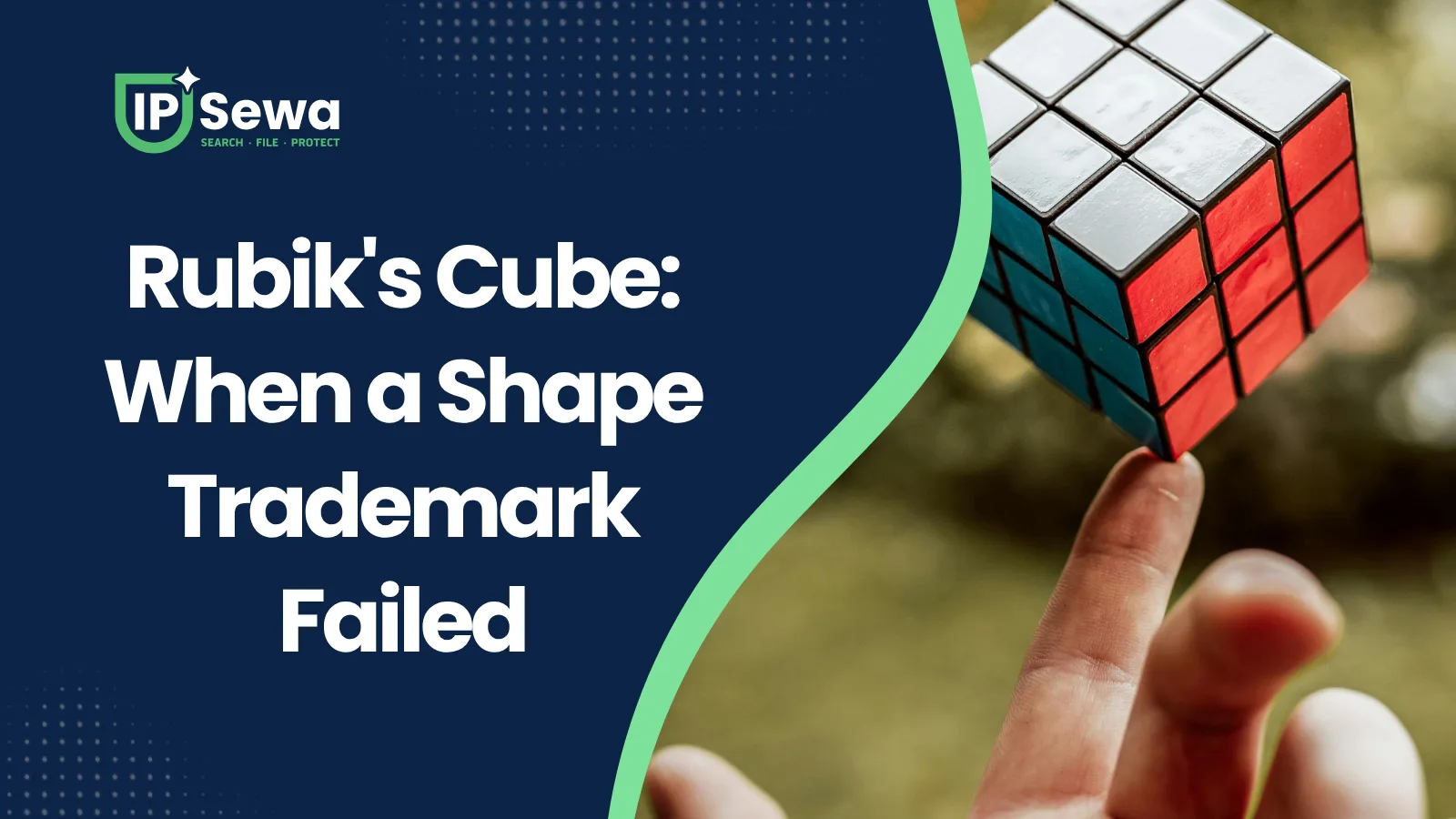
The Rubik’s Cube shape trademark failed because the cube’s visible grid was tied to how the puzzle works, not only to brand identity. In Nepal, the Department of Industry (DoI) examines trade mark applications under the Patent, Design and Trademark Act 1965, and functional product shapes face serious registration risk.
Key Takeaways
A product shape can work as a trade mark only if consumers recognise it as a source sign and it does not unfairly lock up a useful product feature. The DoI uses the Patent, Design and Trademark Act 1965, while trademark registration normally takes about 12–14 months if unopposed.
- The Rubik’s Cube dispute shows why a functional trademark can fail even where a product shape is famous.
- A 3D trademark registration seeks to protect a shape as a badge of business origin, not as a technical invention.
- Nepal is first-to-file: the first valid application in the correct NICE class has a major advantage.
- The DoI process is application, examination, Industrial Property Bulletin publication, a 90-day opposition window, registration, and certificate.
- An industrial design may suit a new ornamental product appearance better than a shape trademark.
- A patent may suit a new mechanism or technical solution, but it does not protect a brand name or logo.
- One Nepal trademark application covers one NICE Classification class, so related goods and services may need separate filings.
What happened to the Rubik’s Cube shape trademark?
The European dispute found that the cube’s black grid could not stay registered as a shape mark where it represented the puzzle’s rotating function. The Court of Justice of the European Union treated technical results as outside trademark control, a useful warning for DoI applicants under Nepal’s 1965 Act.
Rubik’s Cube is an unusually strong example because almost everyone recognises the object. Recognition alone, however, does not answer the legal question. A trademark is meant to distinguish one trader’s goods or services from another’s. It should not give one business a perpetual monopoly over features competitors need to make a working product.
The cube’s rows and columns are not merely decorative lines. They relate to the movement that lets users scramble and solve the puzzle. The European ruling did not mean every cube-shaped product lacks trademark value. It showed that the claimed shape must be assessed in relation to the goods and the feature being claimed.
How does Nepal assess a shape trademark or 3D mark?
Nepal’s trademark definition in Sec. 2(c) refers to a word, symbol, picture, or their combination used to distinguish goods or services. It does not expressly set out a modern 3D-mark category, so the DoI’s examination under Sec. 18 is especially important for any shape trademark Nepal application.
A shape application should make clear what you claim. Is it the entire bottle, a cap profile, the outline of a snack packet, or a repeated surface pattern? Clear drawings and a precise description help the DoI understand the proposed mark. They also prevent an applicant from claiming more than the visual feature actually supports.
The statutory refusal grounds include marks that damage another mark’s goodwill or are already registered in another person’s name. A functional or ordinary shape can also struggle because it may not truly distinguish one source from another. The safer view is practical: the more a feature helps the product operate, the weaker its trade mark case becomes.
Nepal is a member of the Paris Convention and TRIPS framework, both administered internationally through bodies including WIPO. Those commitments do not create automatic registration in Nepal. Your national application is still examined by the DoI under Nepal’s own Act and practice.
Which NICE classes apply to a 3D trademark registration?
A 3D trademark registration in Nepal is filed in the NICE Classification class covering the goods or services sold under the shape. NICE has 45 classes, and Sec. 18A requires a separate application for each class, so a toy product and its retail service do not sit in one filing.
For a Rubik’s Cube-style puzzle, Class 28 is the starting point because it covers games, toys and playthings. A seller that also runs a branded retail store may consider Class 35 for retail-related services. The right answer depends on what you actually sell now and reasonably plan to sell, not every class that sounds useful.
A common mistake we see is treating a company name, a shop sign, and a product shape as the same right. They are not. The Office of the Company Registrar (OCR) records company names, but OCR registration does not replace trademark registration at the DoI. Use the NICE class finder before finalising your filing list.
How do you register a non-functional shape mark in Nepal?
You register a possible non-functional shape mark by filing directly with the DoI, which then examines, publishes, and decides registration under Sec. 17–18 and Sec. 21A. An unopposed trademark commonly takes 12–14 months end to end, while only smooth straightforward cases may finish in about 6–8 months.
- Assess the feature honestly. Ask whether the shape makes the product work, gives a technical advantage, or is a standard form buyers expect. If so, consider patent or design protection first.
- Search for earlier marks. Search identical and similar names, logos, and visual identifiers using the Nepal trademark database. A professional clearance review is useful where a similar registered mark could create a conflict.
- Select each relevant class. List the actual goods and services and match them to the NICE Classification. File separately for each class you need.
- Prepare the application evidence. Provide clear views of the claimed shape, a label or visual representation, applicant details, and supporting documents. Avoid images that hide the exact feature claimed.
- File and answer examination issues. The DoI examines similarity, registrability and documents. An examiner may ask questions or raise concerns before publication.
- Wait through publication and opposition. If accepted, the mark appears in the Industrial Property Bulletin. Another person may oppose within the 90-day window, and the DoI considers the complaint.
- Obtain and maintain registration. If the matter proceeds, the DoI issues a registration certificate. The registered mark lasts seven years and can be renewed in further seven-year terms.
What documents support a product-shape application?
A Nepal shape-mark application needs the prescribed application materials, visual representations of the claimed mark, and applicant authority documents required by the DoI. For foreign owners, a Nepal-based representative files directly because Nepal is not part of the Madrid System, and a notarised power of attorney is generally needed.
For a Nepali company, the document set commonly includes its board resolution, industry certificate, and current tax clearance alongside the mark label and application form. For a foreign company, the home registration certificate may be relevant, especially where it supports the ownership record. A Paris Convention priority claim needs supporting filing documents in English.
For a shape, photographs or line drawings should show the product consistently from relevant angles. Do not rely on promotional images filled with colours, slogans, shadows, or unrelated graphics if the claim is only the form. Ask the DoI filing team to review the representation before filing; this article is general information, not legal advice.
Should you choose trademark, design, or patent protection?
You should choose trademark protection for source identity, industrial design registration for visual appearance, and patent registration for a new technical solution. The DoI registers each right under the 1965 Act, but their terms, tests and opposition windows differ, so calling everything a “3D trademark” can waste time.
| Protection route | What it protects | Nepal term | Best fit |
|---|---|---|---|
| Shape trademark | A shape used as a badge of origin | Seven years, renewable | A distinctive non-functional container or form |
| Industrial design | The appearance, pattern or ornament of a product | Five years, renewable | A new non-functional visual design |
| Patent | A new and useful technical invention | Seven years, renewable twice | A mechanism, process or working feature |
Imagine “Himal Spin,” a fictional Nepali puzzle maker. Its wordmark and mountain logo may be strong trademark assets in Class 28. Its new ornamental outer shell may justify a design application. But if its interlocking centre mechanism makes the puzzle turn in a new way, that mechanism needs a patent assessment rather than permanent trademark control.
What are the common mistakes with trade dress protection?
The biggest mistake is claiming product function as brand identity, as the Rubik’s Cube shape trademark dispute illustrates. The DoI can refuse marks that conflict with earlier rights under Sec. 18, and an opposition after Industrial Property Bulletin publication can delay or block registration during the 90-day challenge period.
- Filing a shape without checking whether the feature is essential to use or manufacture.
- Using one vague image instead of clear views that show the claimed form.
- Applying only for a logo while assuming it protects the product’s shape or packaging.
- Choosing the wrong NICE class or forgetting separate filings for separate classes.
- Assuming an overseas registration automatically covers Nepal; it does not.
- Waiting until a distributor, competitor, or copycat has filed first in Nepal.
Read the official English text of the Patent, Design and Trademark Act 1965 alongside practical filing advice. If a similar mark appears, a tailored clearance opinion through our trademark search and clearance service is more useful than guessing from a name search alone.
How long does shape trademark protection last in Nepal?
A registered trademark lasts seven years from registration in Nepal and can be renewed for further seven-year terms. Under Sec. 23B, renewal timing matters, while a shape mark that is not used within one year of registration may face cancellation under Sec. 18C.
Industrial designs have a five-year renewable term, while a patent runs for seven years and may be renewed twice. These limits explain the Rubik’s Cube lesson. A technical feature should not be converted into a trademark merely because patent protection expires; each IP right has its own purpose and lifespan.
In short: a memorable object is not automatically a registered mark. If the shape is needed for the product to work, use the Rubik’s Cube result as a warning. Protect the wordmark, logo, ornamentation, and genuine invention through the correct Nepal IP route instead of forcing one right to do every job.
People also search for
These related Nepal IP guides answer the next practical questions founders ask after assessing a product shape. They cover brand conflicts, design copying, patents, renewal deadlines, and the wider trademark registration process handled by the Department of Industry.
- Toblerone’s shape trademark story
- How to register a trademark in Nepal
- How to register a logo as a trademark in Nepal
- When industrial design copying becomes infringement
- Patent filing strategy in Nepal
- How two Nepali brands resolve a trademark clash
- Trademark renewal deadlines in Nepal
Start by searching Nepal’s trademark database, then speak with our team through IP Sewa contact support about a functional trademark, design, or patent strategy. We can help you prepare the right filing through our Nepal IP registration services.











Comments (0)
Leave a comment
Replying to — cancel