
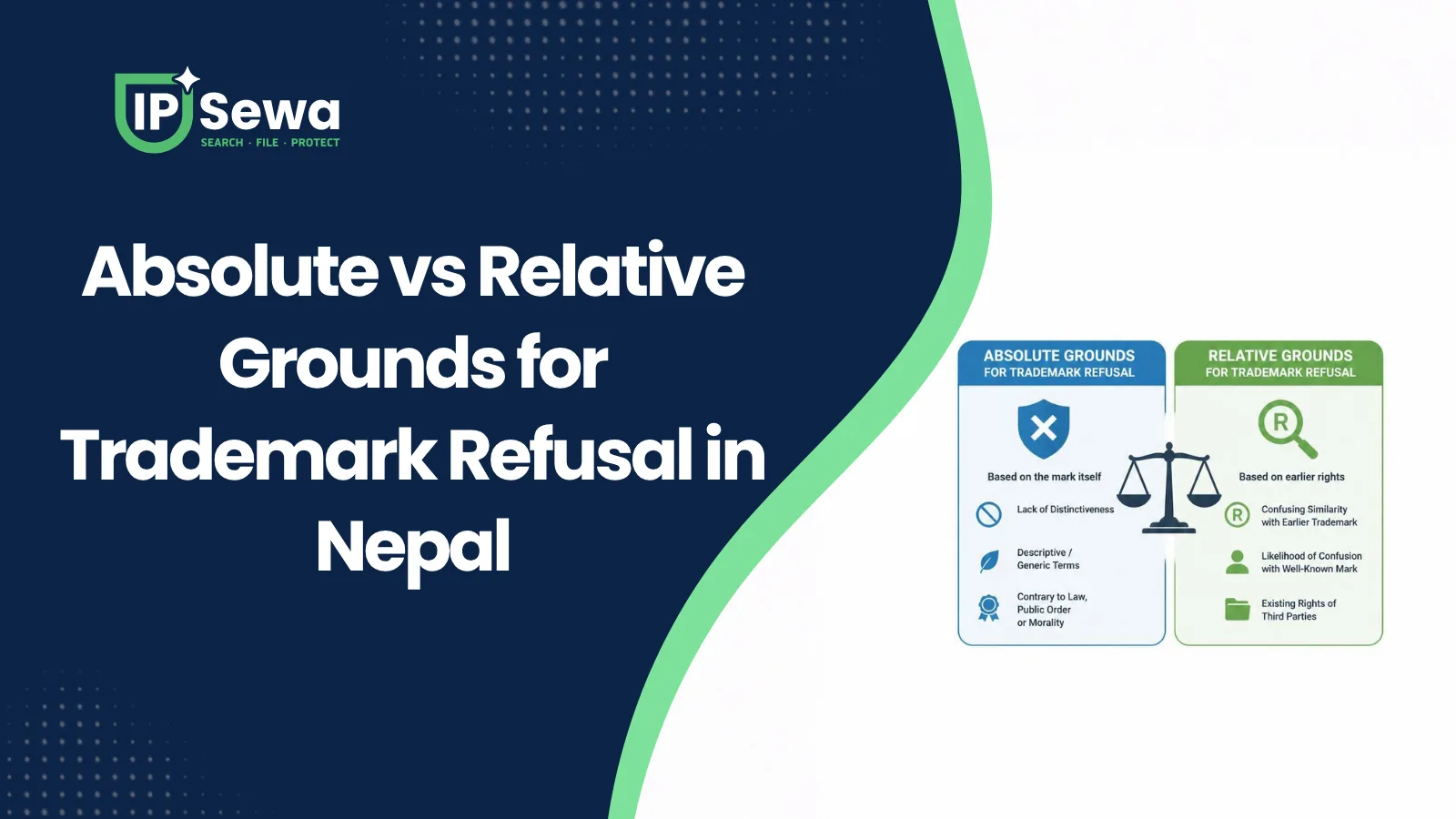
The Department of Industry (DoI) may refuse a trademark in Nepal because the mark itself is unsuitable or because it conflicts with an earlier mark. These are absolute and relative grounds for trademark refusal under the Patent, Design and Trademark Act 1965 (PDTA). A clean filing usually takes 12–14 months when unopposed.
Key Takeaways
The DoI examines every trademark application under the PDTA before publication in the Industrial Property Bulletin. Absolute grounds Nepal concerns defects in your own mark, while relative grounds trademark concerns earlier rights. Knowing the difference helps you choose a defensible brand, class, and filing strategy before committing to registration.
- Absolute grounds concern whether your wordmark, logo, or other sign can function as a trademark at all.
- Relative grounds arise where an earlier filed or registered mark creates a conflict.
- Nepal follows a first-to-file system, so the earliest valid application usually has the stronger position.
- Descriptive, deceptive, offensive, and protected signs create common absolute-ground risks.
- Similar names for related goods or services create common relative-ground risks.
- A DoI objection is not automatically a final trademark rejection Nepal; the response depends on the reason given.
What are absolute grounds for trademark refusal in Nepal?
Absolute grounds Nepal means the DoI finds a problem in the sign you want to register, regardless of who else owns a trademark. Sec. 18 of the PDTA prevents registration where a mark harms reputation, public conduct, morality, national interest, or another mark’s goodwill. The problem begins with the proposed brand itself.
A trademark must identify the commercial source of goods or services. It is not simply a business description, advertising claim, or attractive graphic. A strong registered mark tells customers that goods come from one business, even before they read a company name.
Marks that are descriptive, generic, or not distinctive
A descriptive mark tells customers what the goods are, what they do, or where they come from. For example, “Pure Honey” for honey gives competitors ordinary language they may also need. “Kathmandu Coffee” for coffee can face a similar problem because it describes a geographic connection and product.
Generic terms are weaker still. A trader should not obtain exclusive rights over the ordinary name of a product or service. In practice, invented names, arbitrary names, and carefully designed distinctive logos are usually easier to defend than common product descriptions.
Marks that mislead or offend
A mark can also fail if it misleads buyers about quality, origin, nature, or another relevant feature. A tea product branded to falsely suggest a foreign origin is a practical example. Claims that create a false impression may attract examination concerns even if no earlier trademark exists.
The PDTA also addresses marks affecting public conduct, morality, or national interest. Private businesses should avoid national flags, state emblems, official-looking seals, and signs that imply official approval. A logo/wordmark registration should build a brand, not borrow public authority.
What are relative grounds for trademark refusal in Nepal?
Relative grounds trademark means the DoI finds that your application conflicts with an earlier party’s trademark position. Under Sec. 18, the DoI cannot register a mark already registered in another person’s name or one that damages another trademark’s goodwill. Nepal’s first-to-file rule makes early searching and filing especially important.
The DoI compares the overall impression of the marks and the relationship between the listed goods or services. Exact copying is not required. A spelling change, added word, different font, or minor logo adjustment may not remove the risk if customers could still assume a commercial connection.
Identical and confusingly similar marks
An identical wordmark for identical goods is the clearest conflict. More often, the issue is similarity in sound, appearance, or meaning. “Himal Brew” and “Himāl Brew” may be read or pronounced alike. If both cover related beverages, the later application has a serious relative-ground risk.
A class number matters, but it does not decide the whole question. Two marks in the same NICE class may cover unrelated specifications, while goods in separate classes may still be commercially connected. The wording of goods and services therefore needs as much care as the brand name.
Earlier marks and well-known brand concerns
An earlier application can matter before its registration certificate is issued. This is why a basic web search is not enough. You should check the DoI record for earlier applications, registrations, owner names, and close variations before launching packaging, signage, or a digital campaign.
Nepal is a member of the Paris Convention and TRIPS framework, and well-known marks may receive broader consideration than ordinary marks. Do not assume that choosing a different product class makes a famous brand name safe. The facts, reputation, goods, and likely public confusion all matter.
How do absolute and relative trademark grounds differ?
The DoI distinguishes these grounds by asking two different questions during examination under Sec. 18 of the PDTA. Absolute grounds ask whether your mark is inherently suitable for registration. Relative grounds ask whether the mark unfairly interferes with an earlier trademark. The table shows why the response strategy changes.
| Issue | Absolute grounds | Relative grounds |
|---|---|---|
| What is examined? | The mark itself | An earlier trademark or protected reputation |
| Typical trigger | Descriptive, deceptive, offensive, or official-looking sign | Identical or confusingly similar earlier mark |
| Does another owner need to exist? | No | Yes, usually an earlier applicant or registrant |
| Best prevention | Choose a distinctive and honest brand | Search close marks before filing |
| Practical response | Change or narrow an unsuitable mark | Argue differences, revise goods, or reconsider the brand |
Which NICE classes should you check before filing?
The DoI uses the NICE Classification, which has 45 classes, to organise goods and services under Sec. 18A of the PDTA. Nepal requires one trademark application for one class. You should search the class that directly covers your offering and any related class where customers may expect the same business source.
Classes 1–34 cover goods, while Classes 35–45 cover services. A café selling packaged coffee may need to consider both its food-service activity and its packaged goods. A clothing retailer may need a different class strategy from a clothing manufacturer.
Use the NICE class finder for Nepal trademark filings to identify likely classes, then check the wording with care. An overly broad list can create avoidable conflict; an overly narrow list can leave a core commercial activity outside the application.
How can you reduce trademark rejection risk before filing?
You can reduce grounds for trademark refusal by testing the name, class, and earlier-register risk before submitting to the DoI. The DoI process runs from filing through examination, Bulletin publication, a 90-day opposition period, registration, and certificate. Prevention is cheaper in time and rebranding effort than a late response.
- Choose a distinctive sign. Prefer an invented or arbitrary brand over words that merely describe your product.
- Check honesty and public-sign issues. Remove claims that mislead and avoid official emblems, flags, or seal-like devices.
- Select the correct NICE class. Identify every class needed because each class requires its own application.
- Search for close earlier marks. Check exact names, spelling variants, sounds, and similar logos in relevant goods or services.
- File promptly with the DoI. In Nepal, earlier valid filing generally matters more than earlier use.
- Prepare for examination and publication. If accepted, the mark appears in the Industrial Property Bulletin for opposition.
What documents support a stronger trademark application?
The DoI requires a complete application and supporting records before it can assess trademark refusal grounds. Domestic applicants commonly provide the application form, mark label, notarised power of attorney, company records, industry certificate, and tax clearance. Foreign applicants file through a Nepal-based representative and provide additional authenticated home-country documents where relevant.
If you claim Paris Convention priority, supporting filing evidence should be prepared carefully. A priority claim can affect your position against later filings, but it does not cure an inherently descriptive mark or erase an earlier conflicting right. Document quality and class accuracy both affect examination.
How long does a refusal issue affect the trademark timeline?
The DoI commonly completes an unopposed trademark registration in about 12–14 months, including examination, Industrial Property Bulletin publication, and the 90-day opposition period. A straightforward application may finish in about 6–8 months in favourable conditions. An objection, opposition, amendment, or incomplete document package can extend the process.
Registration then lasts seven years from registration and can be renewed in further seven-year terms. Registration is valuable, but it is not a reason to stop using the mark. Sec. 18C permits cancellation where a registered trademark is not put into use within one year of registration.
What costs affect a trademark refusal response in Nepal?
Trademark costs in Nepal depend on the number of NICE classes, government charges, professional work, document preparation, and whether examination raises a refusal issue. Since one application covers one class, a business protecting the same name across goods and services needs separate filings. Use the trademark fee calculator for a current estimate.
A weak name can create costs beyond the application itself: revised labels, packaging changes, new signage, fresh class analysis, and legal submissions. This is why a professional clearance opinion can be useful for a name central to your business or a launch with high marketing spend.
What should you do after a DoI trademark objection?
You should identify whether the DoI objection concerns Sec. 18 registrability, an earlier mark, class wording, or missing evidence before replying. An examiner’s concern is a stage in the process, not a registration certificate refusal that cannot be discussed. The facts and the exact wording of the objection determine the sensible response.
For an absolute issue, changing the mark may be safer than trying to defend a plainly descriptive or deceptive name. For a relative issue, the response may explain different marks, different goods, or different customer channels. Do not assume consent or a class amendment will solve every conflict.
If a conflicting application reaches publication, a third party may oppose it within the Industrial Property Bulletin’s 90-day window. Our team can help assess the record and prepare a practical response through our trademark opposition and enforcement service. This article is general information, not legal advice; seek advice on your specific facts through IP Sewa’s contact team.
What is a practical Nepal example of absolute and relative grounds?
Imagine a Pokhara tea seller applying for “Nepal Tea” in Class 30 for tea. The DoI may question the phrase on absolute grounds because it describes the goods and their claimed origin. The seller’s use of a mountain illustration would not automatically make the whole brand distinctive enough for registration.
Now imagine the seller chooses the invented name “Himtara” but finds an earlier “Himtara” application for tea and herbal drinks. That is a relative-ground problem. The better next step is to compare the exact goods, dates, sound, spelling, and overall commercial impression before investing in printed packaging.
In short
Grounds for trademark refusal in Nepal fall into two practical groups under the PDTA and DoI examination practice. Absolute grounds mean the mark is unsuitable by nature; relative grounds mean it clashes with earlier rights. A distinctive name, correct NICE class, and careful pre-filing search give your application its best chance of registration.
- Fix an absolute problem by choosing a mark that can truly distinguish your business.
- Reduce a relative problem by finding earlier marks before you file, not after launch.
- Remember that publication does not end risk: opposition remains possible for 90 days.
People also search for
These related Nepal trademark guides explain the wider filing process, similarity checks, class selection, and common reasons an application does not proceed. Each topic connects directly to the DoI’s examination of a proposed mark under the PDTA and the practical steps businesses should take before they file.
- Why do trademark applications get rejected in Nepal?
- What is a confusingly similar trademark in Nepal?
- How do you search for a trademark in Nepal?
- What is the NICE Classification for trademarks?
- How do you choose the right trademark class in Nepal?
- What is the trademark application process in Nepal?
- How do you register a trademark in Nepal?
Before filing, search existing marks in the Nepal trademark database, then ask our team for professional trademark search and clearance advice. If you are ready to protect a wordmark, logo, or business brand, contact IP Sewa for filing support with the DoI.











Comments (0)
Leave a comment
Replying to — cancel