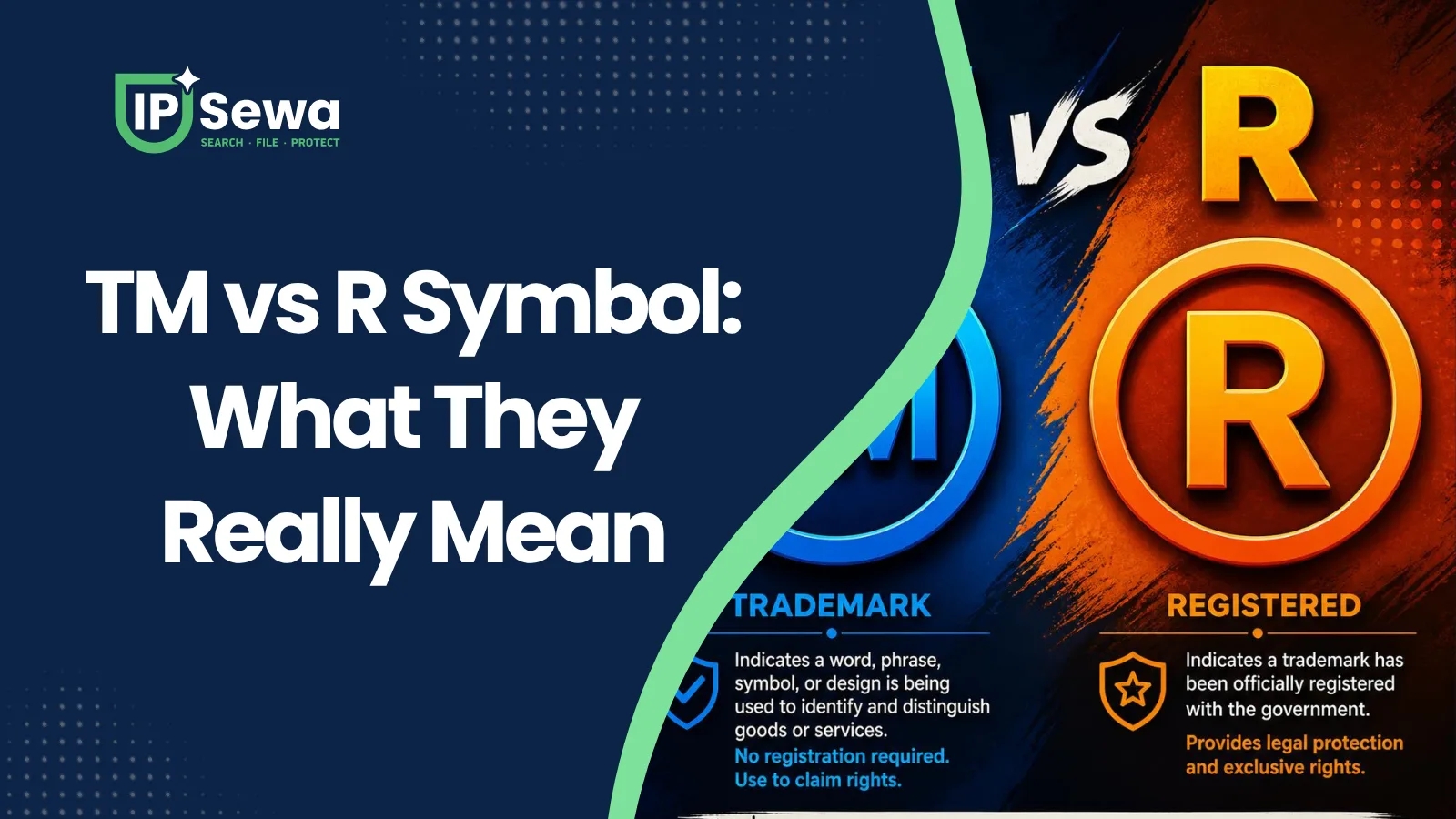
A TM symbol on a brand in Nepal means the owner is claiming it as their trademark — no registration required. The ® symbol means the mark has been officially registered with the Department of Industry (DoI) under the Patent, Design and Trade Mark Act 1965. Using ® without registration is illegal.
Key Takeaways
- TM and SM are informal claim markers — anyone can use them in Nepal without filing anything, but they carry no legal rights under the Act.
- The ® symbol is strictly reserved for marks that have completed registration and received a certificate from the DoI.
- Using ® on an unregistered mark in Nepal violates Sec. 18B of the Act — it can block your future application and trigger penalties.
- Nepal is a first-to-file country — actual prior use alone does not give you ownership of a mark unless you file first.
- The term of a registered mark is 7 years, renewable indefinitely for further 7-year periods.
- Only a registered mark lets you file an opposition during the 90-day publication window or take enforcement action.
- Foreign marks already registered elsewhere must still complete a fresh filing through a Nepal-based agent — there is no automatic recognition of overseas ® status.
What does the TM symbol actually mean in Nepal?
The TM symbol — short for "trademark" — is an informal notice that the owner considers a word, logo or slogan to be their brand identifier. There is no section of the Patent, Design and Trade Mark Act 1965 that defines or governs TM. You can place it on any mark you use in commerce, whether you have filed an application or not, simply to signal "I am claiming this as mine." It does not mean the DoI has examined or approved anything.
In practice, TM is a deterrent. It tells competitors and the public that you are treating the mark as proprietary. But in Nepal's first-to-file system, the person who files first owns the right — not necessarily the person who used TM first. A TM symbol alone gives you zero standing to oppose a published application or to sue for infringement. If someone else files the same mark before you do, your TM claim will not save you.
What does the ® symbol mean under Nepal's trademark law?
The ® symbol — often read as "registered trademark" — means the mark has been examined, published in the Industrial Property Bulletin, survived the 90-day opposition window, and been issued a registration certificate by the Department of Industry. Sec. 18 of the Act vests ownership in the registrant once that certificate is granted. Only then can you legally use ® in Nepal. Every registered mark in Nepal gets a 7-year term from the date of registration, renewable for successive 7-year periods under Sec. 23B.
The ® symbol is not just cosmetic. It is your public declaration that the mark enjoys the full bundle of rights the Act provides: the right to oppose confusingly similar applications, to seek cancellation of later marks, to license or assign ownership, and to take enforcement action — including through the DoI's quasi-judicial powers. It also puts the world on constructive notice, which matters if you ever need to prove that an infringer knew of your claim.
Can you use the ® symbol without registering in Nepal?
No. Sec. 18B of the Patent, Design and Trade Mark Act 1965 explicitly prohibits using a mark "as a registered trademark" unless it is actually registered. Applying the ® symbol to an unregistered mark is a false representation. In Nepal, this can result in the DoI refusing your later application once the misrepresentation comes to light. Though criminal penalties are rarely pursued for ® misuse alone in Nepal, the practical risk to your registration prospects is real — examiners check for prior use of ® on the mark itself during the examination phase.
A common mistake we see: a business registers its mark abroad — say in India or the US — and then uses the ® symbol on its packaging in Nepal, assuming the foreign registration carries over. It does not. Nepal is not a member of the Madrid System, and there is no treaty under which a foreign registration automatically confers ® rights here. Until the DoI issues a Nepali certificate, the correct symbol is TM, never ®.
What is the difference between TM, SM and ®?
TM stands for "trademark" and is used for goods — think packaged food, clothing, electronics. SM stands for "service mark" and is used for services — a restaurant brand, a consultancy, a software firm. In Nepal, both TM and SM function identically: they are unregistered claim markers with no statutory basis. Neither gives you ownership under the Act. The ® symbol is the only one that signals statutory registration with the DoI, regardless of whether the underlying mark covers goods or services.
There is no requirement in Nepal to use SM at all. Most businesses simply use TM for both goods and services until they register. After registration, ® replaces whichever unregistered symbol was in use. You should never stack them — Brand™® looks amateurish and can confuse consumers about what is actually registered. Pick one: TM (or SM) before registration, ® after.
| Symbol | Legal meaning in Nepal | Registration required? | Enforcement rights? |
|---|---|---|---|
| TM | Unregistered trademark claim for goods | No | No |
| SM | Unregistered service-mark claim for services | No | No |
| ® | Registered mark under PDTA 1965, DoI certificate issued | Yes | Yes — opposition, enforcement, licensing |
When can you start using the ® symbol on your brand in Nepal?
Only after the DoI hands you the registration certificate. It is not enough to have filed the application, or to have cleared examination, or even to have been published in the Industrial Property Bulletin. The statutory condition under Sec. 18 is that the mark is "registered" — and registration is only complete when the certificate issues. The typical timeline from filing to certificate in Nepal is about 12–14 months when unopposed. During that entire window, the correct symbol is TM.
Some businesses are tempted to switch to ® the moment the 90-day opposition period closes without objection. That is premature. Until the registration fee is paid and the certificate is physically or digitally in your hands, the mark is not yet registered. If you are uncertain about your exact status, our team can help you check where your application stands with the DoI.
What happens if you misuse the ® symbol in Nepal?
The law treats misrepresenting an unregistered mark as registered as a violation. Sec. 18B of the Act creates the prohibition, and while Nepal does not have a history of standalone criminal prosecutions for ® misuse, the practical consequences can be serious. An examiner who spots ® on a mark during the DoI's examination may question the applicant's good faith, delay the application, or recommend refusal on the ground that the mark is deceptive. If the misuse amounts to passing off — using ® to suggest a connection with a genuinely registered brand — civil liability can also arise under common-law principles recognised in Nepali courts.
If you have already used ® on a mark that is not yet registered, the safest course is to remove it from all packaging, signage and online profiles immediately and replace it with TM. Then focus on completing the registration. If the mark is already published, you are close — but do not jump the gun. A quick conflict check can also confirm no similar registered mark is being infringed.
Why does the TM vs ® distinction matter more in a first-to-file country like Nepal?
In a first-to-use jurisdiction — the United States, for instance — prior commercial use can establish ownership even without registration. Nepal is the opposite. Under Nepal's first-to-file system, rights flow from the filing date, not from the date you first used the mark. The TM symbol does nothing to establish priority. If a competitor files an identical or confusingly similar mark before you, they get the registration and the exclusive right to use ® — even if you had been using TM openly for years.
This is why the distinction is not just academic in Nepal. Using TM for years without filing is a gamble. You are building brand recognition that someone else can legally capture by filing first. The ® symbol, once earned, locks in your priority date and prevents anyone else from registering a confusingly similar mark for the same NICE class. If you are serious about a brand, the goal should be to move from TM to ® as quickly as the DoI process allows. You can order a professional trademark search before filing to make sure the path is clear.
Which NICE classes does the symbol choice affect?
The symbol itself — TM, SM or ® — is class-neutral. It does not change which NICE class you file under. But the class strategy directly affects when you can safely use ®. In Nepal, one application covers one class. If your brand operates across multiple classes — say, Class 25 for clothing and Class 35 for retail services — and you only register in Class 25, you can use ® on the clothing labels but only TM on your store signage and advertising materials. Using ® across an unregistered class is still a misrepresentation under Sec. 18B.
How do you actually earn the right to use ® in Nepal?
There is only one route: file an application with the Department of Industry, get through examination, survive publication and opposition, and receive the certificate. Below is the step-by-step process that turns a TM claim into a ® registration under Nepal's Patent, Design and Trade Mark Act 1965.
- Search the trademark database. Before you commit time and money, check whether an identical or confusingly similar mark is already registered or pending in your NICE class. You can run a preliminary search using the DoI trademark database search or order a professional search that includes figurative and phonetic analysis.
- Identify the correct NICE class(es). Nepal uses the NICE Classification — 45 classes. One application covers one class. If your brand spans, say, packaged tea (Class 30) and a tea-house service (Class 43), you need two separate applications. Use the NICE class finder to confirm your class before filing.
- Prepare and submit the application. File Schedule 1(c) with four specimens of the mark, a notarised Power of Attorney (for companies), and the application fee. Foreign applicants must file through a Nepal-based agent and include a notarised copy of their home registration certificate.
- DoI examination. The Department examines the mark for distinctiveness, conflicts with prior registrations, and compliance with the grounds for refusal under Sec. 18. If an objection arises, you will have an opportunity to respond.
- Publication and 90-day opposition. If the mark clears examination, it is published in the Industrial Property Bulletin. Anyone may file an opposition within 90 days of publication.
- Pay registration fee and receive certificate. If no opposition is filed — or if any opposition is resolved in your favour — you pay the registration fee and the DoI issues the certificate. This is the moment you can legally switch from TM to ®.
Does a registered mark abroad let you use ® in Nepal?
No. Nepal is not a member of the Madrid System, and there is no automatic recognition of foreign trademark registrations. A US, EU, Indian or Chinese registration — even one bearing the ® symbol — has no independent legal effect in Nepal. To use ® here, you must file a fresh application with the DoI, go through the full process, and obtain a Nepali registration certificate. Foreign applicants can claim priority under the Paris Convention if they file in Nepal within six months of their home filing, but that priority right does not shortcut the need to register locally. Until that local certificate issues, TM is the only correct symbol.
A real-world Nepal example
Imagine a Pokhara-based coffee roaster called "Himal Bean" that has been selling packaged coffee in Kathmandu supermarkets for two years, always with a ™ symbol next to the logo. The founders assume that years of use and the TM symbol give them some protection. A larger competitor notices the brand's growing popularity, files "Himal Bean" in Class 30 (coffee) with the DoI, sails through examination because no prior registration exists, and gets published. The original roaster now faces a 90-day window to oppose — but because they never registered, their opposition relies solely on common-law passing-off arguments, which are harder and costlier to prove. Meanwhile, the competitor can soon use ® on its own "Himal Bean" packaging with full statutory backing.
Had the original roaster filed early, they would have locked in their priority date, earned the right to use ®, and been able to oppose the competitor's application from a position of strength. The TM symbol alone did nothing to stop the competitor from capturing the brand legally. This scenario plays out more often than you would think in Nepal's first-to-file system.
Common mistakes when choosing between TM and ®
- Using ® the moment you file. Filing an application does not make a mark registered. The DoI must examine, publish, and issue the certificate first. Jumping to ® early is a violation of Sec. 18B.
- Assuming TM gives you ownership. TM is a claim, not a right. In Nepal's first-to-file system, the first valid applicant owns the mark — not the first user of the TM symbol.
- Carrying over ® from a foreign registration. A ® from India, the EU or the US means nothing in Nepal until you obtain a separate Nepali registration. Continuing to use ® here without local registration is a misrepresentation.
- Using ® across unregistered classes. If you registered in Class 25 (clothing) but sell branded mugs (Class 21), the ® symbol on the mug is unlawful. File separately for each class where you want ® protection.
- Not switching back to TM if registration lapses. A mark is renewable every 7 years. If you miss the renewal deadline — 35 days after expiry, with a 6-month late grace period — the registration is automatically cancelled. You must revert to TM immediately.
How to check if a mark is already registered (and using ®)
Before you adopt a brand or start using TM, it is wise to find out whether anyone else already holds a ® registration for a similar mark in your class. You can search by mark name, owner, or application number using the DoI's public database — we provide access through our trademark search tool. For a more thorough check that includes figurative and phonetic conflicts across all relevant classes, our team can conduct a professional search and give you a clearance opinion. Knowing who already holds a ® right in your space helps you avoid an infringement claim — and a wasted application fee.
In short: TM is a claim. ® is a right. In Nepal, only the Department of Industry can turn the first into the second. Use TM while you build your brand and file your application; switch to ® only when the certificate is in your hands. If you are not yet registered, file now — because in a first-to-file country, waiting is the biggest risk of all.
People also search for
- What is a trademark under Nepal's IP law?
- How to register a trademark in Nepal — step by step
- How long does trademark registration take in Nepal?
- How much does trademark registration cost in Nepal?
- Documents required for trademark registration in Nepal
- What can be trademarked in Nepal?
- What is the NICE classification for trademarks?
- How to choose the right trademark class in Nepal
Not sure whether your mark can use ® yet, or want to start the registration process? Search the trademark database now to check for conflicts, or get in touch with our team — we will help you move from TM to ®<<>> excerpt: Restaurants in Nepal register a trademark with the Department of Industry under the Patent, Design and Trademark Act 1965, a first-to-file process taking about 12–14 months. meta_title: Trademark Registration for Restaurants in Nepal | IP Sewa meta_description: Protect your restaurant’s name and logo in Nepal. Learn the steps, NICE classes, timeline, and costs for a trade mark with the Department of Industry. meta_keywords: restaurant trademark Nepal, food brand registration Nepal, cafe trade mark, logo registration Nepal, hotel trademark tags: trademark, restaurants, nice classes, hospitality, brand protection <<
>A restaurant’s trademark in Nepal is registered with the Department of Industry (DoI) under the Patent, Design and Trademark Act 1965. Nepal follows a first-to-file system, so the right to a name or logo belongs to whoever files a valid application first — not whoever used it first.
Key Takeaways
- A restaurant trade mark in Nepal covers your name, logo, or both — but one application protects only one NICE class.
- The Department of Industry publishes your application in the Industrial Property Bulletin for a 90-day opposition period.
- Registration typically takes about 12–14 months end to end; a straightforward case might finish in roughly 6–8 months.
- A registered mark is valid for 7 years and can be renewed indefinitely every 7 years.
- Nepal is not a member of the Madrid System, so foreign restaurant chains must file directly through a local agent.
- Using an unregistered mark in a crowded street like Jhamsikhel or Thamel leaves your brand legally exposed.
- Professional help with the trademark database search and classification dramatically reduces the chance of a rejection.
Why does a restaurant need a registered trademark in Nepal?
Without a registered mark under the Patent, Design and Trademark Act 1965, your restaurant’s name and logo have no legal shield. Nepal’s first-to-file system means someone else can register your brand name, even if you opened your eatery years earlier. A registration certificate lets you stop copycat restaurants, gives you the exclusive right to use the ® symbol, and turns your goodwill into a transferable asset. It’s the single most important legal step for any restaurant planning to franchise, expand to multiple locations, or build a delivery-only ghost kitchen.
Who can file a restaurant trademark application in Nepal?
Any person or company claiming to be the owner of a mark can file. For a restaurant, the owner is typically the proprietor of a sole proprietorship, the partners in a partnership firm, or a private limited company registered with the Office of the Company Registrar. Foreign restaurant chains without a local entity must file through a Nepal-based agent or legal representative because Nepal is not a member of the Madrid System. A common mistake we see is filing in the owner’s personal name when the restaurant operates as a separate company — that mismatch can cause problems during enforcement.
Which NICE classes apply to restaurant trademarks in Nepal?
The Department of Industry uses the NICE Classification, and one application covers one class. A restaurant’s core service sits in Class 43, which captures the act of serving food and drink. But a modern restaurant business almost always needs more than one class. The food products you might package and sell at a deli counter or retail shelf need Class 29 or 30. A branded delivery app needs Class 9. Merchandise needs Class 25. Filing across multiple classes means filing multiple applications.
How do you register a restaurant trademark in Nepal?
Registration follows a fixed statutory path under the Patent, Design and Trademark Act 1965. You file an application with the Department of Industry, which examines it, publishes it in the Industrial Property Bulletin, and opens a 90-day opposition window. If no third party objects, the DoI issues the registration certificate. The whole process typically takes 12–14 months.
- Search the trademark database. Before you file, you need to know whether an identical or confusingly similar mark already exists for restaurant services. A search across the DoI’s records (which our team can help you perform) is the single best way to avoid a rejection. You can use the trademark database search tool to start.
- Choose your mark and NICE classes. Decide whether you are protecting the restaurant name, the logo, a tagline, or a combination. Identify every NICE class you genuinely need. Remember that a restaurant serving branded packaged sauces will need Class 30 in addition to Class 43.
- Prepare the required documents. Gather a notarised power of attorney (if filing through an agent), a clear representation of the mark, the applicant’s registration certificate (if a company), and a detailed list of the goods and services.
- File the application with the DoI. Submit the completed forms and pay the government fee per class. The DoI assigns a filing date and an application number — that date is critical in Nepal’s first-to-file system.
- Formality examination. The registrar checks that the forms are complete and the mark is not prohibited under Sec. 17 of the PDTA (deceptive marks, scandalous matter, or marks identical to an existing registration).
- Publication and opposition. If the application passes examination, the DoI publishes it in the Industrial Property Bulletin. Any third party has 90 days to file an opposition. If no opposition is filed, or if an opposition is resolved in your favour, the process continues.
- Registration and certificate. The DoI issues the registration certificate. The registered trade mark is valid for 7 years from the filing date and is renewable every 7 years.
What documents do you need for the application?
A complete restaurant trade mark application in Nepal requires four core documents. A notarised power of attorney authorises your agent to act before the DoI. A representation of the mark — a high-resolution image for logos or simply the typed word for a wordmark — is needed. If a company owns the mark, you must include the company registration certificate from the Office of the Company Registrar. Finally, you need a clear list of the specific goods and services for each NICE class you are filing under.
How long does the process take and how long does protection last?
For an unopposed application, the realistic timeline from filing to receiving the registration certificate is about 12–14 months. In a very smooth case with no queries from the examiner and no opposition, it can complete in roughly 6–8 months, but that is the exception, not the norm. Once registered, the protection lasts for 7 years. You can renew the mark indefinitely for further 7-year blocks by filing a renewal application and paying the prescribed fee before expiry.
| Stage | Approximate Time |
|---|---|
| Filing to formality examination | 2–4 months |
| Publication in Industrial Property Bulletin | After examination clearance |
| Opposition window | 90 days (fixed by law) |
| Issuance of registration certificate | 2–4 months after opposition closes |
| Total (unopposed) | 12–14 months |
What does restaurant trademark registration cost in Nepal?
The total cost has two components: the government fee payable to the Department of Industry and the professional fee for your agent. Government fees are charged per class, so a restaurant filing in both Class 43 and Class 30 pays for two applications. The professional fee depends on the complexity of your mark, whether you need a detailed search report, and how many classes are involved. To get a current, personalised figure, use our fee calculator or contact our team. A common mistake is budgeting for only one class and later discovering your packaged products need separate protection.
What legal rights does registration give you under the PDTA?
A registered trade mark under the Patent, Design and Trademark Act 1965 gives you the exclusive right to use the mark on the goods and services listed in your application. Under Sec. 21–24, you can sue for infringement, seek an injunction to stop a copycat restaurant, and claim damages. The registration certificate is prima facie evidence of your ownership in court. Without it, you rely on the far weaker and harder-to-prove claim of passing off under common law. Nepal’s membership in the Paris Convention and TRIPS means your priority date is recognised internationally, but only the Nepal registration protects you inside the country.
What are the common mistakes restaurant owners make?
The most costly error is filing nothing at all. A close second is filing only for the restaurant name while ignoring the logo — the two are separate marks and need separate protection. Many owners file under the wrong name: a proprietorship firm’s owner files in her personal name, but the restaurant trades under a different business name, which leaves the trading name unprotected. Choosing only Class 43 when you sell branded momo sauces, pickles, or coffee beans in retail packaging is another frequent gap. Finally, not running a proper trademark search before investing in signage, menus, and branding leads to painful and expensive rebrands when a prior registration surfaces. Our team can help you conduct a thorough pre-filing search across our trademark database.
How would a concrete Nepali restaurant example work?
Imagine a restaurant in Patan called “Himalayan Smokehouse” that serves grilled meats, sells its own branded chilli sauce in glass jars at the counter, and plans to franchise. The owner would file a wordmark application for “Himalayan Smokehouse” in Class 43 for the restaurant service, a logo application also in Class 43, and a second wordmark application for the sauce in Class 30. She would file through a registered agent, because the paperwork requires a local presence. After roughly 12–14 months, assuming no opposition, she receives three separate registration certificates. Seven years later, she renews all three. She now owns a trade mark portfolio that fully protects the dine-in experience, the retail product, and the future franchise brand.
Can a foreign restaurant chain register a trade mark in Nepal?
Yes, a foreign restaurant chain can register a trade mark directly with the Department of Industry. Because Nepal is not in the Madrid System, the chain cannot use an international registration to extend protection. It must file a fresh application through a local agent or representative, based on its home-country registration or intended use. Nepal’s obligations under the Paris Convention mean the foreign applicant can claim a six-month priority date from its first filing in a Convention country, which is critical for global chains timing their launch.
What happens if someone else registers your restaurant’s name first?
Because Nepal is strictly first-to-file, the first valid applicant owns the mark. If someone else registers your restaurant’s name, you cannot simply prove you used it earlier and expect the registration to be cancelled. You may need to file an opposition during the 90-day window if you catch it in time, or later seek cancellation through legal proceedings — both are difficult and uncertain. That’s why early filing is everything. For detailed guidance on challenging a conflicting mark, you can consult our team through our trademark services page.
In short: a restaurant’s brand is its most valuable asset, and in Nepal, the only way to own it legally is to register it first. The process is structured, the timeline is predictable, and the cost is a fraction of what a rebrand or a lawsuit costs later.
People also search for:
- Trademark registration process in Nepal
- How to trademark a logo in Nepal
- NICE classification in Nepal explained
- Trademark search before filing in Nepal
- How to oppose a trade mark application in Nepal
- Trademark renewal in Nepal
- Trade mark infringement in Nepal
Ready to protect your restaurant’s name? Start with a free search of the Nepal trademark database, then contact our team to discuss your NICE classes and file your application. If you want to understand the costs first, visit our fee calculator for a current estimate.


Comments (0)
Leave a comment
Replying to — cancel