
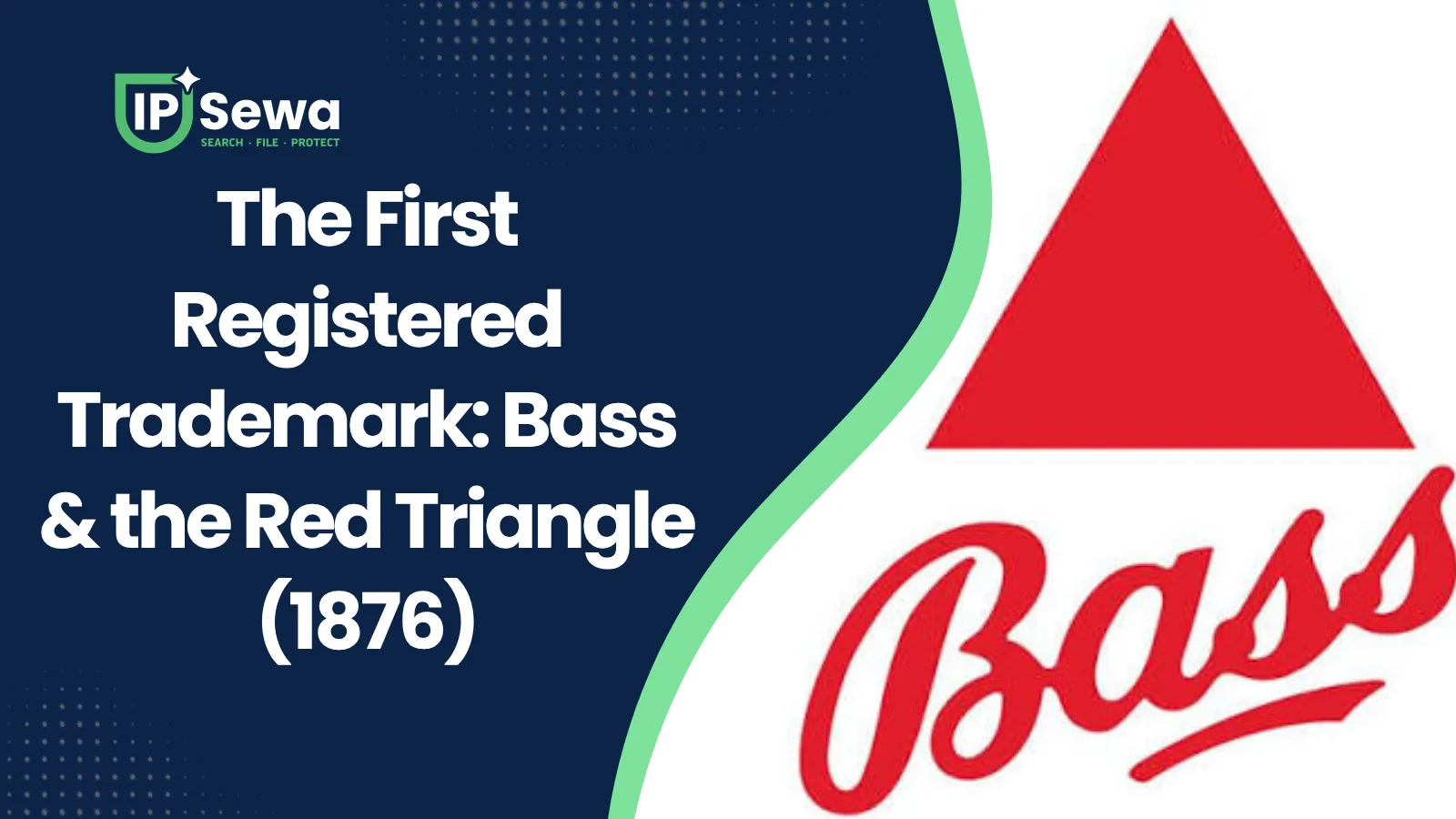
The first registered trademark was Bass Brewery’s red triangle, entered on 1 January 1876 under the UK Trade Marks Registration Act 1875. Its lesson still matters for Nepal trademark registration: file a distinctive mark early with the Department of Industry (DoI) under the Patent, Design and Trademark Act 1965.
Key Takeaways
The Bass red triangle shows why registration, distinctiveness and filing priority matter. Nepal’s DoI follows a first-to-file system under the Patent, Design and Trademark Act 1965, with a typical unopposed trademark process of about 12–14 months and renewable seven-year registrations.
- Bass Brewery’s red triangle is widely recognised as the first mark entered on the UK’s modern trademark register.
- The UK Trade Marks Registration Act 1875 created a formal registration system that began operating in 1876.
- A simple logo can be strong if consumers can identify one business from the mark alone.
- Nepal protects registered trademarks through the Department of Industry, not through use alone.
- One Nepali trademark application covers one NICE Classification class, so wider business activity may need several filings.
- After DoI publication in the Industrial Property Bulletin, a trademark faces a 90-day opposition period.
What was the first registered trademark in history?
The Bass red triangle was the first mark entered on the United Kingdom’s new register on 1 January 1876. It was a device mark, meaning a visual symbol rather than a word, used for Bass beer. That formal entry made it a landmark in the history of trademarks.
Bass Brewery used the red triangle on bottles of pale ale made in Burton upon Trent, England. It is commonly identified as UK Registration No. 1. The popular account says a Bass representative waited to submit the application as soon as the new register opened. Whether told as business folklore or filing strategy, the point is clear: being first had value.
The phrase “first registered trademark” needs one careful qualification. Traders had used signs, seals and names for centuries before Bass. What made the red triangle historic was its place on a modern statutory register created by a national trademark law, rather than its being the first commercial symbol ever used.
Why does the Bass red triangle still matter to brand owners?
The red triangle proves that a mark can be legally valuable because it identifies one source. In Nepal, the DoI examines whether a word, symbol, picture or combination can distinguish your goods or services under the Patent, Design and Trademark Act 1965, especially Sec. 16 and Sec. 18.
This quality is called trademark distinctiveness. It means customers can see or hear a mark and connect it with one business. A made-up word, unusual logo, or striking combination of elements is often easier to distinguish than a direct product description.
A plain word such as “Fresh Beer” tells customers what the product is. It does not readily identify one brewery. A unique name paired with a carefully designed triangle, however, gives the DoI something more specific to assess. Bass succeeded because its device was simple, memorable and used consistently.
A TM symbol can signal that you claim a brand, but it does not create registration. You should use ® only after the DoI has issued a registration certificate. Sec. 18B of the PDTA restricts presenting an unregistered mark as registered.
What did the UK Trade Marks Registration Act 1875 change?
The UK Trade Marks Registration Act 1875 introduced a formal register and opened it in 1876, allowing businesses to record marks through a defined legal system. Nepal’s equivalent national framework is the Patent, Design and Trademark Act 1965, administered by the DoI under Sec. 2 and Sec. 16.
Before statutory registers became common, brand disputes often depended on evidence of reputation, copying and customer confusion. Registration changed the discussion. A register gave businesses a public record of ownership and gave later applicants a reason to search before they invested in packaging, signs and promotion.
Modern systems differ from Victorian Britain, of course. Nepal uses the NICE Classification, an international system dividing goods and services into 45 classes. Nepal is also a member of the Paris Convention and TRIPS framework, while remaining outside the Madrid System. A foreign business therefore files directly through a Nepal-based agent or representative.
You can check potentially conflicting wordmarks and owner records before filing through the Nepal trademark database search. A database result is a useful first screen, not a legal clearance opinion; similar spellings, logos and related goods still need practical assessment.
How does first-to-file work in Nepal today?
Nepal awards trademark priority through the first valid application filed with the DoI, not simply through first market use. This first-to-file rule makes early brand registration important, because a later applicant may face refusal where an earlier registered mark would damage goodwill under Sec. 18.
That is the closest Nepali parallel to the Bass story. If two businesses independently choose similar marks for similar goods, the business that files first is normally in the stronger position. Social-media posts, a local shop sign or an informal agreement may help explain facts, but they do not replace registration.
In practice, founders often wait until a product sells well. That is risky. By then, a distributor, competitor or unrelated applicant may have filed a similar trade mark. Search before launch, choose a defensible mark, and file while the name is still available.
IP Sewa’s team can help with a professional trademark clearance search and class assessment before you commit to labels, menus, bottles or storefront signage.
Which NICE classes would a brewery use in Nepal?
A brewery normally files beer and non-alcoholic beverages in NICE Class 32, while alcoholic drinks other than beer fall in Class 33. A taproom, restaurant or catering operation may also require Class 43. Nepal requires a separate DoI application for each class under Sec. 18A.
The classification is not an optional filing detail. It sets the goods or services listed in the application and helps define where your registered mark is protected. A brewery cannot assume that registration for bottled beer automatically covers a restaurant, a retail service or a different alcoholic product.
For example, imagine a Bhaktapur brewery called “Himal Sudha” that uses a green triangle logo. Its bottled beer belongs in Class 32. If it later sells cocktails under the same brand, Class 33 becomes relevant. If it opens a branded taproom, Class 43 may also matter. Use the NICE class finder to make an initial class list.
How do you register a distinctive logo or wordmark in Nepal?
You register a logo, wordmark or combined brand by filing at the DoI, passing examination, appearing in the Industrial Property Bulletin and completing the 90-day opposition period. An unopposed Nepal trademark registration typically takes about 12–14 months, although the smoothest straightforward matters may finish in six to eight months.
- Search the mark. Check identical and similar names, spellings and logos in the relevant class before filing.
- Select the class or classes. Use the NICE Classification and prepare a clear description of the goods or services.
- Prepare the application. Include the applicant details, mark specimen, supporting corporate documents and power of attorney where needed.
- File with the DoI. Each class needs its own application, creating the filing date that matters in Nepal’s first-to-file system.
- Respond during examination. The DoI may examine conflicts, distinctiveness and the application details before accepting the mark.
- Wait for publication and opposition. Accepted marks appear in the Industrial Property Bulletin, where others can oppose within 90 days.
- Obtain the certificate and renew. If registration proceeds, keep the certificate safe and renew every seven years.
What documents and cost factors apply to Nepal trademark registration?
A Nepal trademark application normally needs the application form, mark label, applicant documents and a notarised power of attorney where applicable. The DoI issues the registration certificate only after examination, Bulletin publication and the 90-day opposition stage, while total cost depends on class count and applicant circumstances.
Domestic companies commonly need a board resolution, industry certificate and current tax-clearance letter alongside the filing papers. Foreign applicants generally need a Nepal-based representative, a notarised power of attorney and supporting home registration material where relevant. A Paris Convention priority claim requires its supporting filing record.
Costs are usually made up of government charges and professional work. The number of NICE classes, whether the mark is a wordmark or detailed logo, document preparation, foreign applicant formalities, examiner questions and any opposition can all change the total. For a current estimate, use the trademark fee calculator or ask our team through IP Sewa’s contact page.
How does Nepal’s trademark process compare with the Bass era?
Nepal’s DoI system gives applicants a seven-year renewable registration after examination and a 90-day opposition window. Bass entered a new UK register in 1876 under different rules, but both systems show the same commercial principle: a public record helps identify who has the stronger claim.
| Issue | Bass red triangle in 1876 | Nepal trademark registration today |
|---|---|---|
| Legal setting | UK Trade Marks Registration Act 1875 | Patent, Design and Trademark Act 1965 |
| Registering authority | UK statutory trademark register | Department of Industry |
| Core lesson | Secure a place on the new register early | File first in the correct NICE class |
| Mark type | Red triangle device mark for beer | Word, symbol, picture or a combination |
| Registration term | Historical UK term under its law | Seven years, renewable in further seven-year terms |
| Public challenge stage | Early statutory registration practice | Industrial Property Bulletin and 90-day opposition window |
The governing Nepali statute is available through the Nepal Law Commission. This article is general information, not legal advice. A mark may be refused or opposed for facts that are not visible from a basic public search.
What mistakes do businesses make after choosing a logo?
Businesses often assume that a simple shape is automatically distinctive, but the DoI can refuse a mark that conflicts with another’s goodwill or is already registered under Sec. 18. Nepal’s first-to-file rule also means that delaying a filing can leave a business exposed before its 12–14 month registration process even begins.
- Copying a visual trend. A triangle, circle or mountain shape may be common in a sector. Make the overall design recognisable as yours.
- Searching only exact names. Similar sound, spelling, appearance and related goods can create trouble.
- Filing in only one class. A brand used for beer, hospitality and another drink category may need separate applications.
- Using ® too soon. Wait until the DoI registration certificate is issued.
- Ignoring renewal. Registration lasts seven years and must be renewed to remain active.
- Assuming overseas protection covers Nepal. Nepal is not in the Madrid System, so foreign owners need a direct Nepali filing through a local representative.
What should a Nepal business learn from the Bass red triangle?
A Nepal business should choose a mark customers can identify, search it before launch and file promptly with the DoI in each relevant NICE class. Registration then follows examination, Industrial Property Bulletin publication and a 90-day opposition period before the seven-year renewable certificate is issued.
The real lesson is not that every brand needs a triangle. It is that consistency matters. If your tea shop uses one logo on cups, signboards, delivery apps and packaged products, protect the version you actually use. If you use both a name and logo, consider whether separate wordmark and logo applications suit your business plan.
For a business moving quickly, the earlier question is often better than the later dispute: “Can we own this mark in Nepal?” That is why the first registered trademark remains more than a museum fact. It is a practical warning against treating brand protection as an afterthought.
People also search for
These related trademark questions help business owners understand DoI registration, first-to-file risk, classes and unregistered logo problems in Nepal. Each topic supports better decisions before filing a wordmark, logo or trade mark under the Patent, Design and Trademark Act 1965.
- What are the oldest registered trademarks in history?
- What is the difference between a registered and unregistered trademark in Nepal?
- How do I check if a trademark is registered in Nepal?
- What is trademark squatting and bad-faith filing in Nepal?
- What happens if someone copies my unregistered logo?
- Which NICE classes are most registered in Nepal?
- Which unusual trademarks have actually been registered?
In short: Bass’s red triangle became famous because it was first on a formal register and easy to recognise. For your Nepal trademark registration, search for conflicts, choose the right classes, file early with the DoI and maintain the registration through timely renewal.
Start by searching existing Nepal trademarks, then speak with our team through IP Sewa’s contact page for filing support or explore our trademark and IP services.











Comments (0)
Leave a comment
Replying to — cancel