
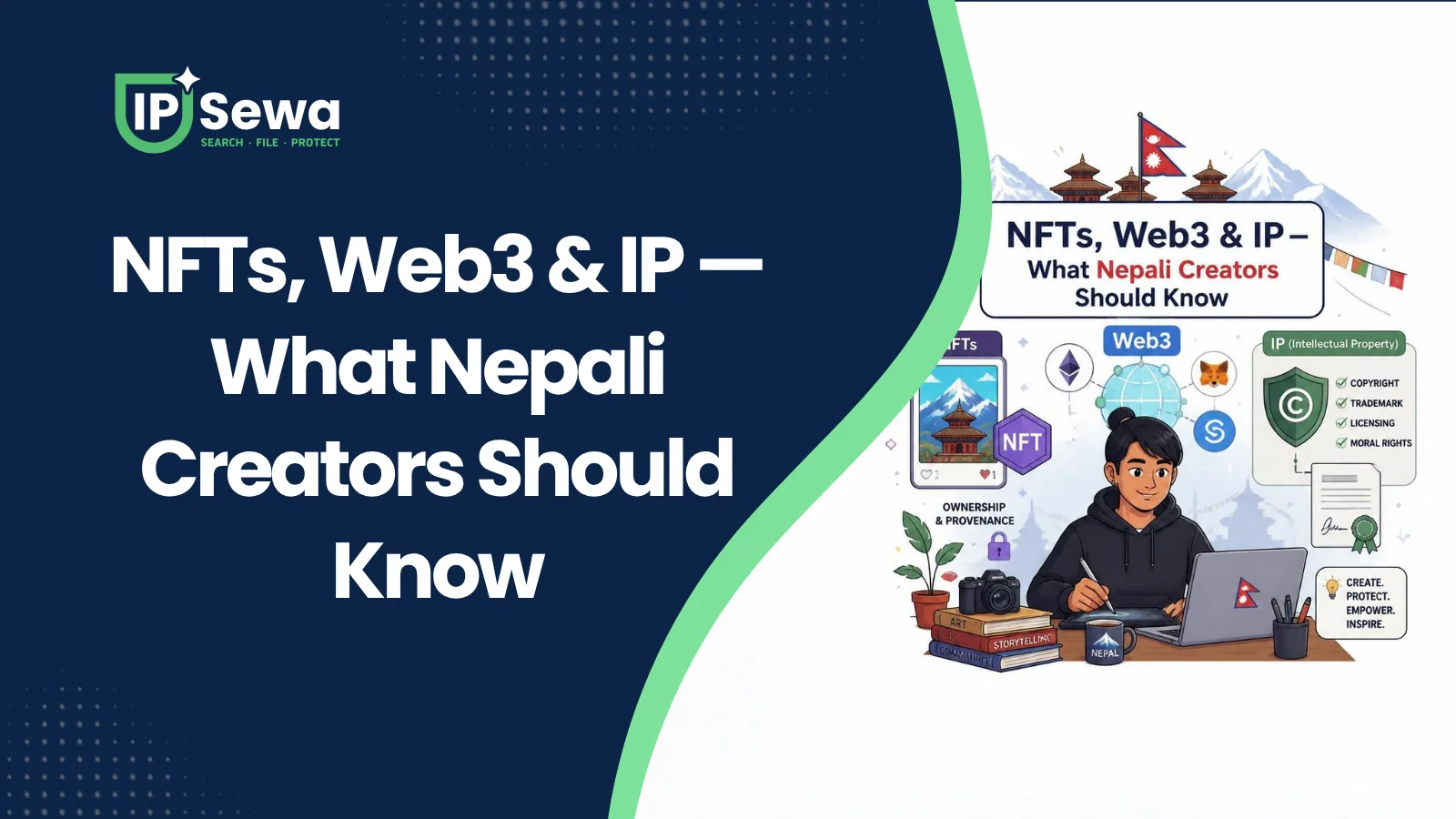
For NFT IP Nepal, the key rule is simple: minting or buying a token does not transfer copyright. Nepal’s Copyright Act 2059 protects the underlying work, while the Department of Industry registers project trademarks under the Patent, Design and Trademark Act 1965. Trademark registration typically takes about 12–14 months when unopposed.
Key Takeaways
Nepali creators retain copyright in original work automatically, but NFT sales need clear licences. The token, artwork, brand and payment arrangement are separate legal matters. Nepal’s Department of Industry handles trademark registration, while Nepal Rastra Bank’s restrictions make the crypto transaction layer a separate compliance risk.
- An NFT is a blockchain token or record, not the artwork’s copyright.
- Buying an NFT normally gives the buyer the token and only the licence stated in the sale terms.
- Original copyright arises automatically under Nepal’s Copyright Act 2059; minting is not required.
- A collection, studio or project name may be protected as a trademark through the Department of Industry.
- Nepal is first-to-file for trademarks, so early clearance and filing matter.
- Written licence terms should cover display, copying, commercial use, resale and sublicensing.
- Nepal Rastra Bank restricts cryptocurrency transactions, so crypto advice must be checked separately from IP advice.
What is an NFT, and what do you actually own?
An NFT, or non-fungible token, is a unique blockchain record associated with a digital item. The token can identify a wallet or transaction history, but the blockchain does not decide who owns copyright. A buyer owns the particular token received under the sale, not automatically the image, music, video, code or brand attached to it.
The linked file may sit on a platform, server or storage system rather than inside the token itself. A token can continue to exist even if the linked file changes or becomes unavailable. That technical risk is separate from legal ownership, but it is a practical reason to preserve the original files, creation records and sale terms.
Does buying an NFT give you copyright?
Buying an NFT does not normally give you copyright. Copyright is the legal right to control protected creative expression, including copying, distribution and other permitted uses. The creator keeps it unless a valid written assignment transfers it. The buyer receives only the rights clearly granted, such as personal display or a limited commercial licence.
Do not assume that a marketplace description, token image or “ownership” label transfers IP. Check who created the work, whether the seller owns all rights, and whether third-party material appears in it. A buyer who reproduces the artwork on clothing, merchandise, advertising or another collection may need permission even after purchasing the token.
An assignment is different from a licence. An assignment transfers specified rights; a licence gives permission while ownership remains with the creator. The document should identify the work, rights granted, territory, duration, permitted media, payment, sublicensing and termination. It should also say whether the buyer may alter, commercialise or use the creator’s name.
How does copyright work for Nepali NFT creators?
Nepali creators generally receive copyright protection automatically when they create an original work under the Copyright Act 2059. Minting is not required, and selling a token does not by itself surrender copyright. Registration is not the source of copyright, but records held with the Copyright Registrar’s Office may help establish creation or ownership if a dispute develops.
Keep layered working files, dated exports, sketches, source code, commission agreements and correspondence with collaborators. If another artist, photographer, musician, employee or contractor contributed, document who owns each contribution. A creator cannot grant a buyer broader rights than the creator lawfully holds.
AI-generated elements, stock assets, samples and commissioned artwork require extra care. The person minting may not own every part of the final work. Read the relevant platform terms and third-party licences before promising exclusive rights. For a wider creator-focused explanation, see copyright guidance for Nepali YouTubers and social creators.
What does an NFT licence need to say?
An NFT licence should state exactly what the buyer may do with the associated work. Clear terms can grant personal display, advertising use, merchandise rights or other commercial permission, while reserving copyright to the creator. They should also identify the token and artwork, explain transfer rules, and address modifications, credit and prohibited uses.
| Item | What it represents | Who usually controls it | Document or rule to check |
|---|---|---|---|
| NFT token | A blockchain record linked to a digital item | The wallet or buyer recorded by the transaction | Sale terms and platform rules |
| Artwork copyright | Rights in the original creative expression | Creator or lawful copyright owner | Copyright Act 2059 and written assignment |
| Collection brand | Name, logo, symbol or project identity | Applicant or registered trademark owner | Department of Industry registration |
| Smart contract | Code that can automate token or payment events | Parties and platform, subject to its design | Code plus readable legal licence |
Royalty language deserves special attention. Code may attempt to pay a creator when a token is resold, but payment depends on the platform and transaction route. A smart contract can automate an instruction; it does not replace a complete legal licence or guarantee that every future transfer will honour it.
Can you trademark an NFT collection or Web3 project in Nepal?
You can seek trademark protection for a distinctive NFT collection name, studio name, project name, wordmark or logo through Nepal’s Department of Industry. A trademark distinguishes your goods or services from others. Registration protects the brand, not the artwork itself, and one application covers one NICE class under Nepal’s first-to-file system.
Choose the goods or services you genuinely plan to offer. A digital art collection may involve downloadable or recorded digital content, online marketplace activity, entertainment, education, software or retail services, depending on the business model. The correct class depends on the actual specification, not simply the fact that the project uses blockchain.
Search similar words, spellings, sounds and logos before publicising a collection. The Department of Industry’s record is central, and IP Sewa’s Nepal trademark database search can help you identify earlier marks. A search is not a guarantee of registration, particularly where logo elements or related goods and services create risk.
Which NICE classes may apply to an NFT project?
Nepal uses the NICE Classification, which has 45 classes: Classes 1–34 cover goods and Classes 35–45 cover services. NFT businesses may need different classes for digital content, software, retail, entertainment or education. Because Nepal requires one application per class, a brand spanning several activities needs separate applications.
These are starting points, not a blanket filing formula. A project selling physical merchandise may need goods classes as well. A project offering only a name and artwork may not need every class shown. Use a NICE class finder for the proposed goods and services, then refine the wording before filing.
How do you register an NFT brand in Nepal?
Register an NFT or Web3 brand through the Department of Industry using the ordinary trademark process. First search the mark and select the correct NICE class. Then file, answer examination queries, wait for Industrial Property Bulletin publication and allow the opposition period before registration and the certificate.
- Identify the asset. Decide whether you are protecting a collection name, studio name, wordmark, logo or related service brand.
- Check earlier marks. Search the Department of Industry record for similar names, spellings, sounds and logos.
- Select each NICE class. Nepal requires a separate application for each class, so list the real goods and services carefully.
- Prepare the application. Gather the form, mark label, applicant details, power of attorney where needed, and supporting company documents.
- File with the DoI. The filing establishes your position in Nepal’s first-to-file system, subject to a valid application.
- Answer examination. Respond to similarity, classification or other questions raised by the Department.
- Follow publication. The accepted mark is published in the Industrial Property Bulletin. Third parties may oppose within the applicable 90-day trademark window.
- Obtain the certificate. If the matter proceeds without a successful opposition, the DoI completes registration and issues the registration certificate.
What documents should an NFT creator prepare?
A Nepal trademark application generally needs the prescribed application, the mark label and applicant information. A company may also need its board resolution, industry certificate and latest tax clearance letter. A representative files with a notarised power of attorney. Foreign applicants need local representation and may need certified English documents for priority or home registration.
Prepare clean versions of the wordmark and logo, the exact owner name, business details and a focused goods-and-services description. Keep evidence showing creation and ownership of the artwork, but do not treat those files as substitutes for trademark documents. The required documents can vary with the applicant, ownership structure and priority claim.
How long does NFT trademark registration take in Nepal?
NFT brand registration typically takes about 12–14 months from filing to certificate when the application is unopposed. A smooth, straightforward matter may finish in roughly 6–8 months, but that is the favourable end rather than the normal promise. Examination queries, amendments, publication timing and opposition can extend the process.
What does NFT IP protection cost in Nepal?
The total cost depends on the number of NICE classes, government charges, document certification, professional work and any examination or opposition response. Nepal’s one-class-per-application rule means a project covering several business activities may need several applications. For a current estimate, use the IP Sewa tools and fee calculator or ask our team through contact.
Budget for more than the initial filing. You may need a clearance search, class drafting, logo preparation, notarisation, translations, responses to DoI queries, and later renewal. A contested application has a different workload from a clean filing. Professional fees and government charges are separate, so ask for a current itemised explanation before instructing anyone.
What does Nepal’s crypto position mean for NFTs?
The IP question and the crypto question are not the same. Nepal Rastra Bank has restricted cryptocurrency transactions, including trading and dealing in virtual currencies. Nepal has no specific NFT statute identified here. Copyright and trademark principles still apply to creative work and brands, but minting, selling or purchasing through crypto may create separate legal and regulatory risks.
Do not describe an NFT as legally safe merely because a token is recorded on-chain. Check the current Nepal Rastra Bank position, payment route, tax treatment, platform terms and identity requirements before transacting. This article explains IP ownership, not financial, tax or crypto compliance. Get advice on the complete arrangement before launching a paid drop.
What mistakes do NFT creators commonly make?
Nepali creators often focus on minting and overlook ownership, permission and brand clearance. The most serious errors include using artwork made by someone else, promising copyright without owning it, selling before checking a project name, and assuming a smart contract replaces legal terms. Each mistake can create disputes that blockchain records cannot solve.
- Using commissioned art without a written transfer: payment alone may not give you every right needed for NFT sales.
- Calling the buyer an IP owner: say precisely whether the buyer receives a token, display permission or commercial rights.
- Ignoring collaborators: obtain written arrangements with artists, musicians, developers and co-creators.
- Filing too late: Nepal’s first-to-file system rewards the earliest valid applicant, not simply the person who used a name first.
- Overclaiming exclusivity: a trademark in one class does not automatically cover every product or service.
- Relying on platform rules: marketplace terms may change and may not provide the licence your business needs.
- Forgetting renewal: a Nepal trademark lasts seven years and must be renewed for continued protection.
Can foreign creators or buyers protect NFT rights in Nepal?
Foreign owners cannot rely on a global NFT listing to protect a brand in Nepal. Nepal is not part of the Madrid System, so a foreign applicant files directly through a Nepal-based agent or representative. A Paris Convention priority claim may be available where its requirements are met. The filing still faces Nepal’s examination and opposition process.
A foreign project entering Nepal should check its name, appoint a local representative and identify the goods or services it will actually offer here. A foreign registration does not automatically cover Nepal. The Department of Industry remains the relevant national authority for trademark registration and related proceedings.
What is a practical NFT IP plan for a Nepali creator?
Start before launch, not after a collection becomes popular. List every asset and contributor, record ownership, search the proposed brand, choose the NICE class, and prepare a readable buyer licence. Then separate the IP plan from the crypto transaction plan, because each has different rules, evidence and risks in Nepal.
Imagine a Kathmandu illustrator preparing a collection called “Himalayan Pixel Yaks”. She creates the illustrations herself, hires a developer for the minting page and plans branded digital downloads and community events. She should document the developer’s work, search the name, consider the relevant NICE classes, and state that buyers receive tokens plus limited display rights.
If the collection later expands into clothing, software or physical exhibitions, the original trademark filing may not cover every activity. She should review the specification before expansion. A registered mark can become a valuable business asset, but it does not prove that every image, soundtrack or code component belongs to the project.
Where can creators get Nepal-specific IP help?
NFT disputes may involve copyright ownership, trademark confusion, contract wording and platform conduct at once. The Department of Industry is the filing authority for trademarks, and its official information should be checked for current procedure. The Department of Industry’s official website and the Nepal Law Commission’s legal resources are useful starting points.
IP Sewa can help with trademark search, class selection, trademark registration, renewal, and opposition or enforcement work. Our team can also help review the IP side of your project through a direct consultation request. We do not treat a token sale as a substitute for legal ownership or a clear licence.
In short, what should a Nepali NFT creator remember?
NFT copyright and token ownership are separate. Keep evidence of creation, obtain contributor permissions, write the buyer licence in plain language, and protect the collection name early through the Department of Industry. Check Nepal’s crypto position independently before transacting. A blockchain record may support an account of events, but it does not replace copyright, trademark or contract law.
People also search for
- Copyright for YouTubers and social media creators in Nepal
- AI, ChatGPT and copyright law for creators
- What is a trademark in Nepal?
- Logo versus brand: what are you protecting?
- What is intellectual property law in Nepal?
- Interesting copyright facts creators should know
Before you mint, search existing Nepal trademarks, review your proposed goods and services, and consider trademark registration for your collection or studio. If ownership, licensing or crypto compliance is unclear, contact IP Sewa’s team for Nepal-specific guidance.









Comments (0)
Leave a comment
Replying to — cancel