
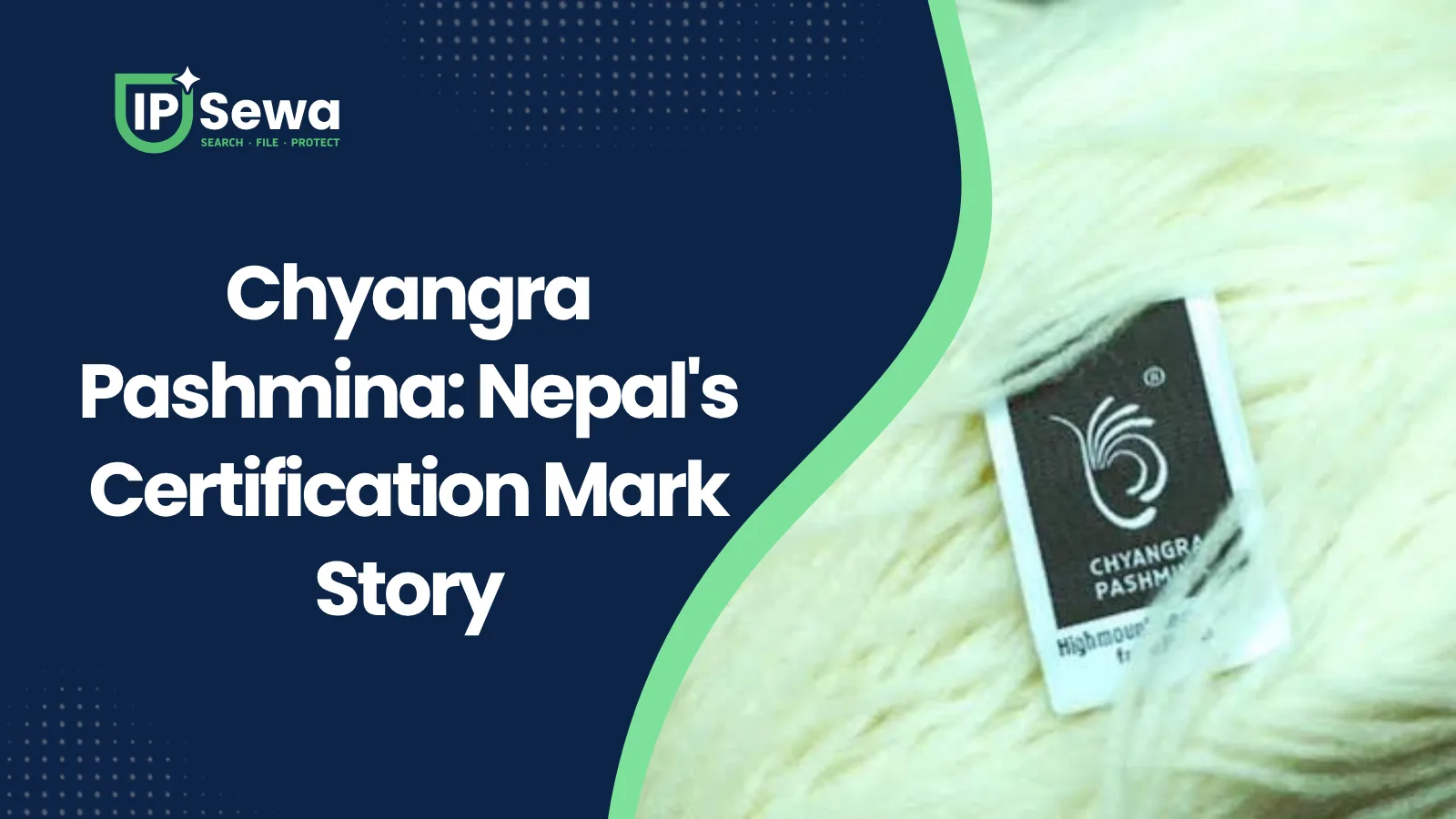
The Chyangra Pashmina certification mark shows how Nepal protects genuine pashmina through trademark law. Registered through the Department of Industry (DoI) under the Patent, Design and Trademark Act 1965 (PDTA), it identifies qualifying pashmina products and follows Nepal’s trademark process, which typically takes 12–14 months when unopposed.
Key Takeaways
Chyangra Pashmina demonstrates that a certification mark Nepal system can protect shared product standards, not just one seller’s brand. The DoI registers marks under the PDTA, publishes accepted applications in the Industrial Property Bulletin, and allows a 90-day opposition period before registration and a seven-year renewable term.
- Chyangra Pashmina is a certification mark, not an ordinary seller’s trademark.
- It is associated with standards for genuine pashmina made from Chyangra goat fibre in Nepal.
- The mark is owned by the Nepal Pashmina Industries Association (NPIA), which authorises qualifying users.
- A certification mark tells buyers about product qualities, origin, material, or a production method.
- Nepal is first-to-file, so a clear filing strategy matters before a name or label becomes widely used.
- NICE Classification has 45 classes, and Nepal requires a separate application for each class.
- A trademark registration lasts seven years and can be renewed in further seven-year periods.
What is the Chyangra Pashmina certification mark?
The Chyangra Pashmina certification mark identifies pashmina that meets defined standards linked to Chyangra goat fibre and processing in Nepal. Unlike a pashmina trademark owned for one company’s goods, the certification label can be used by authorised producers. The DoI records the mark under the PDTA trademark framework.
A certification mark is a sign that confirms a product characteristic. That characteristic may concern origin, material, quality, accuracy, or a mode of manufacture. It gives a buyer a reason to trust a label where the product’s true fibre content cannot be judged simply by touch or appearance.
The NPIA owns the Chyangra Pashmina certification mark. Its role is different from that of a shawl retailer: it maintains the certification scheme, decides whether an applicant meets the stated requirements, and can act against misuse of the label.
Why does genuine Nepali pashmina need certification?
Certification protects genuine Nepali pashmina by separating qualifying Chyangra-fibre products from blended, substituted, or falsely described goods. The DoI registration gives the certification scheme a legal basis under the PDTA, while the Industrial Property Bulletin makes the registration visible to traders and the public during the opposition process.
Pashmina is valuable because buyers connect the name with fine Himalayan fibre, skilled work, and Nepal’s textile reputation. That reputation can be harmed if ordinary wool, synthetic blends, or imported material is presented as genuine pashmina without meeting the product standard.
For a producer, the label can support credibility in Kathmandu shops and export-facing markets. For a buyer, it offers a practical signal that the producer has been accepted under a common system. It does not mean every pashmina business must use the label; a business may still build its own wordmark or logo registration.
Who may own and use a certification mark in Nepal?
A certifying association or competent body may own a certification mark Nepal registration, while producers who meet its rules may use it. The DoI examines the application under Sec. 18 of the PDTA and considers whether the mark conflicts with earlier rights, public interest, or another party’s goodwill.
The owner should be able to administer standards fairly. In practice, that means having clear eligibility rules, a way to assess goods, and a process for withdrawing permission if a user no longer complies. A scheme that is vague or selectively applied will be difficult to defend.
Users should treat the certification sign and their own brand as separate assets. For example, a hypothetical Lalitpur workshop might sell a certified shawl under its own “Himal Loom” logo. The certification label speaks to the product standard; the workshop’s logo tells customers who made or sold it.
Which NICE classes apply to pashmina certification marks?
Pashmina certification usually needs careful NICE Classification selection because Nepal uses all 45 NICE classes and requires one application per class. Class 25 commonly covers finished clothing items such as shawls and scarves, while Class 24 can cover textile goods. The exact goods description determines the correct filing approach.
NICE Classification is the international system for grouping goods and services. It has Classes 1–34 for goods and Classes 35–45 for services. A registration in one class does not automatically cover another class, even where the same label is used.
A common mistake we see is filing only for a finished shawl while ignoring other intended products. Before filing, use the NICE class finder for Nepal trademark applications to test goods descriptions, then obtain advice where a certification scheme covers several forms of textile product.
How do organisations register a certification mark in Nepal?
An organisation registers a certification mark by filing with the DoI, passing examination, appearing in the Industrial Property Bulletin, and completing the 90-day opposition stage before certificate issuance. The usual unopposed trademark timeline is about 12–14 months, although the smoothest straightforward files can finish in about 6–8 months.
- Define the certification standard. Set out the fibre, product, origin, process, inspection, and compliance requirements in plain, workable rules.
- Search and classify the mark. Review existing registrations and pending marks, then select every relevant NICE class. Search word elements through the Nepal trademark database, but remember that logo similarity needs separate assessment.
- Prepare the application. File the prescribed trademark application, mark specimens, authority documents, and certification regulations with the DoI.
- Respond during examination. The DoI may review distinctiveness, prior conflicts, and whether the scheme can genuinely certify qualifying goods.
- Wait for publication and opposition. An accepted application is published in the Industrial Property Bulletin. Any person may oppose within 90 days, and the DoI deals with the complaint.
- Complete registration and administer use. After approval, obtain the registration certificate, authorise compliant users, and keep evidence of quality checks and permissions.
Registration is not a substitute for running the scheme. A certification owner must keep standards meaningful after the certificate is issued. Records of approval, product checks, and corrective action are useful if misuse later becomes an opposition or enforcement dispute.
Which documents support a certification mark application?
A certification mark application needs the ordinary DoI trademark materials plus clear certification regulations that explain standards and access. Domestic applicants commonly provide authority documents, a mark label, industry and tax documents, while foreign applicants file through a Nepal-based representative because Nepal is not in the Madrid System.
- The prescribed trademark application and specimens of the proposed mark.
- A notarised power of attorney where an agent acts for the applicant.
- Board or organisational authority showing the body can make the filing.
- Documents supporting the applicant’s legal status and relevant business records.
- Priority documents where a valid Paris Convention priority claim is made.
- Certification regulations covering product standards, eligibility, inspection, permission to use the mark, and action for non-compliance.
Rules should be specific enough to apply consistently. “High-quality pashmina” alone is not a useful standard. A stronger document identifies what is tested, who checks it, what evidence a producer supplies, and what happens if goods fail inspection.
How does a certification mark differ from a geographical indication?
A certification mark can protect product standards through the PDTA, while a geographical indication Nepal system would protect a product name tied to a place and its qualities. Nepal currently uses trademark tools for this practical purpose, with the DoI administering registration and the PDTA providing the enforceable trademark structure.
A geographical indication, or GI, normally links a product’s reputation or characteristics to a defined place. Think of a name that matters because of local climate, raw materials, skills, or traditional know-how. A certification mark instead depends on a certifying owner and the rules that owner administers.
Chyangra Pashmina has GI-like features because buyers associate it with Nepal, local fibre, and craft. Yet it remains important not to call every regional product name a registered GI. A certification mark is an existing route, while wider geographical-product protection needs careful legal and policy treatment.
What mistakes weaken pashmina trademark protection?
Weak pashmina protection often starts with filing the wrong class, using vague standards, or assuming an OCR company name protects a brand. The Office of the Company Registrar (OCR) records company names, but trademark registration is handled by the DoI under Sec. 18 and gives the relevant registered-mark protection.
| Common mistake | Why it creates risk | Better approach |
|---|---|---|
| Using “certified” without written standards | Buyers and users cannot verify what the label means. | Create measurable, published certification rules. |
| Filing in only one unsuitable class | The registration may not cover the intended goods. | Match the goods description to Class 24, Class 25, or other justified classes. |
| Skipping a clearance search | An earlier similar mark can lead to objection or opposition. | Review records before filing and assess similar names and logos. |
| Confusing company registration with trademark rights | An OCR record does not replace a DoI trademark registration. | Protect the trade name, wordmark, and logo through the right systems. |
| Failing to control authorised use | Inconsistent use can damage trust in the certification. | Keep approval records and address misuse promptly. |
How long does protection last and what does it cost?
A registered certification mark lasts seven years from registration and can be renewed for further seven-year terms under the PDTA. Total cost depends on the number of NICE classes, government charges, document preparation, search work, and professional support, so current figures should be checked before filing.
One application covers one class in Nepal. A certification scheme for both textile material and finished pashmina scarves may therefore need separate filings. Regulations also take time to draft because they must be usable by producers, inspectors, and the owner after registration.
Use the trademark fee calculator for a current class-based estimate, but seek tailored advice for a sector-wide certification programme. This article is general information, not legal advice; the practical scope depends on the mark, goods, and governing rules.
What should a pashmina association do before filing?
A pashmina association should settle ownership, product standards, class coverage, and enforcement responsibilities before filing at the DoI. Because Nepal is first-to-file, delay can create avoidable conflict with an earlier application. A professional clearance review can assess the proposed name, logo, and goods descriptions before the filing date.
Start by mapping the supply chain. Identify the fibre source, production stages, approved manufacturers, labels, and the evidence needed for each stage. Then decide whether the mark will certify raw fibre, finished shawls, or both. That decision drives the NICE class and wording.
Also plan for disputes. A conflicting application can be challenged during the Industrial Property Bulletin opposition period, while misuse after registration may need a cease-and-desist or DoI action. Our team can help with trademark opposition and enforcement support where a certification label is being copied or challenged.
In short
Chyangra Pashmina proves that Nepal’s trademark system can protect a shared reputation through certification standards, not merely a single company’s logo. The DoI route requires a sound application, correct NICE classes, publication, a 90-day opposition period, registration, and disciplined control of authorised use throughout the seven-year renewable term.
- Use a certification mark to verify defined product characteristics.
- Use a separate pashmina trademark to distinguish your own business.
- File directly in Nepal through the DoI; foreign registrations do not automatically cover Nepal.
People also search for
Related trademark questions help pashmina makers, associations, and exporters choose the right protection before they invest in labels or packaging. These guides explain the DoI process, classification, searches, documents, timelines, and common refusal risks under Nepal’s first-to-file trademark system.
- How to register a trademark in Nepal
- What is NICE Classification for trademarks?
- How to choose the right trademark class in Nepal
- How to search for a trademark in Nepal
- Documents required for trademark registration in Nepal
- How long trademark registration takes in Nepal
- Trademark versus trade name and company name in Nepal
Before adopting a pashmina label, search existing Nepal trademark records, review our trademark registration service, and contact our team for help with certification rules, class selection, filing, opposition, or renewal planning.











Comments (0)
Leave a comment
Replying to — cancel